
West Jakarta Residents Learn Waste Sorting to Support Governor's Instruction
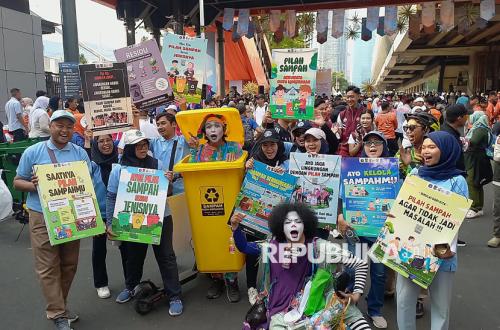
Residents of West Jakarta have begun training in household waste sorting to support the Jakarta provincial government’s policy mandating source-level waste management. The community initiative Prakarsa Warga Jakarta Barat held a socialisation and training event on citizen-based waste sorting at the Pasar Jaya Cengkareng market in West Jakarta, aimed at improving public understanding of household waste management.
Marlin Bato, coordinator of Prakarsa Warga Jakarta Barat, said participants received not only educational materials but also hands-on practice in separating organic, inorganic, and residual waste. “We hope this activity becomes the first step in building a culture of waste sorting that starts at home, is carried out consistently by residents, and grows into a collective movement with a real impact on the environment,” Marlin said.
Participants also received explanations on waste management through waste banks that can provide economic value to the community. Speakers from the West Jakarta Environmental Agency contributed material on waste management policy and household waste sorting techniques.
Marlin emphasised that waste management must begin at the source, namely households. He noted that community involvement is a crucial factor in reducing the volume of waste ending up at final processing sites.
The activity was held amid the Jakarta provincial government’s push to strengthen the waste sorting movement. Governor Pramono Anung previously stated that Jakarta currently produces around 9,000 tonnes of waste per day, while the capacity of the Bantargebang Integrated Waste Processing Site is increasingly limited.
“Precisely on the momentum of Jakarta’s 499th anniversary, together with all Jakarta residents, the Provincial Government of DKI Jakarta reaffirms its commitment to maintaining Jakarta as a global city that is clean, liveable, and sustainable,” Pramono said.
According to Pramono, the situation can no longer be addressed solely through a collect-and-dispose approach. Consequently, the Jakarta administration issued Governor’s Instruction Number 5 of 2026 on Source-Level Waste Sorting and Management. “Jakarta now has a strong foundation to make the waste sorting movement part of the community’s culture. The main target is the sorting of organic and inorganic waste so it can be managed through the principles of reduce, reuse, and recycle,” he said.
Pramono added that community participation in waste management continues to grow. Several residential areas have even developed innovative waste processing methods, ranging from maggot cultivation to producing fertiliser from organic waste. “Many neighbourhood units (RT) and community units (RW) have progressed further than we expected. Therefore, this movement must not lose momentum and must continue to expand until it becomes a culture for all Jakarta residents,” Pramono said.