
West Jakarta Mayor Launches One Data Book, Proposes AI to Harmonise DTKS
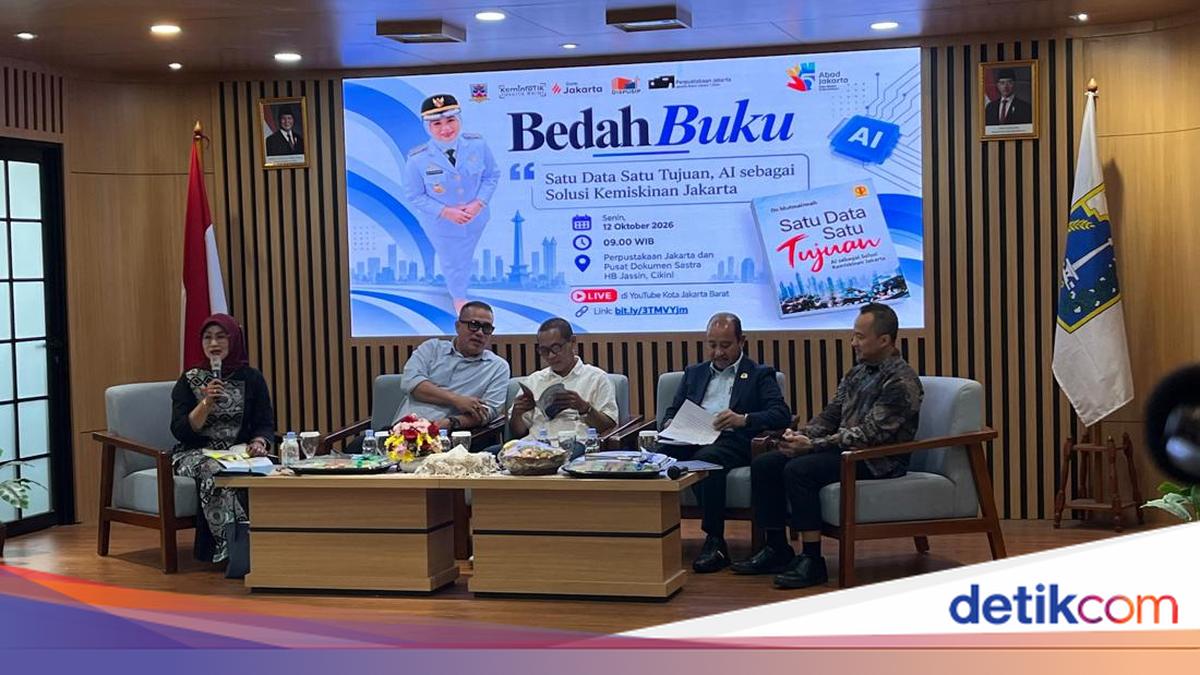
West Jakarta Mayor Iin Mutmainnah has released a book titled One Data, One Goal: AI as a Solution to Jakarta’s Poverty. In it, she argues for using artificial intelligence (AI) to improve social-assistance data so that anti-poverty interventions in Jakarta are better targeted.
Iin made the remarks during a discussion and book review at the HB Jassin Literary Documentation Centre in Taman Ismail Marzuki, Cikini, Central Jakarta, on Monday (12 October 2026). She said the book was based on her experience as a civil servant working in the field.
According to Iin, Jakarta faces a stark paradox: grand physical development exists alongside pockets of poverty.
“Jakarta faces a paradox. The city may be seen through its magnificent buildings, rapid growth and the pace of development across all the areas people need,” Iin said in her presentation.
“But behind those magnificent buildings, there may still be people who need substantial intervention. We need to see Jakarta from a different perspective, where many residents still require strong support because poverty remains widespread,” she added.
Iin highlighted errors in the data used to distribute social-welfare programmes. Some residents who are eligible for assistance are left off the lists, while others who are not eligible are included.
“When we talk about data, there are exclusion errors and inclusion errors. Someone who should receive assistance may not receive it in practice. There are also people who should not receive it but do,” she said.
Iin said these problems often leave people living in genuine poverty without support, while better-off residents are registered as recipients.
She cited conditions in the densely populated Tambora area of West Jakarta, where a single semi-permanent house may be occupied by three families, with more than 10 people in total.
At the same time, she said, she often encountered residents asking to have their economic decile classification deliberately lowered so they could qualify for social assistance.
The former deputy mayor of East Jakarta also pointed to siloed working practices between government agencies and a lack of alignment between job-training programmes and the Integrated Social Welfare Data (DTKS).
“Where does that leave us? We work together, but often keep the data to ourselves. We work for our own organisations rather than making information openly available. You need to submit a letter, find the right channel and know someone first. Without connections, it is difficult to get information,” she said.
To address these institutional silos, Iin said AI could help connect the different participants in a pentahelix partnership: government, the private sector, academics and civil society.
She stressed that AI would not make policy decisions, but would instead support the fast, transparent and accurate processing and verification of poverty data.
“Why can AI become a partner for us? Because it can help us collaborate more quickly and accurately, and build trust. That is the point,” Iin said.
She hopes the ideas in her book will move beyond discussion and be tested and implemented gradually with all stakeholders to help address poverty in Jakarta.
“The most appropriate approach today is technology, but technology used wisely. Building trust requires proof and evidence. As an enabler, AI can provide sound evidence,” she concluded.
The book launch was attended by sub-district heads and urban village chiefs in Jakarta, as well as university students and members of the public.
Source: jawawa.id (https://jawawa.id/newsitem/west-jakarta-mayor-launches-one-data-book-proposes-ai-to-harmonise-dtks-1791791637)
Originally published by detikcom (https://news.detik.com/berita/d-8703301/walkot-jakbar-luncurkan-buku-satu-data-gagas-pemanfaatan-ai-sinkronkan-dtks), translated from Indonesian