
West Bandung's Strategy to Meet Rice Production Targets Amid El Nino Threat
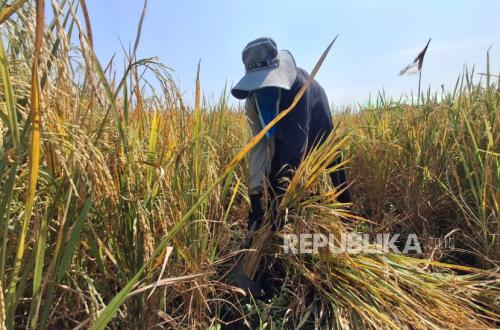
REPUBLIKA.CO.ID, BANDUNG BARAT - The West Bandung Regency Government is targeting rice production of 265,368.2 tonnes of dry harvested grain (GKP) in 2026. Steps have already been drawn up to pursue this target amid the threat of harvest failure, as this year sees the El Nino phenomenon.
Based on rice production data from the West Bandung Food Security and Agriculture Service (Dispangtan), production in the first semester of 2026 reached only 144,977 tonnes of GKP, equivalent to 81,514 tonnes of rice. This represents a decline of 11.59 per cent compared to rice production in the first semester of 2025, which reached 163,974 tonnes of GKP, equivalent to 92,194 tonnes of rice.
“Overall, the 2026 rice production target is 265,368.2 tonnes of GKP, while production achieved in 2025 was 302,518.3 tonnes of GKP. Grain production is projected to fall by around 10-15 per cent in the second planting season of 2026 if there is no intervention to handle the drought,” said the Regent of West Bandung, Jeje Ritchie Ismail, on Wednesday (5/8/2026).
The rice harvest comes from 18,093.77 hectares of designated paddy fields, consisting of 3,737.43 hectares of technically irrigated paddies and 14,356.34 hectares of non-irrigated paddies spread across 13 sub-districts that are centres of rice food-crop production.
“So far, no village has experienced total drought, but according to data from Plant Pest Organism Control (POPT) officers of the West Java BPTPH, villages threatened by drought cover 433 hectares,” said Jeje.
To anticipate drought and harvest failure during this year’s dry season, the Food Security and Agriculture Service and various related stakeholders, including the central government, the province, the TNI and the National Police, are carrying out mitigation and handling measures, starting with the provision of agricultural infrastructure.
“Strengthening agricultural water infrastructure includes the construction of pumped irrigation, piped irrigation, groundwater irrigation networks, improvement of irrigation networks (primary, secondary and tertiary) and water conservation structures,” he said.
The Head of the West Bandung Food Security and Agriculture Service, Lukmanul Hakim, added that mitigation of the drought threat affecting paddy fields is also being carried out through the provision of agricultural equipment. This includes the delivery of 157 units of three-inch water pumps funded by the 2026 state budget, distributed between May and June across 13 affected sub-districts.
“The irrigated area covers 785 to 1,500 hectares, with a service coefficient of 5 to 10 hectares, depending on land conditions. We are also recommending the use of drought-resistant rice seed varieties such as Inpari 42 and Inpari 48, as well as hybrid maize seed for the 2026 dry season,” said Lukmanul.
His office is also conducting outreach and assistance. Farmers have been advised to adjust their crop cultivation practices, including through water-saving cultivation techniques, such as using drought-tolerant commodities and varieties including inpago, secondary crops (palawija) and others.
“The SRI (System of Rice Intensification) method, the use of mulch, crop replacement or diversification, and shifts in planting times can also be carried out by farmers,” said Lukmanul.