
West Bandung Livestock Service Takes Steps to Address FMD in Sacrificial Animals
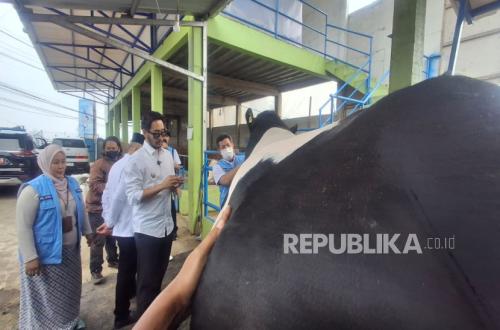
BANDUNG BARAT — The Fisheries and Livestock Service (Dispernakan) of West Bandung Regency (KBB) has tightened surveillance of sacrificial animal traffic ahead of Eid al-Adha 1447 Hijriah to prevent the spread of foot-and-mouth disease (FMD), lumpy skin disease (LSD), and brucellosis.
“We continue to monitor sacrificial animals, of course such measures are taken to anticipate the spread of contagious animal diseases ranging from FMD, LSD to brucellosis,” said Head of the KBB Fisheries and Livestock Service, Wiwin Aprianti, when confirmed on Saturday (23 May 2026).
She emphasised that sacrificial animals from outside the West Bandung Regency must be equipped with an Animal Health Certificate (SKKH), Veterinary Certificate for inter-district transport, and Animal Quarantine Certificate for inter-quarantine zone transport.
The service also urged traders and livestock farmers to report each animal arrival. Animal health officers, she said, are currently circulating around trading posts and sacrificial animal farmers to ensure livestock are in good health, free from disease, and meet the requirements for sacrifice at this year’s Eid al-Adha.
Based on data from the Fisheries and Livestock Service, as of Friday (22 May 2026), 8,703 sacrificial animals from 148 trading points have been inspected. The breakdown is 4,540 cattle, 21 buffalo, 4,030 sheep, and 12 goats.
“The results show 7,494 animals declared healthy, 965 still young, and 144 animals classified as sick. Of course we continue to conduct inspections to ensure sacrificial animals are disease-free,” said Wiwin.
Disease prevention is also carried out by the KBB Fisheries and Livestock Service through FMD vaccination, which is performed twice yearly. Wiwin stated that approximately 26,000 head of cattle are distributed across the West Bandung region.
“For the first dose of FMD vaccine we have completed all. Next is the second dose. According to the instructions of the Regent (Jeje Ritchie Ismail) it must be given every year and of course this is free,” said Wiwin.
Wiwin reminded the public to purchase sacrificial animals that have been labelled with a collar or sticker indicating health certification from the KBB Fisheries and Livestock Service. Sacrificial animals bearing labels have already passed inspection by health officers.
“For the public, we urge you to purchase sacrificial animals that have been given a health label by the Fisheries and Livestock Service. With such a label, the public can ensure that the animal purchased has undergone health inspection, so that the meat consumed will be safe,” said Wiwin.