
West Bandung Fisheries and Livestock Agency records 22.12 tonnes of fish deaths at Saguling Reservoir
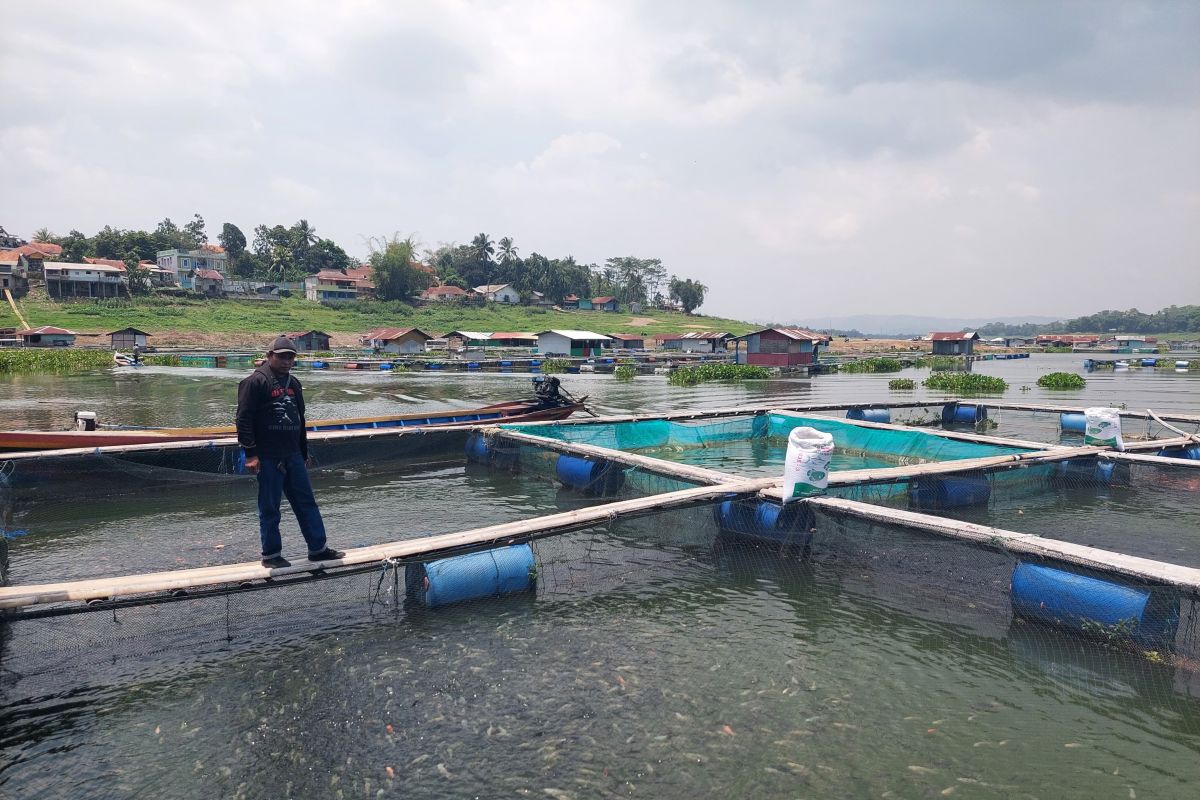
Bandung Barat (ANTARA) – The West Bandung Regency Fisheries and Livestock Agency (Dispernakan), West Java, has recorded the mass death of 22.12 tonnes of carp in floating net cages at Saguling Reservoir. The deaths were caused by an upwelling phenomenon triggered by extreme weather changes.
Dispernakan head Wiwin Aprianti said the fish died after continuous rain caused waste materials from rivers to flow into the reservoir, reducing water quality and dissolved oxygen levels.
“According to the reports received, a total of 22.12 tonnes of fish died because of the upwelling,” Wiwin said when contacted in West Bandung on Tuesday.
Data collected from fish traders and farmers showed that the deaths occurred at seven cage locations. The worst-affected was Blok Ugrem in Cililin district, where 15 tonnes of carp died.
Fish deaths were also recorded at Blok Bongas, with two tonnes; Blok Cikadu, three tonnes; Blok Balong, two tonnes; Blok Pakuwon in Jati village, 50 kilogrammes; Blok Cijati in Saguling village, 30 kilogrammes; and Blok Mariuk in Girimukti village, 40 kilogrammes.
Wiwin said the incident had caused economic losses for fish farmers, making urgent action necessary to save surviving fish and prevent water pollution from the carcasses.
“Farmers must immediately separate the surviving fish from the dead ones, then move them to separate rearing facilities so they can be raised further or harvested promptly,” she said.
Dispernakan has also urged farmers to remove carcasses from the cage areas and bury them well away from water sources and residential areas to prevent decomposition and further pollution.
Fish that meet food-safety standards may be used for consumption, while those deemed unfit to eat may be processed as an ingredient for animal feed, provided the processing is appropriate.
Wiwin advised farmers to reduce fish density through partial harvesting, limit feeding ahead of an upwelling event, and stop feeding while it is under way.
“If possible, additional aeration can be provided in the fish-rearing facilities. We urge everyone to take greater care in managing fish farming,” Wiwin said.
As a follow-up measure, Dispernakan has urged farmers to increase monitoring of water conditions and stocking density, particularly during extreme weather, to prevent similar incidents and safeguard the sustainability of fish farming at Saguling Reservoir.