
Wells Run Dry in Majalengka, Threatening Water Crisis
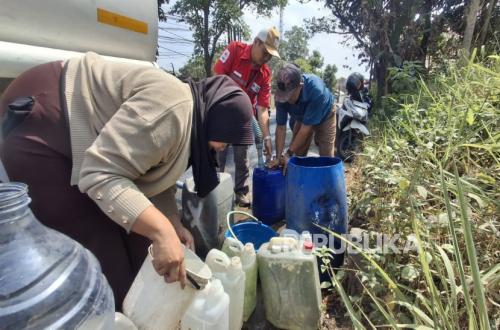
MAJALENGKA – Residents of Pilangsari village in Jatitujuh subdistrict, Majalengka regency, have begun to feel the threat of a clean water crisis. As the dry season sets in, residents’ wells have run dry, leaving them reliant on a water source near the village gate.
The source is a pumped well located about 1.5 kilometres from the settlement. Residents typically crowd the well to collect water in the morning between 05:00 and 09:00 Western Indonesian Time, and again from 15:00 in the afternoon. Those wishing to avoid the queues often collect water at night instead.
Most residents bring containers in the form of 20-40 litre jerry cans. The water is then used to fill bathing tanks, wash clothes and cook. For drinking water, some residents choose to buy refillable gallon containers instead.
“Almost every dry season we collect water from this pumped well,” said a local resident, Warkiah, on Tuesday (21/7/2026).
Warkiah said the pumped well has been the residents’ mainstay every dry season. Not only is the water always available, its quality is also clean and clear, making it fit for consumption.
Another resident, Wawan, revealed that the PDAM water network has in fact reached their area. However, not every household is connected to the PDAM installation.
Beyond its limited coverage, the PDAM water supply is also frequently hampered by low flow. As a result, residents still have to rely on well water.
In addition to these technical problems, he continued, residents’ beliefs have also contributed to the low take-up of PDAM services. According to him, residents consider well water cleaner than the PDAM’s raw water, which is drawn from the Cimanuk River.
“So they prefer to use well water rather than PDAM water,” he said.
Source: jawawa.id (https://jawawa.id/newsitem/wells-run-dry-in-majalengka-threatening-water-crisis-1784692327)
Originally published by Republika (https://rejabar.republika.co.id/berita/tik4c1487/sumur-warga-di-majalengka-mengering-krisis-air-bersih-mengintai), translated from Indonesian