
Weighing the existence of bicycle lanes in Jakarta
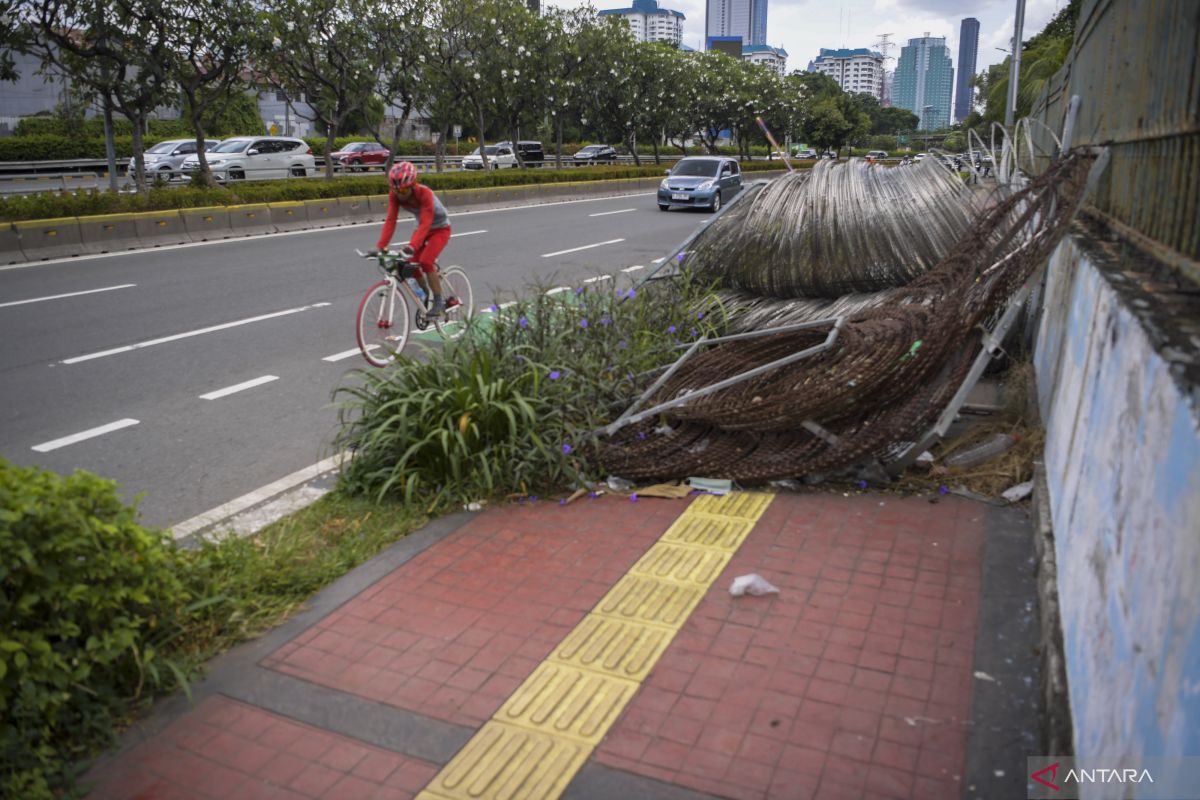
A new bicycle lane can only function optimally if it has physical protection separating it from motorised vehicles, rather than merely using painted markings.
Jakarta (ANTARA) - The bicycle lanes in Jakarta, initiated by DKI Jakarta Governor Fauzi Bowo (2007-2012 period) and realised massively and in an integrated manner during the era of Governor Anies Baswedan, were not built for trivial purposes.
The lanes were provided to give cyclists safe, comfortable road space separated from motorised vehicles in order to reduce air pollution, tackle congestion, and support public transport integration.
Over the past week, the existence of these bicycle lanes has become a topic of discussion among netizens on the social media platform Threads. Some argue that the lanes should be removed because they are not being used well. Others want the bicycle lanes to be retained.
As stated by Djoko Setijowarno, an advisor to the Indonesian Transportation Society (MTI), whether bicycle lanes are needed in urban areas cannot be answered simply with a yes or no, but rather depends on their function, integration, and management commitment.
According to him, if they are built merely as a formality without careful planning, bicycle lanes often end up being ineffective.
However, if planned strategically, bicycle lanes are a crucial long-term investment in supporting urban mobility.
Their existence is vital for improving the safety of road users by separating cyclists from high-speed motorised vehicles. In this way, the risk of fatal accidents can be reduced.
In addition, these dedicated lanes are an environmentally friendly solution for easing congestion and reducing carbon emissions by encouraging the use of micro-mobility for short distances.
No less important, the availability of safe bicycle lanes also stimulates an active lifestyle among the public while achieving accessibility justice for residents who do not use private motorised vehicles.
Furthermore, bicycle lanes play an important role as a first-mile and last-mile solution within the public transport ecosystem.
According to Djoko, bicycles are an ideal feeder mode connecting residential areas with mass transit stations or stops, such as the Commuter Line, LRT, MRT, and Transjakarta.
Based on a People Near Bikeways (PNB) study by the Institute for Transportation & Development Policy (ITDP) Indonesia, bicycle lane routes built in Jakarta up to 2022 have been connected to 165 Transjakarta stops, 19 KRL stations, 12 MRT Jakarta stations, 3 LRT Jabodebek stations, and 2 LRT Jakarta stations.
Source: jawawa.id (https://jawawa.id/newsitem/weighing-the-existence-of-bicycle-lanes-in-jakarta-1786708586)
Originally published by Antara (Indonesian) (https://www.antaranews.com/berita/5694711/menimbang-keberadaan-jalur-sepeda-di-jakarta), translated from Indonesian