
Weighing Nature as a Legal Subject
Note: This article reflects the personal opinion of the writer and does not represent the views of the CNBCIndonesia.com editorial team.
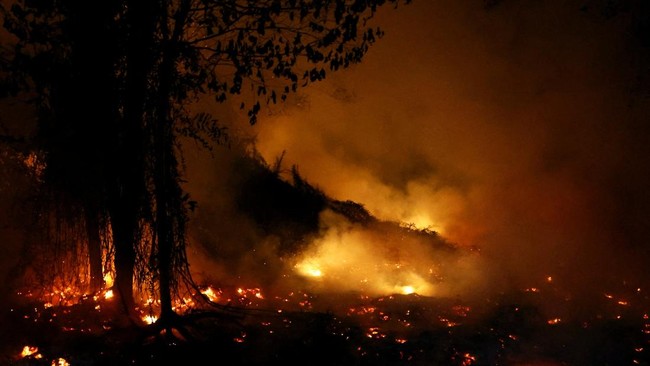
Forest and land fires (karhutla) are once again burning across Indonesia. As of 7 September 2026, the National Disaster Management Agency (BNPB) recorded that 72,008 hectares of peatland across six provinces have burned. Of these, 71,274.29 hectares have been extinguished, but 734.81 hectares remain alight and are still being handled.
The police have received 200 reports related to the fires and named 138 suspects, whilst eight corporations remain under investigation. These figures show that forest and land fires are no longer merely a matter of flames to be doused, but of ecological damage that continues to demand accountability.
The problem is not confined to this year alone. Research published in PLOS One recorded that 5.62 million hectares of Indonesian forest area burned between 2019 and 2024, of which 122,164 hectares were primary wet forest. The researchers also found that the fires were concentrated in certain regions, particularly Kalimantan, Nusa Tenggara and Sumatra, and were linked to climate anomalies such as the Oceanic Niño Index (ONI) and the Indian Ocean Dipole (IOD).
At the same time, deforestation, land clearing and the draining of peat have made ecosystems that were once more fire-resistant increasingly vulnerable. These data show that environmental damage does not occur in isolation; human activity and spatial management policies also determine how much nature loses its resilience.
Amid the blanket of smoke, nature has shown another face not born of human wrongdoing. In early September 2026, Mount Anak Krakatau erupted once more. Volcanic ash spread across parts of Java and Sumatra, even reaching an altitude of around 50,000 feet and disrupting flights.
The government maintained Anak Krakatau’s status at Level III, or Alert, and continues to monitor its activity. The fires and the eruption naturally have different causes. Yet both reveal the same reality: humans live within nature’s system, not outside it.
When the law views nature only as an object to be managed, exploited or protected for the sake of human interests, an important element escapes attention. It is at this point that the idea of placing nature as a legal subject deserves serious consideration.
Who is a legal subject?
In law, a legal subject is the holder of rights and obligations. Human beings are legal subjects by nature, whilst legal entities acquire that standing through legal recognition. Companies, foundations and associations can own assets, enter into agreements, and sue and be sued through their organs or representatives. This means a legal subject need not be capable of acting physically on its own.
Unsurprisingly, the idea of the rights of nature stems from the thinking of Christopher D. Stone in Should Trees Have Standing? Stone proposed granting nature legal standing so that its interests can be championed in court.
Nature need not speak for itself; its interests can be represented, just as a legal entity acts through human beings. Various countries have since begun to recognise legal rights for rivers, forests and specific ecosystems.
Indonesia already recognises environmental protection through Law No. 32/2009, including the right to a good and healthy environment. However, its construction still rests upon human interests.
Nature is protected because damage to it affects humans. Placing nature as a legal subject would broaden that foundation: forests, rivers, seas and ecosystems could be regarded as having legal interests worthy of being upheld, not merely protected because they are useful to humans.
Nature in the courtroom
Recognising nature as a legal subject does not stop at a change of concept. The consequence touches upon how the law operates when ecological damage occurs. If forests, rivers or ecosystems have legal interests, those interests must be capable of representation in legal proceedings.
The courts would then assess not only how many residents fell ill or how great the economic losses were, but also the damage to the existence and ecological functions of nature itself.
This idea matters greatly for the environment. As long as human losses remain the primary measure, damage to nature is easily considered resolved once victims receive compensation.
Yet money cannot automatically restore a burned forest, damaged peatland, or an ecosystem that has lost its carrying capacity. Ecological restoration must be accorded a place as a distinct legal interest. The state and corporations should not merely be asked to halt the damage, but must also restore nature optimally.
The karhutla provide a clear illustration. When millions of hectares of forest burn repeatedly, the problem is not only residents inhaling smoke or economic disruption. Ecosystems also lose their ecological functions.
Here, recognising nature as a legal subject can give new direction to environmental law in Indonesia. Lawsuits would no longer speak solely of human losses, but also of the rights of forests, peatlands, rivers and ecosystems to remain alive, to function, and to be restored when damaged.
Protecting nature, transforming the law
Placing nature as a legal subject requires a change of perspective as well as legal courage. The state must also begin to see forests, peatlands, rivers, seas and ecosystems not merely as resources to be managed, but as entities whose interests deserve respect.
Development policies, the granting of permits and environmental law enforcement ought to take into account the continuity of ecosystems as genuine legal interests.
The endlessly recurring fires show that the law is not yet strong enough to prevent ecological damage. Enforcement against perpetrators remains important, but the law must also act before the flames grow large.
Permit oversight, peatland protection, spatial planning, early warning systems and ecosystem restoration must operate as one whole. The state cannot merely show up once the damage has become news and the casualties have mounted.
Nature has no voice to appear on its own in a courtroom. It is the law that can give it space, whilst human beings act as guardians of its interests.
If this idea finds a place in Indonesian law, environmental protection will no longer depend solely on how greatly humans have suffered losses. Burned forests, polluted rivers and damaged ecosystems would have their own legal grounds for restoration.
There, the law can move beyond merely regulating the relationship between humans and nature towards a law that respects nature as part of the subjects it protects. A healthy nature sustains human life, whilst its damage brings widespread consequences for society. Protecting nature is, in essence, not merely an ecological matter, but part of the public interest that the state must safeguard. Salus populi suprema lex!