
Weaving the Dreams of Jakarta's Residents
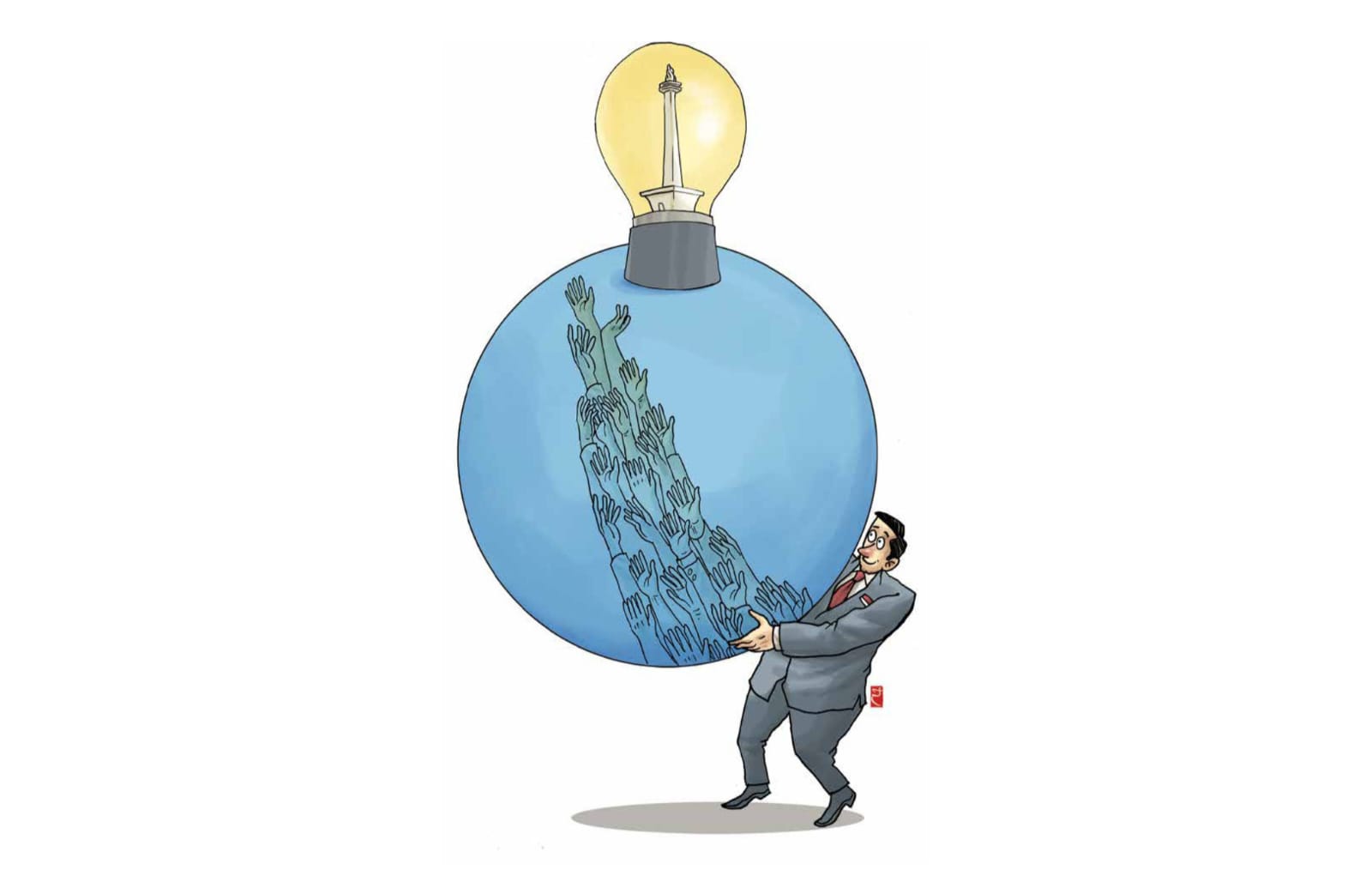
JAKARTA is preparing for its 500th anniversary in 2027. However, a host of unresolved issues still cloud the city’s future. The DKI Jakarta Provincial Government must work hard to realise the dreams of its residents. So, what steps must be taken? First, Jakarta must be free from flooding. Flood control must be focused, carried out in stages and consistently, with measurable results. There are three types of flooding: upstream flooding, local flooding, and tidal flooding. Upstream flooding occurs because the capacity of river bodies shrinks due to changes in land use for settlements along riverbanks. Therefore, widening river bodies, dredging river depths, land acquisition, and relocating residents to liveable vertical housing are a necessity. If two rivers can be rehabilitated each year, all 13 rivers will be completed within the next seven years. Local flooding requires the rehabilitation of all city waterways. If only 33% of waterways are currently functioning well and repairs are targeted at 7% per year, the waterways will function optimally within the next 10 years. Meanwhile, handling tidal flooding includes the arrangement of the north coast area. Flood-prone settlements must be relocated to the nearest vertical housing, and the land must be greened as coastal protection green open space, forming a giant mangrove wall. The construction of a Drinking Water Supply System pipeline network serving 100% of North Jakarta, followed by regulations limiting groundwater extraction, will significantly slow the rate of land subsidence. Second, increasing the area of green open space from 5.6% in 2025 to 30% by 2030 must be a commitment for all parties. Green open space as a water catchment area is needed to reduce flooding, while green open space as the city’s lungs is necessary to absorb air pollutant particles, cool the microclimate, and produce oxygen. Various global city assessment indices for liveable and sustainable cities are always demonstrated by the abundance of green open space. Cities like Melbourne, Sydney, and Adelaide each have 40% green open space. Singapore has 39% green open space and is targeting 56% by 2050. London, Paris, Amsterdam, Brussels, Stockholm, and Copenhagen have long been among the best garden cities in Europe. The potential for green open space can be maximised by building lake, reservoir, and pond parks such as Waduk Pluit and Situ Lembang. Riverbanks and railway lines can be turned into elongated green corridors connecting green open spaces and serving as wildlife corridors, including bird migration routes. The space under flyovers can be transformed into parks and public interaction spaces like skateparks. The opening of 24-hour parks provides inclusive public spaces open to all ages and social strata, befitting a global city. Third, Jakarta must be free from traffic jams. There are two strategies: encouraging residents to switch to public transport and restricting private vehicle movement. The development of the public transport network must become the backbone of future city development. The Mass Rapid Transit south-north corridor from Lebak Bulus to Bundaran Hotel Indonesia will soon continue to Monas by 2027 and Kota Tua by 2029. For the west-east route, MRT is preparing the Tomang-Medan Satria corridor in the north and the Lebak Bulus-Taman Mini Indonesia Indah corridor in the south. The Kelapa Gading-Velodrome Light Rapid Transit will soon be connected to Manggarai by 2026 and Dukuh Atas by 2028. Meanwhile, the LRT from Kelapa Gading to Jakarta International Stadium, Ancol, and Pantai Indah Kapuk and Kosambi is under technical study. The development of Trans-Jakarta services has covered 91% of Jakarta in 2025 and is targeted to reach 95% by 2030. In addition, the development of new Transjabodetabek services, with eight routes in 2026, aims to attract residents of the greater Jakarta area, with the hope of continuously opening new busy routes. A Transjabodetabek loop line is planned to orbit and connect border points of Jabodetabek. Furthermore, the plan to develop Jakarta Sea Transport to the Thousand Islands must be realised as a beautiful gift for the community. Fourth, restricting private vehicle movement can be implemented through policies such as electronic road pricing, progressive electronic parking, low emission zones, car-free zones, and transit-oriented development areas like Blok M, Dukuh Atas, Manggarai, and Kota Tua. The construction of pedestrian infrastructure and cyclist infrastructure will make citizen mobility easier, safer, and more comfortable. The Golkar Party faction in the DKI Jakarta Regional House of Representatives is urging the provincial government to curb the use of private vehicles, which are the main cause of the capital’s congestion.