
Weaving Memories in Andalusia: An Undimmed Longing in Southern Spain
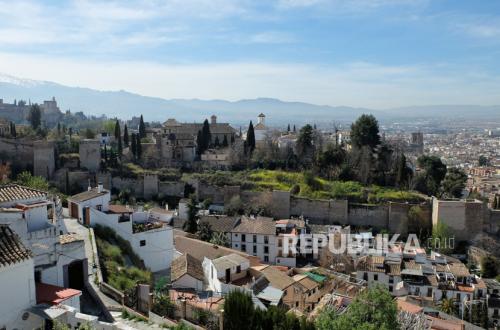
The train pulled slowly out of Málaga station. The clatter of wheels carried it towards the mountains of the Guadalhorce Valley, where whitewashed villages appear to cling elegantly to the hillsides.
Pomegranate trees grew thickly beside the tracks. Palm and cypress trees stood in rows alongside neatly planted orange saplings. Further out, olive groves stretched across the landscape, their leaves shimmering between green and silver in the wind. Small white clouds drifted over the rugged mountains beneath a vast blue sky.
Amid the rumble of the train, an announcement in Spanish came over the loudspeaker: “Next station, Aljaima.” The name comes from the Arabic al-khaima, meaning “tent” — a small trace of a language and a past that have passed through the region.
The train then arrived in Álora. The town has grown around a rocky hill crowned by the remains of an old fortress. Some etymologists believe its ancient name derives from the Arabic al-lawra, loosely translated as “light”.
The railway station was quiet in the midday heat. A large black pick-up truck rumbled into the car park and stopped. Henrietta Szovati, a Muslim woman of British-Hungarian heritage, stepped out after driving down from the mountains to collect supplies.
Wearing a loose blue shirt and cream trousers, she greeted visitors warmly. Silver earrings hung beside her face, and a sea-blue scarf was wrapped neatly around her head like a turban. Red-framed glasses rested above it.
She apologised for the state of her truck. Dust coated the dashboard, and strands of dry grass were caught inside the cab. “It’s a work vehicle,” she said. She was more accustomed to carrying loads across farmland than collecting visitors from the station.
For the past two years, Henrietta and her husband, Ajmal Masroor — a therapist and imam — have been working to transform an old farmhouse and the surrounding land into the House of Andalus. The project aims to bring people closer to the history of Islam in southern Spain, as well as to nature.
Nearly 400 olive trees are spread across the 14-hectare property. Henrietta said she hopes to expand the planting into a grove of 1,000 trees, smiling as she looked out through the open window of the truck.
The road began to climb through the mountains. Henrietta said wildfires swept through parts of the surrounding area at the height of last summer, leaving a harsh landscape. Reddish-brown soil mingled with dried scrub and exposed rock, while sharp grey-silver boulders jutted out from the hillsides.
“That’s slate,” Henrietta explained, pointing through the windscreen. In Spanish it is called pizarra — also the name of a nearby town.
Orange trees thrive here, as do figs and avocados. Even the mangoes here, Henrietta insisted, are much sweeter than those from South Asia.
Source: jawawa.id (https://jawawa.id/newsitem/weaving-memories-in-andalusia-an-undimmed-longing-in-southern-spain-1792986668)
Originally published by Republika (https://analisis.republika.co.id/berita/tnhu21483/merajut-kenangan-di-andalusia-rindu-yang-tak-padam-di-spanyol-selatan), translated from Indonesian