
Weaving Hope for NTT Women Through Traditional Textiles
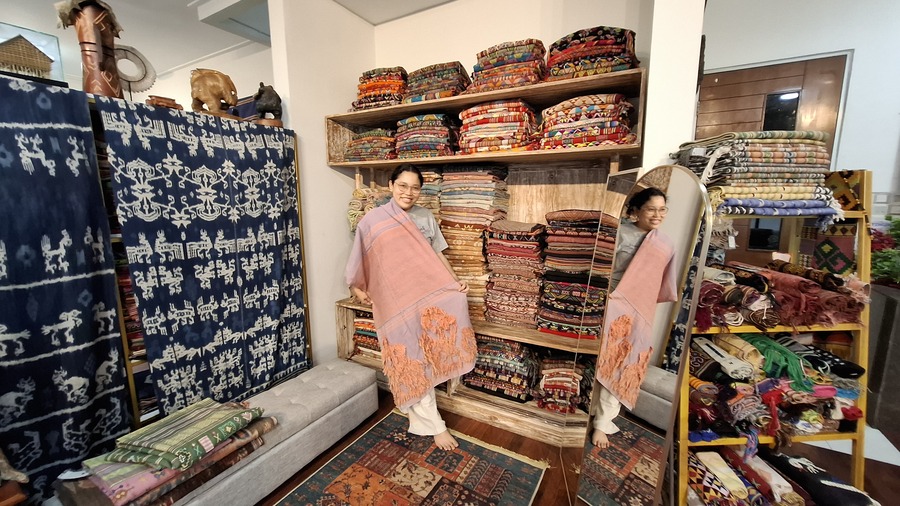
Business was not the original goal for Stephanie Octorina Saing. The 35-year-old began her journey driven by a love for Indonesia’s traditional fabrics. Since her time as a student at the Bandung Institute of Technology (ITB), she enjoyed hunting for regional textiles whenever she travelled with her student mountaineering organisation.
This passion continued throughout her career as a mining consultant. Over time, her interest in traditional woven fabrics evolved into a deeper concern for the artisans behind every piece. Rather than remaining just a collector, she sought to create pathways for empowerment for the women weavers across East Nusa Tenggara (NTT).
Through the Galeri Tinung Rambu, which she founded, she helps introduce the richness of Indonesian weaving to a wider market, while simultaneously creating economic opportunities for women who depend on this ancestral heritage for their livelihoods. As the business grows, capital support from PT Bank Rakyat Indonesia (Persero) Tbk (BRI) has strengthened the development of Tinung Rambu. This access to financing has been utilised to increase production capacity, diversify product ranges, and expand marketing reach to ensure more sustainable business growth.
Initially, her collection was merely kept neatly at home. However, over time, Stephanie began to get to know the weavers more closely, many of whom sold their work to meet essential economic needs, such as school fees and family medical expenses. These encounters fostered a desire within her to help the weavers achieve more prosperous lives.
“They eventually sold to me because during June and July, they usually need to pay for their children’s schooling,” she said when met at the Tinung Rambu Gallery in Tangerang, Banten, last week.
Through these interactions, Stephanie came to understand that every region in NTT possesses a unique weaving heritage. Even within a single regency, every sub-district and village can have its own distinct motifs, techniques, and identities. According to her, this diversity stems from traditions passed down through generations and is highly valued by collectors.
“That uniqueness is what keeps NTT weaving in demand and appreciated by collectors to this day,” she explained.
Her interest in NTT weaving was also driven by broader considerations. She viewed NTT as a region with immense cultural potential, even without relying on the mining sector like other parts of Indonesia. While she noted that mining business licences (IUP) exist in several areas of NTT, management is often suboptimal due to various technical constraints. This, combined with her fascination with the varied and meaningful textiles of NTT, prompted Stephanie to do more than just collect. She began thinking about how to help NTT weavers earn a more decent income.
This drive was further strengthened by her husband’s encouragement. For years, Stephanie continued to buy fabrics from weavers, but it did not create a significant impact. “My husband said, ‘How long are you just going to keep buying? This is like giving a fish.’ If it continues like that, it won’t become anything more than a collection,” she recalled.
This led to the idea of building a business alongside the weavers. In 2019, she began collaborating with weaving families before forming a small group to produce their first works. The fabrics produced were modified in terms of size, design, and colour to maintain the unique identity of Tinung Rambu.
“It started in 2019. Our first product sold was the Pahikung shawl from East Sumba,” she said.
When starting the business, Stephanie sought a name that did not use her personal identity. She wanted a name reflecting the philosophy of the weavers themselves. The choice eventually fell on ‘Tinung Rambu’. In the Sumba language, ‘tinung’ means weaving, while ‘rambu’ means woman.
“I wanted to find a term with the philosophy that this weaving is done by women. So, the name is Tinung Rambu, meaning weaving done by women,” she stated. The name also serves as a symbol of respect for the women who have preserved the weaving tradition in NTT for generations.
From the beginning, Stephanie has endeavoured to build a measurable work system and maintain fabric quality. Alongside the weavers, she calculates raw material requirements, motif complexity, production time, and fair wages. Her initial capital was approximately Rp4 million, which was used to produce 20 shawls for Tinung Rambu’s inaugural collection.
Beyond merely purchasing woven goods, Stephanie has also encouraged weavers to innovate. While traditional colours were dominated by red, blue, black, and other bold tones, she has introduced softer colours such as pastels, yellow, and pink to better suit broader market tastes. This transition was not always easy, as many weavers were accustomed to the same motifs and colours for years. However, they have gradually come to understand the importance of adaptation. Stephanie also implements clear quality standards and work discipline, including deadlines, product dimensions, and commitment to orders, all of which are part of a mutual agreement.