
Weak Oversight and Information Asymmetry Blamed for Rampant Substandard Fortified Rice
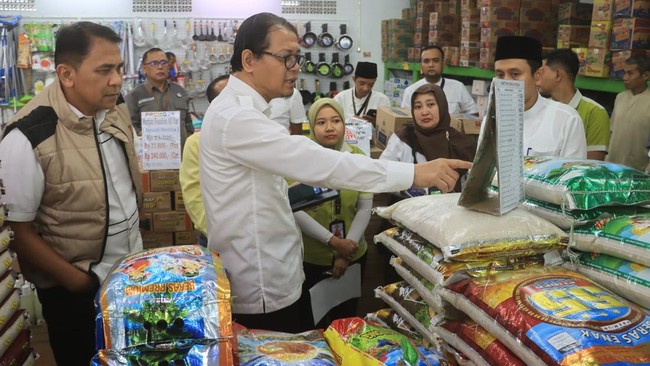
Jakarta, CNBC Indonesia - The polemic over fortified rice that fails to meet quality standards is seen as more than the work of rogue producers. Eliza Mardian, an agricultural observer at the Center of Reform on Economics (CORE), believes the findings point to gaps in the fortified rice trading system, ranging from weak oversight to the absence of an adequate traceability system.
According to Eliza, the finding that 80% of fortified rice samples do not comply with Indonesian National Standards (SNI) should be viewed as an early signal to fix governance, not merely as the end result of a market inspection.
“The fact that 80% of fortified rice samples fail to meet SNI is an initial finding based on government laboratory tests that needs to be followed up transparently. Unfortunately, inspections remain partial, sporadic and have not been fully verified nationally,” Eliza told CNBC Indonesia on Wednesday (5/8/2026).
In her view, the issue points to a more fundamental weakness in the fortified rice trading system.
“This reflects a combination of weak oversight, information asymmetry and incentive structures in the special rice market, not just the highest retail price (HET) issue. Fixing it requires consistent standard enforcement, traceability and policy design evaluation without sacrificing the sustainability of compliant businesses,” she said.
Eliza explained that fortified rice was essentially designed as an instrument to address micronutrient deficiencies in society. However, when the product enters the commercial market with a premium label while oversight and law enforcement remain weak, opportunities for deviation grow.
“Fortified rice should be a public goods instrument to tackle micronutrient deficiency. But once it enters the commercial market without a price cap and with premium claims, rent-seeking opportunities emerge, especially with weak supervision and weak law enforcement,” she explained.
She noted that cases of rice failing to meet quality standards are not new. Because of that, weak enforcement means violators are never truly deterred.
“Sub-standard rice cases have happened again and again. There is no deterrent effect for companies that break the rules,” she said.
According to Eliza, this ultimately harms two parties at once. On one hand, consumers pay premium prices for products that fail to meet quality. On the other, compliant producers face unfair competition.
“Consumers are harmed because what they buy does not match the quality. And compliant producers become victims of cheating by rogue producers. Selective enforcement will destroy the incentive to comply,” Eliza said.
She said one root of the problem lies in information asymmetry. Consumers have no way of checking the quality of the rice they buy, while that information is held only by producers or millers.
“The information asymmetry is that our consumers struggle to verify physical parameters such as broken grains, degree of milling, moisture content and so on - only producers or millers have the complete information,” she said.
On the other hand, regulations that rely solely on SNI compliance without supply-chain traceability are seen as creating gaps in rule enforcement.
“Then the regulatory design that relies on SNI output standards, without a strong traceability system and risk-based supervision, creates an enforcement gap,” she added.
Eliza also highlighted the differing price arrangements between rice categories, which she believes encourages abuse of the fortified label.
“Tight HET on premium and medium rice, while fortified rice (a special category) is relatively looser on pricing, encourages a shift towards the more expensive fortified label even when the nutritional content is not met,” she said.
As a result of these problems, Eliza estimated that losses borne by the public are substantial.
“These findings show practices of selling premium and fortified rice that fail quality standards, with estimated consumer losses in the tens of trillions of rupiah,” Eliza said.
She therefore urged the government to follow up the findings with consistent and transparent law enforcement.
“In the short term, the government must enforce the law and impose appropriate and transparent sanctions. Consistently revoke distribution permits for food products proven to have repeatedly failed tests, as Bapanas has already instructed. Then hand over suspected fraud or false claim cases to the Food Taskforce and law enforcement through a transparent process,” she said.
Eliza also urged the government to announce the identities of brands and producers proven to have violated the rules once legal proceedings are under way. She said this is important so consumers can avoid problematic products while creating a deterrent effect.
“Then, so consumers can be more careful, announce the brands and producers that violated the rules once the legal process is under way, so a deterrent effect emerges and consumers can steer clear,” she said.
In her view, administrative sanctions alone will not suffice to curb violations of such large economic value.
“So a combination of criminal, civil and administrative measures is needed,” she stressed.
Eliza added that the government has taken an initial step by disclosing the findings. The next task, however, is to ensure enforcement is carried out consistently so that public trust in the fortification programme does not continue to decline.
“The government has shown courage in disclosing these findings; the next step is to act consistently, fix the regulatory gaps and ensure fortified rice returns to being a trusted nutrition instrument rather than a margin opportunity exploited fraudulently,” Eliza said.
“Because without that, public trust in food and nutrition policy will continue to erode, and the social cost will be far greater than the estimated Rp71.9 trillion,” she continued.
The fortified rice polemic emerged after the National Food Agency (Bapanas) found that the majority of monitored products failed to meet quality requirements.
Results of market surveillance in DKI Jakarta in June 2026 covering 15 fortified rice brands showed only three brands complied, while the other 12 did not. The products were sold at prices ranging from Rp17,580 to Rp42,500 per kilogram.
Fortified rice is governed by two standards, namely SNI 9314:2024 for fortified rice kernels and SNI 9372:2025 for fortified rice. Per 100 grams of product, fortified rice must contain a minimum of 0.25 milligrams of vitamin B1, 0.25-0.38 milligrams of folic acid, 1.0-1.5 micrograms of vitamin B12, 3.50-5.25 milligrams of iron and 3.0-4.5 milligrams of zinc, with a minimum mixing ratio of fortified kernels to milled rice of 1%.
Following the findings, the Head of Bapanas, who is also Agriculture Minister Amran Sulaiman, had previously ordered the revocation of distribution permits for a number of fortified rice brands and rice with nutritional claims proven to fail the requirements based on laboratory test results.
“As Head of Bapanas, to the Secretary-General and the Deputies: revoke their permits. Instruct this down the line. That is my authority. Revoke the permits and they must not distribute, because these are laboratory results,” Amran asserted some time ago.
Beyond permit revocation, Amran also asked that the suspected violations be processed through the Food Taskforce. He even said he would write to the National Police Chief to escort the legal process against producers suspected of breaking the rules.
Source: jawawa.id (https://jawawa.id/newsitem/weak-oversight-and-information-asymmetry-blamed-for-rampant-substandard-fortified-rice-1785912665)
Originally published by CNBC Indonesia (https://www.cnbcindonesia.com/news/20260805111531-4-756699/faktor-ini-disebut-bikin-beras-fortifikasi-tak-sesuai-sni-merajalela), translated from Indonesian