
Watched by Kim Jong Un, North Korean Drones Attack Mock US Tanks
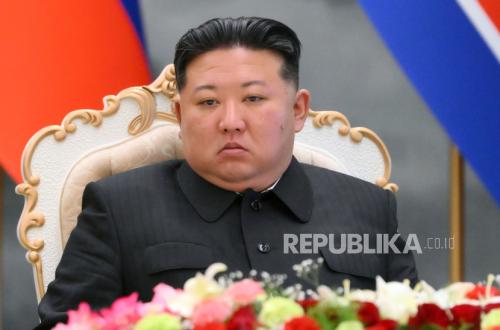
JAKARTA — North Korea showcased its latest military capabilities on Thursday (29 October 2026) in a demonstration featuring attack drones, cruise missiles and a giant 600-millimetre rocket-launcher system. The event came as leader Kim Jong Un called for faster mastery of drone and artificial intelligence technologies to secure an advantage in modern warfare.
The weapons display coincided with the launch of around 10 short-range ballistic missiles, which South Korea’s military detected travelling from the Wonsan area towards the East Sea, also known as the Sea of Japan. The projectiles flew about 250 kilometres, while military authorities in Seoul continued to analyse their characteristics and the types of weapons used.
According to the Korean Central News Agency (KCNA) on Friday (30 October 2026), the demonstration formed part of an exhibition titled Unmanned Aeronautical Technology Development-2026. It presented a range of unmanned aircraft systems for reconnaissance, tactical operations and attacks on military targets.
Kim Jong Un said mastery of drone technology was an essential requirement amid changes in modern warfare. He stressed that North Korea must accelerate the development of unmanned weapons systems while strengthening the use of artificial intelligence (AI) in its defence industry.
“Strength means peace, and peace can only be guaranteed by strength,” Kim said, according to KCNA.
Kim said military technological advances had to be accelerated so that the country’s defence capabilities did not fall behind the evolution of modern warfare. North Korea, he said, needed to develop high-tech conventional forces alongside the nuclear capabilities it had built over several decades.
Reuters reported that the demonstration reflected North Korea’s military modernisation, which increasingly emphasises a combination of drone technology, artificial intelligence and long-range strike systems. This shift comes as experience from the Russia-Ukraine war and conflicts in the Middle East has highlighted the growing role of unmanned aircraft in military operations.
Attack drones and missiles said to have hit their targets accurately
The exhibition featured various types of multipurpose drones for strategic, operational and tactical use. KCNA said the weapons on display included one-way attack drones, multipurpose drones carrying air-to-surface missiles, and tactical cruise missiles.
During the demonstration, several attack drones were directed at mock targets, while other unmanned aircraft launched missiles at designated targets. North Korea also demonstrated cruise-missile launches and simultaneous firing by units equipped with large-calibre rocket launchers.
KCNA claimed that all the attack drones, air-to-surface missiles and cruise missiles directed at a target island hit their marks with 100 per cent accuracy. The claim came from North Korea’s state media and could not be independently verified using publicly available test data.
Photographs published by KCNA showed drones hitting mock military vehicles and causing explosions. Other images showed missiles being launched from unmanned aircraft and rockets fired simultaneously from several launchers.
According to Reuters, some of the mock targets resembled South Korean military positions, armoured vehicles, US M1 Abrams tanks and radar systems. Analysts said this suggested Pyongyang was showcasing its ability to attack military assets associated with South Korea and the United States.
However, the appearance of the mock targets does not in itself prove that North Korea can destroy modern defence systems in real combat. Hitting prepared targets is different from engaging moving targets that can defend themselves, or operating in the face of electronic warfare and air defences.
600mm Sniper rocket launcher
One of the weapons that attracted the most attention at the demonstration was a 600mm-calibre multiple rocket-launcher system named Sniper. KCNA described the firing at the event as the system’s first public demonstration and said it had exceptionally high precision.
According to South Korea’s Yonhap news agency, photographs released by North Korea showed more than 10 launchers firing 600mm rockets simultaneously. The system is part of the development of very large-calibre rocket artillery, which has been one of Pyongyang’s military modernisation priorities in recent years.
Defence intelligence company Janes identified the system as a development of the 600mm rocket launcher associated with the KN-25 weapons family. The system has drawn attention because the size, range and flight characteristics of its projectiles give it certain operational similarities to short-range ballistic missiles.
North Korea has previously said that its 600mm rocket system can be fitted with Hwasan-31 tactical nuclear warheads. That statement is a claim by Pyongyang and does not establish that the projectiles fired on Thursday carried nuclear warheads.
A South Korean military official quoted by Yonhap said the missile launches from the Wonsan area may have involved the KN-25 system. Seoul’s military was also considering the possibility that several types of weapons were used in the exercises conducted that day.
The distinction matters because it has not been conclusively established that the weapons demonstration announced by KCNA and the projectiles detected by South Korea were part of the same sequence of launches. Although they took place on the same day, the technical information available is insufficient to link all the launches to a single weapons system.
The development of very large-calibre rocket launchers gives North Korea a conventional strike option distinct from cruise missiles and drones. Such systems can be used to hit multiple targets, but their actual effectiveness still depends on range, accuracy, ammunition availability and their ability to overcome an adversary’s defences.