
Waste to Wealth: Maggot Farming Drives Circular Economy in Ciliwung Watershed
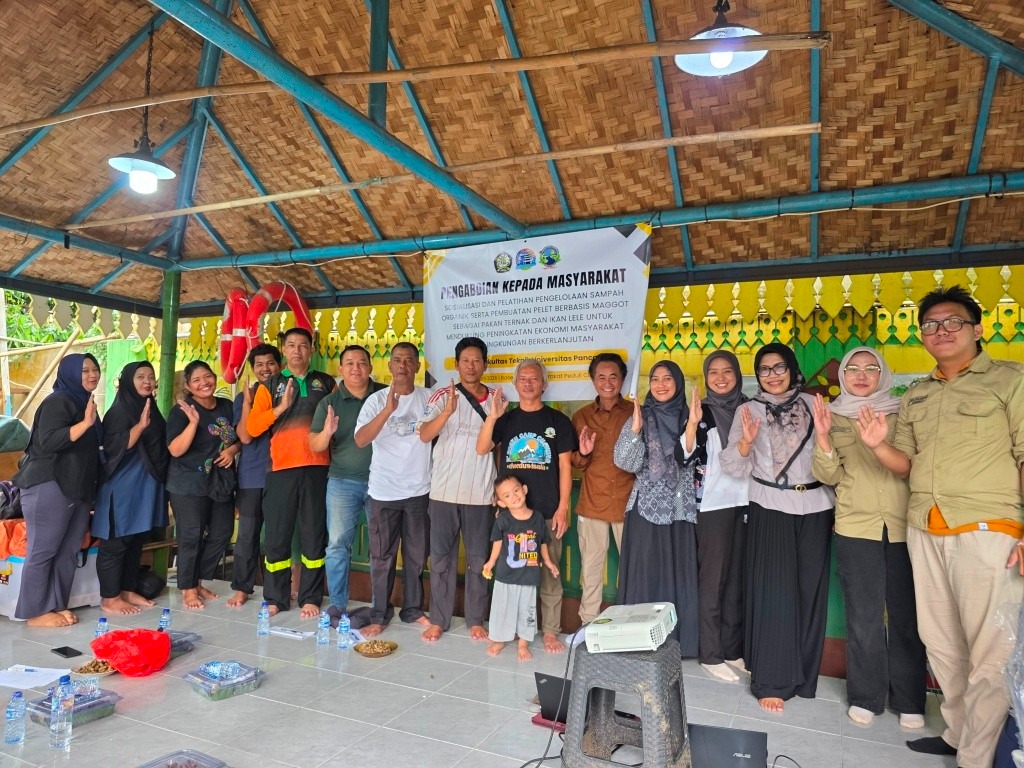
Organic waste, long identified with refuse, is now being viewed as a new economic resource. Through the application of Black Soldier Fly (BSF) cultivation technology, household waste can be processed into valuable livestock and fish feed pellets, while simultaneously helping to reduce the waste burden on landfills.
This circular economy-based waste management model is being implemented in the Ciliwung River Basin (DAS Ciliwung) through training in organic waste processing and BSF-based pellet production. The initiative involves the Ciliwung Care Community (Mat PeCi), waste bank managers, and local residents.
In addition to strengthening environmental conservation efforts, this programme opens new business opportunities for the community by utilising previously valueless waste. This initiative is the result of a collaboration between the Civil Engineering and Industrial Engineering Study Programmes at Pancasili University (UP) through a Community Service (PKM) activity held on 23–24 June 2026. The activity received support from the Ministry of Higher Education, Science, and Technology (Kemdiktisaintek) via the Directorate of Research and Community Service (DPPM) as part of an effort to encourage the use of appropriate innovation and technology within society.
During the training, participants received instruction ranging from organic waste sorting techniques and BSF cultivation to the process of converting maggots into livestock and catfish feed pellets. This approach is expected to create a more productive waste management system and provide economic benefits to the community.
Dwi Ariyani, Head of the UP PKM Team, stated that organic waste management is not only a solution to environmental issues but also has the potential to create new income sources for the community. “Through this activity, we want to provide appropriate technology that is easy for the community to implement. Organic waste, which has long been considered waste, can be transformed into an economically valuable resource through maggot cultivation and pellet production. Thus, the community can contribute to environmental preservation while also gaining economic benefits,” she said on Friday (26/6/2026).
She added that besides contributing to waste reduction and environmental emissions, using maggots as organic waste processors can also drive the emergence of new businesses based on the circular economy. “Consequently, the community will not only achieve a cleaner environment but also gain a sustainable new source of income, supporting the achievement of the Sustainable Development Goals (SDGs), particularly regarding responsible consumption and production, sustainable cities, and climate action,” Dwi concluded.
During the socialisation session, Dino Rimantho explained the life cycle of the BSF (Hermetia illucens) and its ability to decompose organic waste quickly and efficiently. This technology serves as a sustainable waste management solution while supporting the circular economy concept.
As a form of support for the programme’s sustainability, the organisers also handed over various supporting facilities to the community, including maggot cultivation installations, organic waste shredders, and pellet-making machines. This assistance is expected to enable the community to produce feed independently and develop businesses based on organic waste processing.
In addition to providing facilities, follow-up assistance will be conducted to ensure that the maggot cultivation and pellet production processes run optimally so that the resulting economic benefits can continue to grow.
Usman Firdaus, a representative of Mat PeCi, appreciated the training as it provides a real solution to the organic waste problems faced by the community. “We are grateful to UP and the Ministry of Higher Education, Science, and Technology via DPPM for supporting this activity. This training provides new insights into how organic waste can be utilised into useful products with economic value. We hope the knowledge gained can be applied sustainably and serve as an example for other communities,” he said.
Moving forward, UP and Mat PeCi are committed to continuing cooperation through programmes involving assistance, monitoring, and community capacity building. “This programme is expected to become a model for empowerment based on appropriate technology that can be easily replicated in various regions.”
Source: jawawa.id (https://jawawa.id/newsitem/waste-to-wealth-maggot-farming-drives-circular-economy-in-ciliwung-watershed-1782485446)
Originally published by Media Indonesia (https://mediaindonesia.com/megapolitan/904797/limbah-jadi-cuan-budidaya-maggot-dorong-ekonomi-sirkular-di-kawasan-das-ciliwung), translated from Indonesian