
Waste-to-Electricity Project Officially Commences Construction in Legok Nangka, West Java
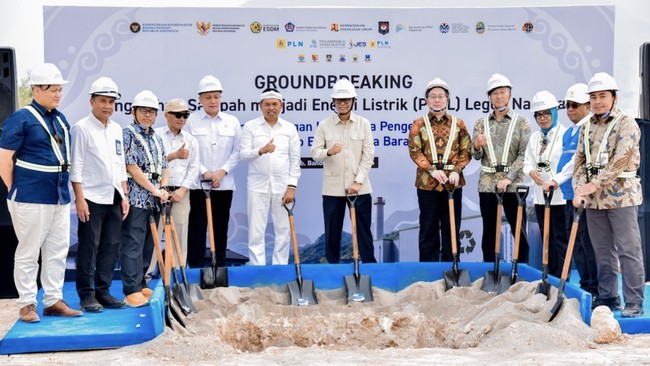
The Ministry of Energy and Mineral Resources (ESDM) has officially inaugurated the construction of the Legok Nangka Waste-to-Energy (PSEL) facility in West Java. The project is designed to process 2,131 tonnes of waste every day, sourced from six regencies and cities across West Java.
Construction at the Legok Nangka Regional Final Disposal Site (TPPAS) in Bandung Regency commenced on Wednesday, 29 July 2026, with a groundbreaking ceremony attended by the Deputy Minister of Energy and Mineral Resources, Yuliot, representing Minister Bahlil Lahadalia.
In his address, Yuliot stated that the comprehensive management of urban waste is an instruction from President Prabowo Subianto. “As instructed by President Prabowo Subianto on many occasions, we must resolve urban waste issues comprehensively before 2029 through upstream and downstream schemes, turning waste into a source of energy (Waste to Energy),” Yuliint stated in a press release on Friday.
This directive encourages relevant agencies to find solutions to prevent urban waste problems from persisting, noting that unmanaged waste piles pose environmental risks such as landslides and fires. “Today’s groundbreaking is not merely marking the start of infrastructure construction, but also serves as a symbol of our shared commitment to realising a cleaner, greener, and more sustainable future for Indonesia,” he added.
Yuliot expressed hope that the Legok Nangka PSEL could serve as a model for waste-to-energy projects that can be implemented in various regions. With significant generation capacity and investment support, the project is expected to provide tangible benefits through waste volume reduction, clean energy provision, job creation, increased regional economic activity, and the reduction of greenhouse gas emissions.
Echoing Yuliot’s sentiments, the Governor of West Java, Dedi Mulyadi, stated that the Legok Nangka PSEL, which is targeted to be operational by 2029, will provide three main benefits: addressing waste issues in the Greater Bandung area, providing electricity for the community and industry, and creating a cleaner environment.
The waste-to-energy project, valued at US$400 million (approximately Rp7.2 trillion), is designed with a capacity of 40.79 megawatts. During its 41-month construction period, the project is expected to employ 1,565 workers and reduce greenhouse gas emissions by 311,874 tonnes of CO2 equivalent.