
"Waste Station" Launches at MRT Blok M, Encouraging Public Waste Sorting
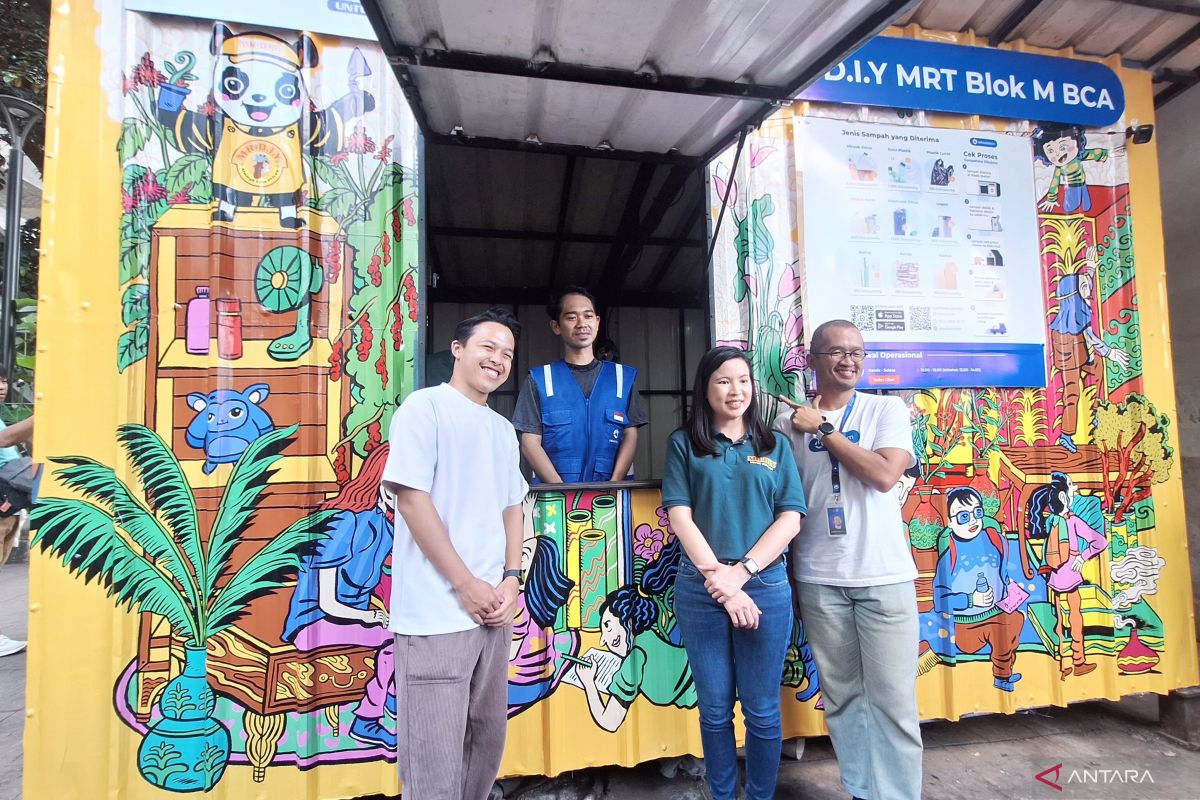
Jakarta (ANTARA) - On the occasion of Earth Day 2026, a special waste management station (waste station), resulting from the collaboration between PT Daya Intiguna Yasa Tbk (MR.D.I.Y. Indonesia) and Rekosistem, has been introduced at Jakarta’s MRT Blok M Station. This allows the public to sort waste directly at the source in public spaces.
“The launch of this waste station is not a standalone initiative, but part of MR.D.I.Y. Indonesia’s long journey in supporting a tangible and measurable waste management ecosystem through the pillar of environmental sustainability,” said Chief Financial Officer of MR.D.I.Y. Indonesia, Rika Juniaty Tanzil, during the inauguration of the waste station at Jakarta’s MRT Blok M Station on Friday.
As a company committed to actively addressing environmental issues, the company highlighted data from the Ministry of Environment and Forestry showing that by the end of 2025, unprocessed waste in Indonesia will still reach 109,092 tons per day.
Meanwhile, Jakarta itself generates around 7,100–8,000 tons of waste every day.
In line with the government’s focus on promoting waste sorting at the source at the household level, the presence of a waste station in high-mobility public spaces becomes increasingly relevant and urgent.
“This facility is not just a symbol, but a functional solution that can be used by visitors to the Blok M area as well as more than 120,000 MRT passengers every day,” she said.
In terms of capacity, the waste station was developed together with Rekosistem, which can accommodate up to 120-150 kilograms (kg) of inorganic waste per day.
This waste station is a follow-up step after the Recycle Dropbox, which is now present in 52 stores in DKI Jakarta, West Java, and Banten.
Later, the public will deposit sorted inorganic waste at the waste station. They will then receive reward points through the Rekosistem app, which can be exchanged for digital wallet balances.
This makes waste sorting not only an act of responsibility but also provides economic benefits.
The unit’s design was created by visual artist from Yogyakarta, Wulang Sunu, with motifs representing the three pillars of “MR.D.I.Y. For Indonesia”, namely women’s and children’s empowerment, local business empowerment, and environmental sustainability.
Meanwhile, Chief Operating Officer and Co-Founder of Rekosistem, Joshua Valentino, said, “Through this collaboration, we can reach the public at the most strategic points in Jakarta. With an integrated system and relevant incentives, we want to prove that sorting waste from home can become a daily habit, not a burden.”
Head of Public Participation, Data, and Information Division of the DKI Jakarta Environmental Agency, Rommel PP Pasaribu, expressed that the Provincial Government of DKI Jakarta appreciates this cooperation as a concrete example of multi-stakeholder collaboration in supporting the waste sorting movement at the source.
“Hopefully, this collaborative initiative becomes an inspiration and spark for other parties, both the private sector, industry players, and communities, to join in the movement,” he said.
In line with that, Co-Founder of Pandawara Group, Muchamad Ikhsan Destian, added, “Waste is a mirror of our habits. The change must start from there, from small things done consistently every day. When the right facilities are available in the right places, that change becomes much more possible.”
Throughout 2025, MR.D.I.Y. Indonesia recorded several environmental achievements, including:
• 2,445 kg of waste collected from Recycle Dropbox in 52 stores (1,211 kg) and beach clean-up actions in Bulukumba with World Clean Up Day (1,234 kg)
• 84 tons of cardboard waste reused in logistics operations, thereby reducing the need for new materials
• 10 waste banks strengthened in Jabodetabek, accompanied by training for dozens of their managers together with T.Care Foundation
• 300 tree saplings planted in the Banten Grand Forest Park together with Jejakin to strengthen the forest’s function as a nature conservation area