
Waste-Processing Technology at Source Could Be Key to Circular Economy
Organic waste management is not limited to collection and disposal; it also includes efforts to process and reuse materials that still have value.
Solutions are therefore needed that can reduce the volume of waste while creating opportunities to use the processed output and derive economic benefits from it.
Developing technology to treat waste at its source could be one alternative to support these efforts and promote the adoption of a circular economy in Indonesia.
Biochemical chamber technology offers one option for processing organic waste, from business-scale operations to industrial facilities. The scale of Indonesia’s waste-management challenge has also underlined the urgency of this approach.
At the seminar “Advanced Composting Technology 2026: Transforming Organic Waste into Valuable Resources”, data showed that Java accounts for around 58.7 per cent of the country’s total waste generation.
Against this backdrop, treating organic waste where it is generated — at hotels, restaurants, food and beverage industries, and commercial areas, for example — is one option for easing the burden on conventional waste-management systems.
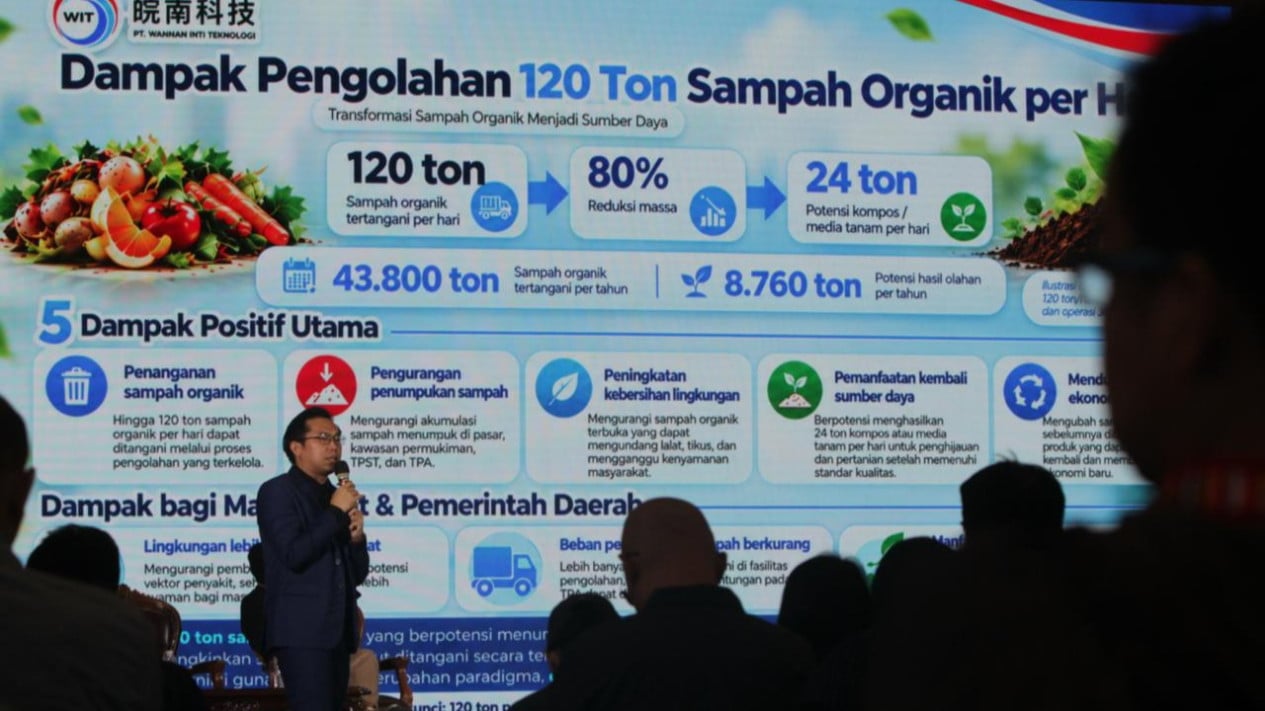
“The question is, how much of the waste can we actually deal with before it reaches landfill? The more organic waste we treat earlier, the less dependent we will be on landfill,” PT Wannan Inti Teknologi director Jeremy Wijaya said in a statement on Friday (23 October 2026).
Organic waste has characteristics that require special handling, including high moisture content and the potential to produce odours as it decomposes. With proper management, however, it can also be processed into resources for reuse.
To meet this need, PT Wannan Inti Teknologi has introduced an integrated waste-treatment system that includes sorting and processing the solid fraction using a biochemical chamber machine.
Wijaya said the technology is available in input capacities ranging from 30 kilograms to 120 tonnes a day, depending on the model and unit specifications. He said it was designed to process organic waste in a 24-hour cycle.