
Waste Problems Resolved in Three Years: Lessons from Indore, India, for Indonesia
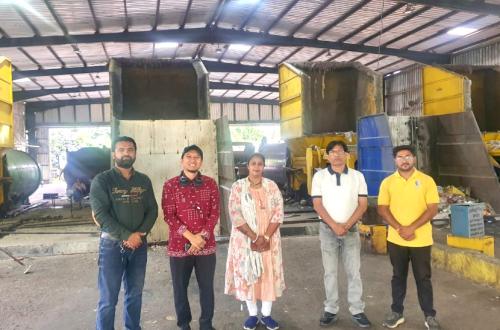
In early September, I stood on a 4-hectare site in the city of Indore, India. Eight years ago, this location was an open dumping site, with waste piled meters high. Approximately 1.3 million tonnes of waste had accumulated over five decades, contaminating groundwater and spontaneously combusting during the dry season. However, on that day, I witnessed lush greenery, a biogas plant, and recycling facilities standing upon it.
What left me speechless was not the scenery, but the duration of the recovery. How could that mountain of waste be cleared in less than two years?
During my two decades working in Indonesia’s waste sector, I have frequently heard the same arguments in meeting rooms: that waste problems are too complex, require long periods, necessitate massive budgets, and require a level of public awareness that has yet to be established. Indore made me question all of those assertions.
Why Indore? Our officials often choose to study waste solutions in Germany, Denmark, Japan, or Singapore. The problem is that the gap between Indonesia and those nations is not merely technological, but also involves per capita income, fiscal capacity, and differences in culture and bureaucracy. Upon returning from those places, we often find many dead ends in implementation because those solutions simply do not fit the Indonesian context.
Unlike Indore, their GDP per capita is actually lower than Indonesia’s. Their bureaucracy is complex, their politics are dynamic, and their informal waste sector issues are as intricate as ours. Indore itself has a population of around 3.5 million, comparable to our major cities.
In 2016, Indore ranked 25th in the Swachh Survekshan national cleanliness survey. A year later, Indore rose to number one and has maintained that position for eight consecutive years leading into 2025. This was achieved not through expensive technology, but through a specific way of working.
What they do every day:
I asked Syed Asad Ali Warsi, the consultant who designed the technical architecture of this transformation: ‘What exactly do you and your team do every day?’
The answer was simple yet demanding. The Mayor, the City Commissioner as the chief executive, and the expert team gathered almost every day, from six to nine in the morning, and then continued from six to nine in the evening.
This was not monthly meetings or annual seminars. For about six hours a decade during the first three years, they discussed planning, financing, implementation, and resolving various obstacles on the ground. They also toured the city and engaged in dialogue with residents. Indore’s actions were not merely commitments on paper; this was dedication and determination paid for with their own rest time.
The sequence we have traditionally reversed:
The most important technical lesson from Indore is the sequence of operations. This is where many of our regions err.
Indore did not start by building processing facilities. They began with comprehensive planning and a target to eliminate all public bins, containers, and temporary collection points throughout the city. These points were the sources of filth and where waste would mix again.
In their place, waste was collected from every house. Door-to-door collection services reached almost 100 per cent in just about one year.
Only after residents experienced a reliable service was sorting made mandatory. Approximately 800 collection vehicles, each accompanied by a volunteer to educate and remind residents daily, were deployed. In less than three years, about 95 per cent of residents were disciplined in sorting waste at the source.
Only after a steady supply of sorted waste was guaranteed did investors enter to build processing facilities. A biogas plant with a capacity of 550 tonnes per day and a dry waste sorting facility with a capacity of 400 tonnes per day were built entirely with private capital. The city government does not pay processing fees; on the contrary, the companies pay royalties to the city.
We often do the opposite: rushing to build processing facilities worth tens of billions of rupiah, while waste at the source remains mixed. Expensive facilities provided with mixed waste will operate far below capacity or stop altogether. What happens is that we build the machines before fixing the raw materials.
Trust as the foundation of financing:
One finding that addresses concerns regarding cost is the waste fee collection rate in Indore. Before the transformation, waste revenue collection was only around 25 per cent. Now, about 95 per cent of residents pay punctually.
The rates were not lowered. What changed was the quality of service. Residents are willing to pay because they see the evidence every morning in front of their homes.
The city government dared to commit significant capital in the initial stages to improve management, fleets, education, and digital monitoring systems. The resulting growth in public trust repaid that investment in the form of payment compliance.
This reverses the logic we commonly use. We often wait, even hoping, for residents to pay punctually before improving services. Indore proves that the sequence must be reversed.
One thing that cannot be easily adopted:
Much of the inspiration from Indore can be emulated, from six-category sorting and satellite-based fleet monitoring to complaint applications with a 24-hour resolution deadline, and the restoration of old landfill sites. All of these are technical and not impossible for Indonesia.
However, there is one thing that cannot be adopted blindly: the leadership courage to be uncompromising. In Indore, three forces moved simultaneously: the chief executive who executed the programme without compromise…