
Waste Management Must Have a Designated Address
Waste piles never truly stop moving when they change hands. From homes, restaurants, hotels, and markets to collectors, materials deemed useless continue to seek their next destination.
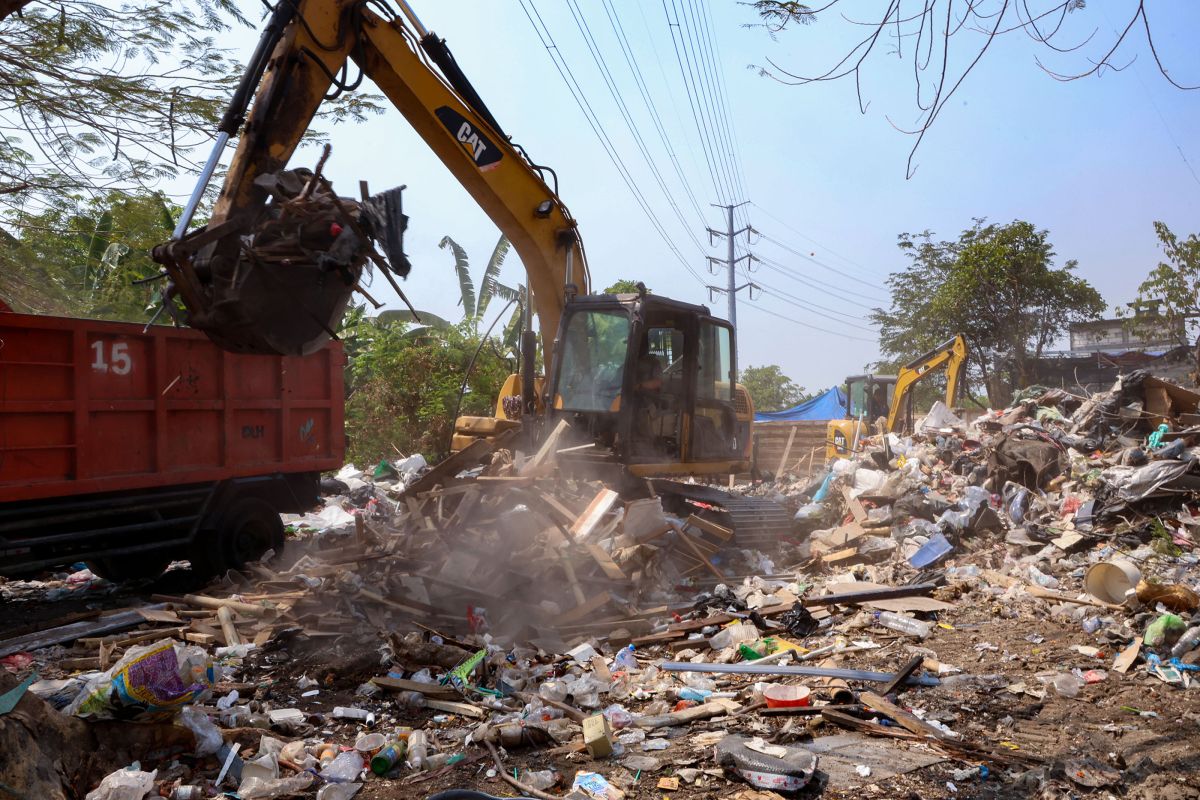
Problems arise when those destinations are in inappropriate spaces, managed without permits, and leave behind odours, leachate, residue, and community complaints. This situation is evident in the Keputih area of Surabaya, East Java. On 1 October 2026, the Surabaya City Government enforced order against unauthorised waste management activities located on seven plots of government-owned land.
This enforcement follows previous actions taken in August, after joint data collection with sub-districts and districts revealed 97 plots being used for unauthorised waste management business activities. The figure of 97 plots is a crucial part of the issue, indicating that the challenge is not merely piles of waste in one location, but an economic ecosystem that has grown around waste.
Therefore, enforcement should not be understood simply as clearing land. The government needs to ensure why these activities emerged, how waste enters the site, who benefits economically, where the residue goes, and how workers can transition towards legal management.
This issue has a broader context. The Surabaya City Government records daily waste generation of approximately 1,800 tonnes. Of this, about 200 tonnes are managed by the community through sorting, 3R-based waste management sites, and waste banks, while approximately 1,600 tonnes are still sent to the Benowo Landfill (TPA). This means there is significant potential for community-based sorting and reuse, as currently, only about 11 per cent of daily waste is managed by the community. This is where the Keputih paradox becomes important.
The city needs more sorting activities so that waste does not all end up at the downstream landfill, but such activities can create new problems if they occur in unsuitable locations without proper environmental infrastructure. The issue is not sorting versus enforcement, but rather how economically useful activities can be placed within a legal, safe, and monitorable framework.
Economic Value
Waste possesses economic value, and because of this, it must not be allowed to exist in a grey area. During the August enforcement on approximately 1.4 hectares of land in Keputih, the Surabaya City Government transported about 32 trucks of waste with no economic value to the Benowo Landfill. The site was also noted to host sorting activities for the hotel, restaurant, and cafe sectors.
At that time, the government identified around 22 to 24 groups operating at the location. The City Government also noted thousands of businesses in the hotel, restaurant, and cafe sectors, as well as dozens of transport vendors, whose waste management flows need to be mapped. This fact reveals a more fundamental problem: when the government only looks at the final point, such as sorting stalls, the source of the problem may be missed. Waste does not suddenly appear in Keputih; there is a chain of producers, transporters, sorters, collectors, material buyers, and residue managers.
Consequently, ideal supervision should follow the journey of the waste, rather than just chasing the accumulation sites. This approach aligns with the waste management reform agenda currently being pushed by the central government. In 2026, the Ministry of National Development Planning/Bappenas placed integrated waste management from upstream to downstream as part of the development agenda, emphasising that waste has potential as a resource within a circular economy.
Furthermore, Bappenas studies on the integration of the informal sector show that scavengers and collectors are not merely actors operating outside the system. In several regions, informal sector actors contribute significantly to the collection of materials for recycling. Recommendations include regulation, institutionalisation, partnerships, capacity building, recognition of informal sector actors, and funding support.
These lessons are relevant to Surabaya. Unauthorised collectors or sorters are not automatically synonymous with behaviour that must be removed from the system. What needs to be removed are practices that endanger the environment, use land illegally, burn waste indiscriminately, or leave residue without certain management pathways.
The legal framework is already available. Law Number 18 of 2008 mandates that waste management must be a comprehensive and integrated system from upstream to downstream, while affirming the importance of legal certainty, division of responsibility, the role of the community, and the business world. At the regional level, Surabaya has Regional Regulation (Perda) Number 5 of 2014 concerning Waste Management and Cleanliness, which was amended by Perda Number 1 of 2019. The city government also has Mayor Regulation (Perwali) Number 10 of 2017, which regulates the procedures for administrative sanctions for waste regulation violations.
Thus, the challenge in Keputih is not a lack of regulation. The challenge is ensuring that regulations are present before problems escalate, rather than after the environment has already been disturbed.
Reorganising
Enforcement is important because its impact extends beyond aesthetics. Waste management activities that do not meet standards can produce leachate, odours, air pollution from burning, and residue without clear management paths. In Keputising, these aspects were primary reasons for the government to regulate activities complained about by residents.
However, enforcement loses its meaning if, after the land is cleared, the old system simply grows in another location. Therefore, the next step should be the restructuring of the ecosystem. The city government needs to clearly distinguish between waste management that is economically beneficial…