
Waskita Accelerates Jakarta LRT Phase 1B Construction as Progress Reaches 92.76 Percent
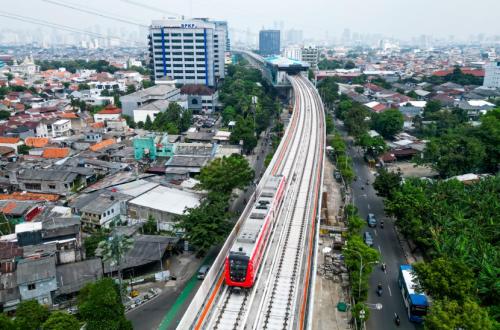
PT Waskita Karya (Persero) Tbk together with PT Jakarta Propertindo (Perseroda) has initiated a series of testing and commissioning (T&C) of the LRT Jakarta Phase 1B Velodrome-Manggarai railway system some time ago. One of the tests involved a 3.6-kilometre track running between Velodrome Station and Pramuka Station.
Jakarta Propertindo (Jakpro) Chief Executive Iwan Takwin said the T&C phase is conducted in detail to ensure the entire system is ready for use. The process includes systematic and structured testing of all components and subsystems before commercial operation, covering the track, signalling, electrification, communications, and operational integration.
“Every metre of the elevated track of LRT Jakarta Phase 1B is our responsibility to the people of DKI Jakarta who will rely on the LRT daily. Therefore, the T&C phase must be prepared very meticulously,” Iwan said in a written statement on Tuesday, 19 May 2026.
Waskita Karya Operations Director II Paulus Budi Kartiko said that Waskita Karya’s involvement in building Jakarta LRT Phase 1B is not only related to construction work but also an opportunity to demonstrate results or showcase capability. This high-visibility project makes the quality of work have a direct impact on long-term reputation.
Waskita’s scope of work on the LRT Jakarta Phase 1B includes civil, track, systems, and operations integration. The company continues to accelerate the work so that the project can be benefited by the public soon. The project, valued at IDR 4.1 trillion, has now reached 92.76 percent completion.
“In the course of the work, the main challenge (urban constraint) we face as the contractor includes Jakarta’s heavy traffic and limited workspace. Therefore, the solution is to optimise night-time working hours that demand focus and innovation in safety systems and working systems. We see this as a constraint that must be managed, not avoided,” Paulus said in a press release on Tuesday, 19 May 2026.
In carrying out the track tests, he added, one of the areas traversed is the crossing over the Wiyoto Wiyono Toll Road active lanes at kilometres 1+700 to 2+100. To safeguard traffic conditions on that toll road during construction, Waskita innovated by using a balanced cantilever method with a 120-metre span.
“Construction safety, both in securing the balanced cantilever construction and for road users, must be prioritised,” Paulus said. He added that survey monitoring and chambers are also conducted regularly every day.
Field teams also installed safety nets around the balance girder segments. Thanks to these measures, Waskita achieved zero accidents during the construction of the LRT Jakarta Phase 1B balanced cantilever.
“The Wiyoto Wiyono crossing has become one of the most important icons in the track tests in recent times. This success signals Indonesia’s construction progress that can integrate public transport with an existing active line in the midst of Jakarta’s busy activity,” he said.
Paulus said coordination with Jakpro, as owner of the project, is being strengthened so that the T&C sequence can run smoothly. This stage is important as it aims to determine the readiness of the LRT Jakarta system to carry tens of thousands of passengers daily.
“A good cooperation with Jakpro as owner ensures that the two train runs conducted so far have proceeded without hindrance. In line with Jakpro’s principle of prioritising sustainability in every project, these train runs will also serve as an internal evaluation to prepare for the next testing phase,” Paulus said.
He revealed that the train run results show the trains can operate smoothly from Velodrome to Pasar Pramuka using full electrical power. Waskita Karya remains committed to delivering the best possible results so that this transport facility is not only safe but comfortable to use.
LRT Jakarta Phase 1B, he said, has been eagerly anticipated. Besides reducing traffic congestion, the project also strengthens inter-regional connectivity and the integration of public transport in the metropolitan city.
“We are optimistic that the arrival of LRT Jakarta Phase 1B will expand modern public transport options, facilitate residents’ mobility, and encourage a shift from private vehicles to public transport,” Paulus said.
He said that this electric public transport mode is the best solution for creating cleaner and healthier urban air. Ultimately, this will support the target of zero emissions or Net Zero Emission (NZE).