
Warning! Prices of 185 Goods Could Rise Due to Weak Exchange Rate and War
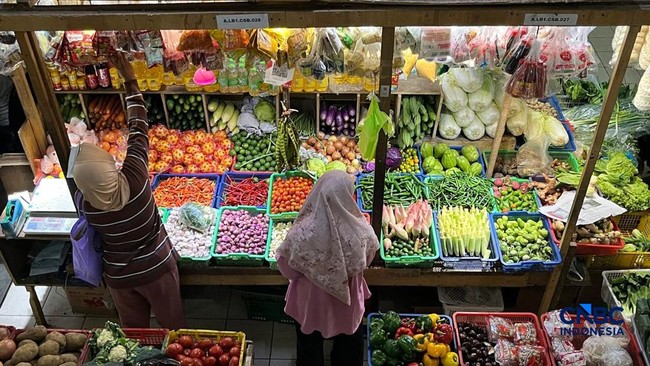
Jakarta, CNBC Indonesia - The Center of Reform on Economics (CORE) Indonesia has cautioned the Indonesian government to promptly anticipate potential price rises for goods, resulting from the continued pressure on the rupiah’s exchange rate against the US dollar and the unresolved conflict in the Middle East disrupting global trade activities.
Research Associate at CORE Indonesia and Professor in the Department of Economics at IPB, Prof Sahara, stated that at least 185 goods are at risk of price increases due to these external issues. These 185 goods have high import intensity during the production process.
“The combination of rising energy prices, adjustments to non-subsidised fuel prices, and the depreciation of the rupiah, based on our calculations, will drive price increases across 185 sectors in Indonesia, with the greatest impact felt in sectors highly dependent on imported inputs and energy,” said Sahara at the Quarterly Economic Review event on Wednesday (29/4/2026).
Sahara explained that imports with the highest intensity, such as wheat flour, starch, and starch products, exceed 55%; followed by alcoholic beverages and measuring instruments, photography, optics, watches, up to jewellery, already above 25%. There are also other metal goods, plastics, rubber, synthetic fibres, paints and printing inks, up to medical equipment, above 15%.
“Our calculations of import intensity across 185 sectors in Indonesia’s input-output table show that there are several sectors with high import dependency, including the wheat flour industry, measuring instruments, photography, jewellery, metal goods, including the plastics sector, whose price increases we have all felt together,” she elaborated.
Meanwhile, for the sectors, those potentially facing price increases due to the effects of non-subsidised fuel propelled by the Iran war with the US-Israel in the Middle East, particularly in the Strait of Hormuz area, up to the rupiah depreciation, include construction with a potential rise of around 3.56%. This is mainly due to high import content such as iron-steel, cement, heavy equipment, and mechanical electrical components.
Then, the provision of food and beverages, with a potential price increase of around 3.46%, caused by dominant imported raw materials for the processed food sector, such as wheat, soybeans, and sugar, plus distribution costs sensitive to fuel.
Ready-made clothing is also calculated to potentially experience a price increase of around 3.34%, basic iron and steel 2.59%, motor vehicle and motorcycle trade 2.31%, yarn 2.1%, government health services 2.02%, processed soybeans 1.97%, electricity 1.91%, plastic goods 1.68%, and textiles 1.67%.
For the electronics, communication, and accessories goods sector, around 1.65% potential increase, rail transport 1.71%, general government services 1.58%, motorcycles 1.56%, prime mover machines 1.45%, and jewellery 1.43%.
“The impact we have calculated is based on economic calculations, but the impact we are most concerned about is the psychological impact of these price increases,” said Sahara.
“For example, in food and beverages, our calculations show that economically the price rises only around 3.46%, but due to public panic and expectations, it could drive prices higher than the economic increase, thus making inflation larger,” she emphasised.
Bank Indonesia (BI) had previously forecasted potential global inflation due to ongoing geopolitical conflicts in the Middle East, between the US and Israel with Iran.
Senior Deputy Governor of Bank Indonesia (BI), Destry Damayanti, said that the global economy even risks experiencing stagflation, like during the Covid-19 period. Stagflation describes a condition where global economic activity will experience consistent slowdown but accompanied by increasing inflationary pressures.
Destry explained that this global stagflation risk emerged after the war between the United States and Israel with Iran has put pressure on various commodity prices, due to disruption of one of the world’s main oil and gas trade routes, the Strait of Hormuz.
“So this increases shipping and logistics costs, leading to global supply chain disruptions. In conclusion, global commodity prices rise, gold, coal, nickel, agriculture also rise. The latest is plastics due to supply chain issues, ultimately leading to production declines,” said Destry at the Central Banking Forum 2026 CNBC Indonesia in Jakarta on Monday (13/4/2026).
Destry explained that the rise in global traded commodity prices causing production declines will certainly hinder global economic activity, slowing the world’s GDP growth rate. However, this pressure occurs alongside high price increases due to supply disruptions, not high demand.
“The impact is that global GDP will slow but inflation will increase. This is called stagflation, not good. Policy responses become important,” said Destry.
In response to this global risk, Destry said that central banks around the world will take a cautious stance in formulating monetary policies together with their governments, through fiscal policies.
“Some countries’ fiscal policies will be loose. Monetary trends downward will be more cautious because now it’s a competition to make domestic assets attractive,” she revealed.