
Warning! Mpox Re-emerges, Now Affecting Children
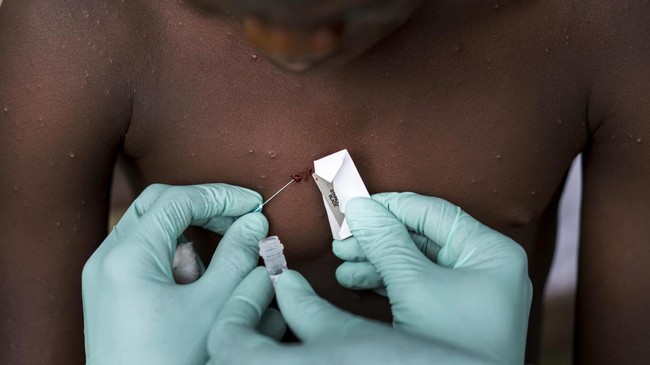
Jakarta, CNBC Indonesia - Mpox has once again drawn global attention after a new outbreak was detected in Guinea-Bissau. This marks the first time the West African country has reported cases of mpox.
The latest outbreak has raised fresh concerns, particularly because a significant number of children are suspected to be infected.
According to The Guardian, citing UNICEF data, of the 46 suspected cases identified in Guinea-Bissau, 23 involve children under the age of 15. Most of those in this group are even under four years old.
The emergence of these new cases follows two major mpox outbreaks in 2022 and 2024 that spread to various countries worldwide. Since 2022, nearly 190,000 laboratory-confirmed mpox cases have been reported across 145 countries.
Prior to that period, mpox outbreaks were generally small in scale and concentrated in a number of African countries, where the virus has long been endemic.
What Is Mpox?
Mpox is an infectious disease that typically begins with flu-like symptoms, such as fever, chills and muscle aches. A characteristic rash then appears on the skin. The rash usually starts as raised spots, then develops into fluid-filled blisters before eventually drying out and forming scabs.
The disease was previously known as monkeypox. The name emerged after the virus was first discovered in monkeys kept in captivity in 1958.
However, when the international outbreak occurred in 2022, concerns arose that the use of the term monkeypox could trigger stigma and racially charged language. The World Health Organization (WHO) subsequently recommended the use of the term “mpox”.
The virus is historically endemic in several regions of Africa. Initial transmission to humans has often been linked to the consumption of infected wild animal meat.
In recent years, the pattern of spread has changed. The virus has become increasingly capable of spreading through human-to-human transmission chains and has begun to be found outside its endemic regions.
The United States Centers for Disease Control and Prevention (CDC) even estimates that mpox could potentially become an endemic disease in the US.
Why Is Mpox Spreading to New Countries?
In general, there are two main groups of mpox known as clade I and clade II. Clade I was previously known as the Congo Basin clade, while clade II was known as the West African clade.
Clade II was the main cause of the global outbreak in 2022. The virus is believed to have undergone changes that made it more easily transmissible from one human to another.
Mpox transmission occurs through close physical contact. In the 2022 outbreak, most transmission was linked to sexual contact, with men who have sex with men being one of the groups at high risk.
Then in June 2024, researchers identified a new variant of clade I in the Democratic Republic of Congo (DRC). This variant also demonstrated a higher capacity for human-to-human transmission.
That outbreak developed into an international emergency. The WHO declared it a public health emergency of international concern on 14 August 2024. According to Professor Michael Marks of the London School of Hygiene & Tropical Medicine and University College London Hospital, the emergence of mpox in more West African countries is actually a predictable development.
Mpox can spread through close physical contact in various situations. Beyond sexual networks, transmission is also more likely to occur in crowded environments, including refugee camps and settlements where many people live in close proximity.
The 2022 global outbreak was declared a public health emergency in July of that year. After contact tracing and mass vaccination programmes were carried out, the emergency status was lifted in May 2023. By that time, around 90,000 infections had been reported.
Meanwhile, the international emergency status resulting from the 2024 outbreak was lifted in September 2025. The lifting of that status does not mean mpox has disappeared. The decision was taken because the number of cases and deaths had declined and the situation was deemed more under control.
However, international emergency status can be reinstated if genetic testing identifies a new variant or monitoring systems show that an outbreak is spreading very rapidly, causing more severe illness, or increasing mortality rates.
Why Is the Guinea-Bissau Outbreak Concerning?
Guinea-Bissau had never previously reported a case of mpox. Particular attention is now focused on children. Of the 46 suspected cases reported, 23 are children under the age of 15, and most are under four years old.
Dr Aula Abbara of Imperial College London and an adviser to Médecins Sans Frontières UK said children have a higher risk of severe illness and death from mpox. Children, particularly very young ones, can experience far more severe conditions than healthy adults.
Nevertheless, data on the high proportion of children in the Guinea-Bissau outbreak needs to be interpreted with caution. According to Abbara, there is a possibility of bias in the data.
Families tend to seek medical help more quickly when a child is ill than when an adult family member shows symptoms, especially in countries with limited health resources.
Environmental factors also play a role. Children have close physical contact with parents and other children. In areas with crowded living conditions, the likelihood of transmission increases.
Also of concern is that a number of confirmed cases do not appear to be linked to one another. This situation could indicate that the virus has spread more widely in the community and that there are still unidentified cases.
Are There Vaccines and Medicines?
The WHO recommends two types of mpox vaccines. Vaccines can be given to high-risk groups as well as to people who have recently been in contact with confirmed patients to prevent further spread.
However, the biggest challenge is vaccine distribution. Vaccine supplies are currently relatively more available in high-income countries. Conversely, low-income countries, which in many cases actually have greater needs and conditions conducive to transmission, face supply constraints.
A new global vaccine stockpile is also scheduled to begin rolling out within a few weeks. This mechanism is expected to accelerate vaccine delivery when new outbreaks emerge.
In addition, the global stockpile is expected to provide demand certainty to manufacturers so that they can plan and increase vaccine production. For treatment, the antiviral tecovirimat did not show better results than placebo in trials involving clade I mpox patients in the DRC.
However, questions remain as to whether the drug could provide benefits for certain groups, including patients with compromised immune systems such as people living with HIV.
Interestingly, the research showed that good supportive care can significantly improve patients’ chances of survival. Experts also consider vaccines to remain an important instrument in controlling mpox outbreaks. However, vaccination is not the only solution.
Early detection, laboratory testing, contact tracing, supportive care and strong public health surveillance systems are also needed to stop the spread.
“Vaccines are important, but outbreaks cannot be controlled with vaccines alone,” said Abbara.
She said the ability to detect cases as early as possible and to know who has been in contact with patients is key to preventing the formation of new transmission chains.
Source: jawawa.id (https://jawawa.id/newsitem/warning-mpox-re-emerges-now-affecting-children-1787806274)
Originally published by CNBC Indonesia (https://www.cnbcindonesia.com/lifestyle/20260827102639-33-762636/waspada-mpox-muncul-lagi-kini-menyerang-anak-anak), translated from Indonesian