
Warning: Entire Southern Coast of Java Lies Within Active Megathrust Subduction Zone
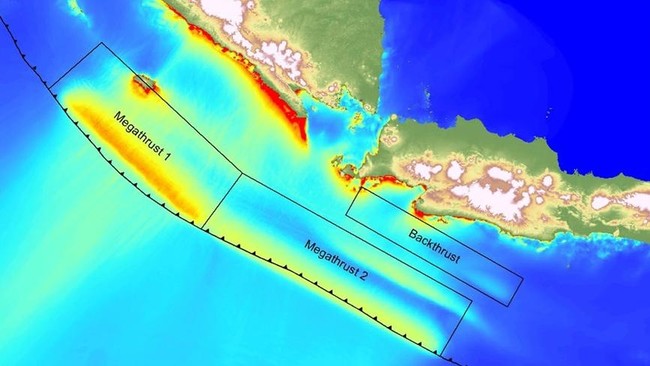
Jakarta, CNBC Indonesia - Experts are highlighting crucial lessons in anticipating earthquakes within the megathrust subduction zone. The entire Southern Coast of Java lies within the Megathrust Zone, a source of shallow-depth plate collision earthquakes. In this scenario, an oceanic plate subducting beneath a continental plate creates a stress field on the contact plane between the plates, which can suddenly slip and trigger an earthquake. If a quake occurs, the part of the continental plate above the oceanic plate is thrust upwards.
Daryono, a member of the Indonesian Association of Disaster Experts (IABI), reminded that the Pangandaran Tsunami on 17 July 2006 was a real megathrust threat. The tsunami was triggered by a megathrust earthquake of the tsunami earthquake type in the subduction zone south of Central and West Java. Daryono noted that the magnitude 7.7 earthquake generated a devastating tsunami that killed more than 668 people and left thousands more injured and homeless.
“The 2006 Pangandaran Tsunami event taught us that not all megathrust earthquakes produce very strong shaking,” Daryono said in a statement quoted on Saturday (18/7/2026). For the tsunami earthquake type, he explained, ground shaking on land can feel relatively weak, but the resulting tsunami is extremely destructive. Therefore, Daryono stressed that several lessons from the Pangandaran Tsunami are vital to understand.
First, he said, understanding the characteristics of the threat, recognising tsunami warning signs, and evacuating immediately after an earthquake—even if it feels weak in coastal areas—is key to saving lives. “Megathrust is not just a potential, but a real threat that must be faced with science, preparedness, and a culture of mitigation,” Daryono stated.
Second, a crucial point to understand is that a tsunami can occur even if the earthquake shaking is very weak. The Pangandaran earthquake, with a magnitude of 7.7, was a tsunami earthquake, meaning it generated a large tsunami but its shaking on land was relatively weak. As a result, many people remained on the beach because they felt the earthquake was “not dangerous”. “The lesson is, do not wait for a strong earthquake to be felt. If you are at the beach and an earthquake occurs, evacuate immediately,” Daryono said.
Third, he noted that the tsunami arrived very quickly. The tsunami waves reached the shore in just about 15-20 minutes after the earthquake, a period too short for the public to wait for official information. “The lesson for us is that carrying out a self-evacuation (natural warning) is far more important than waiting for an early warning system or an evacuation order siren,” Daryono stated.
Fourth, he conveyed that public education saves more lives than technology. Early warning systems, information applications, and sirens are indeed very important. “However, when the public understands the natural signs of a tsunami, they can save themselves even without technology. The lesson is that the best mitigation starts with a community that understands the risks,” Daryono explained.
Fifth, tourist beaches carry a far greater risk of casualties. When the tsunami struck, Daryono recounted, Pangandaran was crowded with tourists as it was late afternoon and the holiday season. Many victims were tourists or visitors unfamiliar with evacuation routes. “The lesson is that all coastal tourist destinations must have evacuation routes, evacuation signboards, evacuation drills, safe assembly points, and tsunami information for tourists,” he explained.
Daryono continued, the sixth lesson is that evacuation routes must be closer than the tsunami arrival zone. The height of the 2006 Pangandaran tsunami varied, reaching 5-8 metres in some places and even more than 10 metres in others. “The community has only a short golden window to survive. The lesson is that evacuation must be designed so that it can be reached on foot within a short time,” Daryono concluded.
Seventh, the largest number of casualties came from the tsunami, not the earthquake. The earthquake itself caused almost no damage at the time. It was the tsunami that claimed more than 668 lives. Daryono said this shows that the greatest danger on the southern coast of Java is not just the earthquake, but the tsunami. “The important lesson is that coastal mitigation must pay equal attention to the tsunami threat,” he stressed.
Eighth, Daryono reminded that a tsunami can occur along the entire southern coast of Java. The Pangandaran Tsunami event proved that the entire southern coast of Java lies within an active megathrust subduction zone. The areas affected at that time included Pangandaran, Tasikmalaya, Garut, Cilacap, Kebumen, Purworejo, and Bantul. The lesson, Daryono said, is that all southern coastal districts of Java must have a tsunami-ready culture and community. Casualties can be minimised through preparedness for megathrust earthquakes that trigger tsunamis.
The ninth lesson, twenty years after Pangandaran, Daryono assessed that Indonesia now has a tsunami early warning system, tsunami hazard maps, evacuation routes, earthquake and tsunami field schools, and UNESCO Tsunami Ready communities in several areas. However, Daryono stressed that the job is not finished. “The greatest lesson is that the success of tsunami management is not measured by how many victims are saved after a disaster, but by how few victims need to be saved because the community was already prepared before the tsunami arrived,” he asserted.
Furthermore, Daryono concluded that the Pangandaran Tsunami disaster became an important milestone that drove the strengthening of the national tsunami early warning system and the improvement of coastal community preparedness culture. Here are the key messages the public must understand, according to Daryono: 1. Twenty years after Pangandaran is not just about remembering the victims, but a reminder that a tsunami will always be a real threat on the southern coast of Java.