
War Triggers Price Increases, Can BI Rate Still Fall?
The war in the Middle East between Iran, the United States, and Israel has caused fluctuations in energy prices such as oil fuels, often breaching the US$100 per barrel range.
Several international institutions forecast that the rise in fuel prices, as the main source of transportation mobility, could trigger spillover effects that push up the prices of goods.
Nevertheless, in Indonesia, this price pressure, according to Investment Director of Sucor Asset Management, Dimas Yusuf, will not worsen inflationary pressures to the point that Bank Indonesia (BI) must close the door on lowering the BI Rate.
This is particularly because inflation remains under control, even though there was an increase in the first two months of 2026, more due to a low base factor from electricity tariff discounts. Annual inflation was recorded at 3.55% in January 2026, and 4.76% in February 2026.
“So if we exclude the impact that can be called one-off earlier, the inflation trend we see is rising, although actually compared to the increase it can be said to be a trade-off,” said Dimas on the Power Lunch CNBC Indonesia programme, Monday (30/03/2026).
In addition, he reminded that under the leadership of President Prabowo Subianto, financial market players have captured clearer signals that inflation figures will be optimised to support economic growth.
“We know that the current government has a different direction compared to the previous government. Perhaps more permissive towards slightly higher inflation levels, but as a trade-off we hope to see economic growth data that is higher than before,” he stated.
Therefore, he predicts that for the central bank, the risk of price increases due to energy commodity volatility amid the war will not halt the trend of lowering the benchmark interest rate this year.
Moreover, the US central bank, the Federal Reserve or The Fed, also faces pressure to maintain the trend of lowering its benchmark interest rate, because unemployment figures under President Donald Trump’s leadership continue to rise.
“This might be one of the concerns for The Fed and giving them more pressure to still lower the benchmark interest rate even with much more limited room than before. For Indonesia, in my opinion, with the current inflation level, it is still within a tolerable range,” Dimas emphasised.
Nevertheless, BI had previously warned of the potential for rising prices or inflation due to the Middle East conflict and the onset of a prolonged dry season in Indonesia.
BI Deputy Governor Aida S. Budiman explained that specifically for the Middle East conflict erupting due to US and Israeli attacks on Iran, it could trigger inflationary pressures in Indonesia from global supply chain disruptions to commodity price pressures, such as in the energy sector.
“This will certainly have an impact on inflation, especially from the supply side or from rising commodity prices. That’s what we need to watch,” said Aida at the virtual press conference on the Board of Governors’ meeting results, Tuesday (17/3/2026).
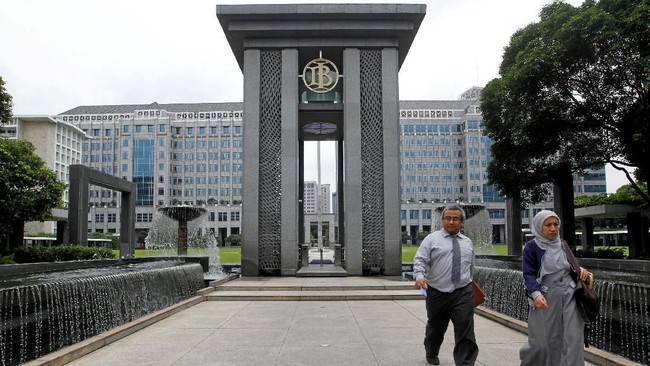
Bank Indonesia Governor Perry Warjiyo has also signalled a focus on holding the BI benchmark interest rate going forward.
Considering the effects of the Middle East war that risk pressuring economic growth, driving inflationary pressures, and drawing foreign capital outflows. Followed by the rupiah exchange rate’s ongoing volatility.
“Because the impact of the Middle East war is why in the current statement (RDG results) we no longer mention the possibility of lowering interest rates,” said Perry at the virtual press conference on the Board of Governors’ meeting results, Tuesday (17/3/2026).