
War Intensifies: Ukraine and Russia Control 91% of Global Drone Imports
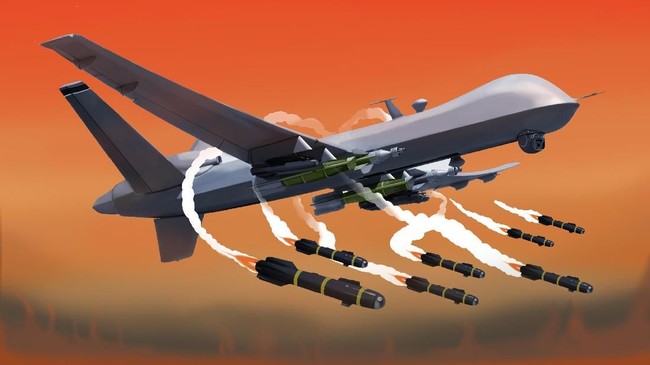
The war between Russia and Ukraine has fundamentally altered the face of modern combat. Drones, previously used primarily for reconnaissance, have evolved into lethal weapons capable of attacking troops, armoured vehicles, ammunition depots, and critical infrastructure.
Their usage continues to expand. Nations are not only developing their own drones but are also importing them from abroad through purchases, military aid, or production under foreign licences. According to data from Visual Capitalist, based on the Stockholm International Peace Research Institute (SIPRE), 16,822 military drones were recorded moving between countries throughout 2022-2025. More than 91% of these flowed to the two warring nations: Ukraine and Russia.
Ukraine holds the top position, having received 8,664 military drones from foreign suppliers. This figure represents 51.5% of all recorded global military drone shipments over the four-year period. Ukraine’s supply is heavily dependent on the United States, with US-made systems accounting for approximately 83% of all foreign military drones received by the country.
Russia follows in second place with 6,720 units, or 39.9% of the global total. Unlike Ukraine, all Russian drone imports recorded by SIPRI originated from Iran. Most of these are Shahed-136, one-way attack drones that carry explosives and strike targets directly. Russia initially imported these drones from Iran before developing and producing its own version, known as the Geran-2.
SIPRI estimates that Iran has supplied approximately 7,000 Shahed-136 drones to Russia. However, Russia is now capable of producing its own version, which is expected to reduce the need for Iranian assistance.
The gap between the top two nations and the rest of the world is vast; no other country received more than 300 military drones during this period.
Outside of Russia and Ukraine, Taiwan is the largest recipient of foreign military drones. In 2025, Taiwan received 291 US-made loitering munitions. These weapons can fly to search for targets before crashing into them and exploding, a mechanism that often leads to them being referred to as ‘kamikaze drones’.
Experience from the war in Ukraine has prompted Taiwan to strengthen its drone fleet. The Taiwanese government even plans to procure up to 200,000 drones over the next decade, a figure nearly 12 times greater than the total number of military drones recorded in international trade between 2022 and 2025.
The actual figures are likely much higher. The 16,822-unit figure does not represent the entirety of global military drone trade. SIPRI only tracks major weapon transfers, including drones with a minimum payload weight of 150 kilograms. One-way attack drones and loitering munitions are included but categorised under missiles, which accounts for approximately 97% of the shipments in the list.
Conversely, most small first-person view (FPV) drones are not included in these calculations, despite the massive quantities of these inexpensive, camera-controlled drones being used on the Ukrainian front lines. For instance, the United Kingdom sent over 85,000 small military drones to Ukraine in just six months in 2025—roughly five times the total global shipments recorded by SIPRI over four years.
Drones produced entirely domestically are also excluded, as SIPRI only records weapons crossing national borders or produced under foreign licences. Ukraine’s domestic defence industry capacity has now exceeded 8 million FPV drones per year, with over 160 companies involved in production, ranging from large factories to specialised unmanned system developers.
Russia is also continuously expanding its domestic production. Ukrainian intelligence estimates that Russia can produce approximately 2,800 Geran-2 drones per month, far exceeding the 2,000 units per year recorded by SIPRI as production under Iranian licence. This discrepancy suggests that official military drone trade records only capture a small fraction of the true volume on the battlefield. Behind the thousands of large-scale drones moving between nations, millions of small drones continue to be produced and deployed directly by the warring states.
Source: jawawa.id (https://jawawa.id/newsitem/war-intensifies-ukraine-and-russia-control-91-of-global-drone-imports-1790347974)
Originally published by CNBC Indonesia (https://www.cnbcindonesia.com/research/20260925151610-128-770977/perang-makin-ngeri-ukraina-rusia-kuasai-91-impor-drone-dunia), translated from Indonesian