
Waqf Land for Sustainable Agriculture: Green Waqf Promotes Self-Reliance and Environmental Conservation
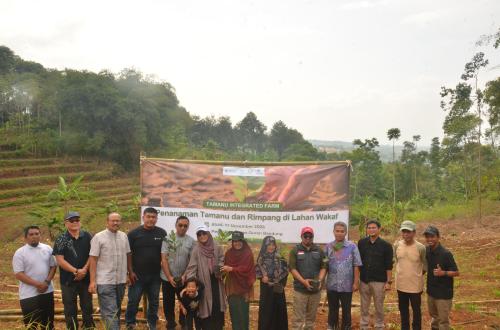
BANDUNG — The use of waqf land to empower communities and restore the environment is being promoted through collaboration. Green Waqf and the Waqf Center of Indonesian Development and Studies (WaCIDS), in partnership with Sekolah Tani Indonesia and PT Majoris Asset Manajemen, held a Tamanu and rhizome planting activity on waqf land at Tunas Quran Islamic Boarding School in Bandung on Sunday (1 November 2026).
The activity forms part of efforts to optimise waqf land for the empowerment of Islamic boarding schools and environmental restoration. It was attended by several village officials and representatives of non-governmental organisations, including Relawan Nusantara, Lokadesa and Tropisme, as well as PT Cinquer Agro Nusantara (CAN).
Waqf land, long associated with the “3Ms” — mosques, madrasahs and cemeteries — also has the potential to be developed for sustainable agriculture. By planting Tamanu and rhizome crops, Green Waqf aims to extend the benefits of waqf assets, adding value for both the boarding school environment and the surrounding community.
Green Waqf coordinator Lisa Listiana said the choice of Tamanu aligns with the movement’s vision. “We want waqf land to provide ecological as well as economic benefits for Islamic boarding schools and nearby communities. Tamanu seeds have the potential to be processed into a versatile oil that can be used in various industries, from renewable energy and pharmaceuticals to natural beauty products such as soap and anti-ageing creams,” she said.
The selection of Tamanu and rhizome plants also takes account of their long-term uses. Tamanu offers economic value through its seeds, which can be processed into versatile oil, while rhizome crops could be developed as agricultural commodities that communities can cultivate and use over a shorter period. The combination is expected to diversify crops on waqf land and support productive economic activity at the boarding school.
Fatoni Saputra, founder of Sekolah Tani Indonesia, said its Santri Tani programme encourages Islamic boarding schools to become learning spaces that equip students with practical skills and economic independence.
“The programme gives students farming skills so they can make the most of local resources to meet the needs of nearby communities. Through this activity, boarding schools also have the opportunity to develop a source of income from agricultural produce and strengthen food self-sufficiency at the local level,” he said.
The initiative is also driven by concern over environmental conditions, particularly in the upper reaches of Mount Malayang, where vegetation cover has declined and critical land has expanded. These conditions, coupled with the threat of forest and land fires, could affect ecosystem balance and the lives of communities downstream.
Planting vegetation suited to the land, alongside ongoing maintenance, is therefore one way to help restore the area’s ecological functions. The involvement of Islamic boarding schools and local communities is also expected to foster a shared commitment to environmental conservation.
Source: jawawa.id (https://jawawa.id/newsitem/waqf-land-for-sustainable-agriculture-green-waqf-promotes-self-reliance-and-environmental-conservation-1793782331)
Originally published by Republika (https://halalhub.republika.co.id/berita/tnywy9502/lahan-wakaf-untuk-pertanian-berkelanjutan-green-waqf-dorong-kemandirian-dan-kelestarian-lingkungan), translated from Indonesian