
Waqf Forests Can Prevent Wildfires and Provide Income for Local Residents
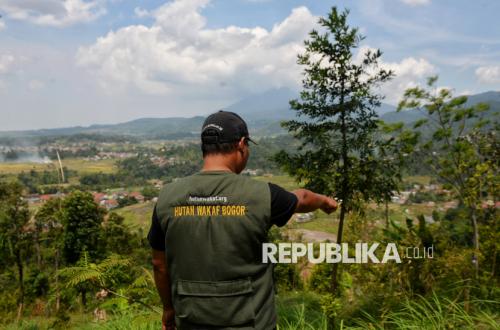
JAKARTA — Involving local communities in the management of waqf forests is considered a potential strategy for preventing forest and land fires. As well as conserving forests, the scheme provides residents with economic benefits from harvests, giving them a direct interest in protecting the forest from fires.
Khalifah Muhammad Ali, head of the Department of Islamic Economics at IPB University’s Faculty of Economics and Management and an advocate for waqf forests, said community involvement was an important factor in protecting forest areas. He said the waqf forest area he manages had not experienced a fire to date.
“Frankly, we have never had a forest fire in our area, but I think waqf forests are one way to prevent them,” Khalifah said at a public discussion entitled ‘The Role of Zakat, Infaq, Sadaqah and Waqf in Disaster Mitigation and Environmental Recovery’, organised by students on the Islamic Economics specialisation of Universitas Paramadina’s master’s programme on Sunday (25 October 2026).
Khalifah explained that waqf forests are managed with the participation of people living nearby. This is intended to foster a sense of ownership while providing economic benefits from forest resources.
Residents can, for example, earn income through the sharing of harvests of durian, cloves, petai and jengkol. Forest fires therefore not only damage the environment but could also deprive communities of a source of livelihood.
Khalifah said this approach could complement government efforts to prevent forest and land fires. Protecting forest areas, he said, cannot rely solely on officials and government monitoring; it also requires the involvement of communities that directly benefit economically from the forest.
“In my view, the key to preventing forest fires is that the line of defence must not be only the government. Forest rangers and the Ministry of Forestry are certainly important, but local communities also need attention, so that they cannot easily be persuaded by certain parties to burn forests,” he said.
Ali Bastoni, general manager of waqf fundraising at Dompet Dhuafa, said waqf forests could be a model for managing land in ways that support fire prevention. Clear land status and the presence of a manager, he said, can help ensure forest areas are maintained and monitored.
Ali explained that the principle of waqf places the public good at the centre of asset management. Waqf forests are therefore not intended solely to generate economic returns, but also to protect the environment.
“Clear status means that waqf forests will certainly be closely associated with conservation, unless the waqf has become capitalist. The principle of waqf is public benefit, not merely profit,” Ali said.
He said forest and land fires were a complex issue involving competing interests in land use. Ali also suggested that human activity was one factor that should be examined when considering the causes of fires.
“My hypothesis is that they are deliberately started. In fact, during the Covid-19 pandemic there were no forest and land fires because people were in lockdown, so no one was burning the forests,” he said.
Ali also drew attention to fires in concession areas and land targeted for business expansion. He said changes in land use after fires should be scrutinised as part of fire prevention efforts.
Productive waqf, in addition to supporting land management, could also help provide resources for disaster response. Ali cited the proceeds from Dompet Dhuafa’s productive waqf, which have been used to provide water tankers.
The tankers can help fight fires and supply water to communities during droughts. Using waqf proceeds for these purposes demonstrates the potential of Islamic social finance instruments to address environmental challenges.
“The water tanker, funded by waqf proceeds, is also used to help people affected by drought,” he said.
Sunaryo, head of Universitas Paramadina’s master’s programme in Islamic Studies and Civilisation, said zakat, infaq, sadaqah and waqf (Ziswaf) could contribute to environmental sustainability. The social and economic benefits of Ziswaf, including its role in disaster prevention, should be supported by academic research, he said.
“Ziswaf activities make a tangible contribution to surrounding communities in social and economic terms. It has also been said that they can help anticipate forest and land fires; this contribution needs to be established through academic research,” Sunaryo said.
The discussion also featured Rumah Zakat chief executive Irvan Nugraha, who discussed Ziswaf’s role in climate action and environmental recovery. Indonesia Zakat Watch coordinator Barman Wahidatan Anajar and Fauziah, a senior researcher at BRIN’s Centre for Religious and Belief Research, also presented perspectives on disaster mitigation and community recovery through Islamic social finance.
Source: jawawa.id (https://jawawa.id/newsitem/waqf-forests-can-prevent-wildfires-and-provide-income-for-local-residents-1792925456)
Originally published by Republika (https://esgnow.republika.co.id/berita/tngj7a416/hutan-wakaf-bisa-cegah-karhutla-sekaligus-jadi-sumber-penghasilan-warga), translated from Indonesian