
WANTRII: AI Adoption in Manufacturing Must Be Matched by Cybersecurity
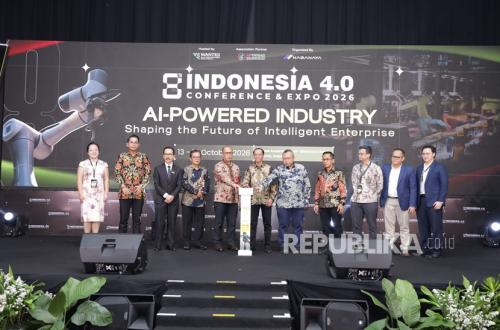
JAKARTA — The adoption of artificial intelligence (AI) in the manufacturing industry must be matched by stronger cybersecurity. While the technology offers opportunities to improve productivity, it also brings risks of cyberattacks that need to be anticipated from the outset of digital transformation.
Fadli Hamsani, chair of the Indonesian Industry Digital Transformation Council (WANTRII), said industrial transformation could no longer be measured simply by whether technology was being used. Companies needed to ensure that technology delivered tangible improvements in productivity and competitiveness, while also mitigating the risks involved.
“The question now is no longer whether AI is being used. It is what impact AI is having, and how its risks are being mitigated,” Fadli said at the Indonesia 4.0 Conference & Expo 2026 in Jakarta on Tuesday (13 October 2026).
Fadli said efforts to strengthen industrial transformation should focus on three areas: human resources, business processes and technology. On the workforce side, training and mentoring are needed to improve skills and enable employees to use technology appropriately.
On processes, industry players should share best practices in technology implementation. Companies should also assess the extent to which technology is improving operations and productivity.
Fadli said that since the launch of the Making Indonesia 4.0 roadmap in 2018, more than 1,300 companies had undergone readiness assessments through the Indonesia Industry 4.0 Readiness Index (INDI 4.0). The Ministry of Industry has also designated 29 national lighthouses, which are expected to serve as models for industrial transformation.
However, he said AI adoption in Indonesia remained at an early stage, particularly at enterprise level. Citing McKinsey data, Fadli said about 85 per cent of AI adoption worldwide was still used to support human work, while adoption at enterprise level stood at around 30 per cent.
WANTRII and relevant stakeholders are therefore promoting the development of AI ethics guidelines for industry and cybersecurity guidance. The initiative is expected to help companies adopt technology more safely and expand its use.
Muhammad Neil El Himam, deputy for digital creativity and technology at the Ministry of Creative Economy, said AI had three roles that needed to be understood: as a technology that boosts productivity, as a tool used by criminals, and as a technology that could itself be targeted in attacks.
Neil said AI could improve work efficiency and effectiveness. The same technology, however, could also extend the reach of cyberattacks and make them faster and more efficient.
“The issue now is how to raise awareness among the workforce so that, when using AI, we also mitigate its risks, and how we provide alternative solutions to attacks that use AI,” Neil said.
He said raising user awareness was essential to addressing those risks. AI-enabled attacks could impersonate convincing communications, such as a phone call that appears to come from a family member or a workplace superior.
Neil said capacity-building and digital literacy needed to be developed in partnership with industry and government agencies. The availability of technology must be matched by user understanding so people can identify potential threats and take preventive action.
Albertus Rachmad Wibowo, deputy head of Indonesia’s National Cyber and Crypto Agency (BSSN), also spoke about securing Indonesia’s industrial transformation in the Industry 4.0 era. According to an event release, he stressed that cybersecurity should be the foundation of digital transformation to maintain trust in the national industrial ecosystem.
The government is also seeking to strengthen the domestic technology-company ecosystem. Neil said support for local AI businesses should go beyond incubation to include business acceleration and the facilitation of meetings with prospective customers, allowing local firms to demonstrate their technological capabilities.
He also highlighted the importance of intellectual property protection as AI use grows. Using AI as an aid, he said, should still leave human creativity and control central to the creation of works.
The issue is also a concern for the media sector. Neil pointed to AI-powered search engines using journalistic content to provide users with direct summaries of information. This could reduce traffic to news websites and affect media monetisation.
Deng Genxian, vice-president of PT RJGF International Indonesia, said developments in AI and digital technology offered manufacturers opportunities to improve operational efficiency, productivity and competitiveness.
He said collaboration between technology providers and industry was needed to accelerate this transformation. By participating in the Indonesia 4.0 Conference & Expo 2026, his company hoped to exchange insights, explore potential partnerships and contribute to the development of Indonesia’s manufacturing ecosystem.
As part of the event, WANTRII and PT RJGF International Indonesia were also scheduled to sign a memorandum of understanding (MoU) to strengthen collaboration in Indonesia’s industrial ecosystem and digital transformation.
Discussions on AI adoption, digital transformation and cybersecurity formed part of the Indonesia 4.0 Conference & Expo 2026, held in Jakarta on 13–14 October 2026. The event brought together manufacturers, technology-solution providers, government representatives and other stakeholders to discuss the application of technology in industry.
Source: jawawa.id (https://jawawa.id/newsitem/wantrii-ai-adoption-in-manufacturing-must-be-matched-by-cybersecurity-1791930041)
Originally published by Republika (https://ekonomi.republika.co.id/berita/tmugt5349/wantrii-adopsi-ai-di-industri-manufaktur-perlu-diimbangi-keamanan-siber), translated from Indonesian