
Wall Street Tumbles, US Treasury's Debt-Reduction Strategy Fails Completely?
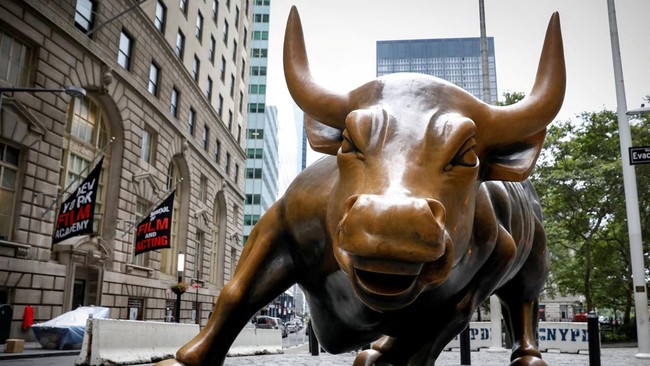
Wall Street was once again rattled. US stock and bond markets both plunged in trading on Thursday (20/8/2026), even though the US Treasury Department had deployed a bond buyback strategy to curb the surge in borrowing costs.
Treasury Secretary Scott Bessent’s move to expand buybacks of government debt briefly cooled Treasury yields this week. But the effect was short-lived, with the 10-year bond yield climbing back to 4.697%, near its highest level in recent years.
Citing a report from The Wall Street Journal, LPL Financial Chief Fixed Income Strategist Lawrence Gillum said the buyback measure is nothing more than a temporary solution that does not address the root of the problem.
Pressure in the bond market spilled over into equities. Retail giant Walmart reported its weakest sales growth in six years, reinforcing signals that US consumer purchasing power is beginning to weaken. Consumption is the main engine of growth for the US economy.
Walmart shares tumbled 9.2% and dragged major Wall Street indices lower, with the Dow Jones Industrial Average down 1.3%, the Nasdaq Composite down 1% and the S&P 500 down 0.9%.
Tech giants such as Nvidia and SpaceX also came under pressure because both rely heavily on debt to finance massive expansion of AI data centres.
A day earlier, on Wednesday (19/8/2026), the quantitative trading world was also shaken by its own drama. Biotech stock Moderna soared 177% after its cancer therapy results were deemed highly promising, leaving short sellers who had bet the stock would fall nursing heavy losses.
Morgan Stanley dubbed the phenomenon the “MRNA squeeze”. According to Goldman Sachs, it was the worst day in more than two years for systematic long-short fund managers, with average losses of 1.4% in a single day, although they were still up 1.7% on a monthly basis.
Besides Walmart, results from other retail giants such as Target, TJX, Home Depot and Lowe’s also painted a mixed picture of the American consumer. Lowe’s CEO Marvin Ellison acknowledged that middle-class consumers remain cautious about spending, and not just because of fuel prices.
Fuel prices are indeed one of the concerns. According to research from Brown University’s Climate Solutions Lab, Americans are estimated to have spent an additional US$88 billion on petrol and diesel throughout 2026 due to energy shocks linked to the Iran war. Crude oil prices rose again, with Brent jumping 2.4% to US$93.78 per barrel on Thursday.
Even so, not all signals are negative. Data from the Bank of America Institute showed discretionary spending by lower-middle income groups actually accelerated in July, while spending by the wealthiest 5% slowed slightly after a long climb.
This “not too hot, not too cold” economic condition is seen as keeping inflation in check and sustaining stock market optimism throughout the year. Investors have begun to scale back expectations of a Federal Reserve rate hike in 2026, which has helped boost semiconductor and memory chip maker stocks recently.
Wilmington Trust Chief Economist Luke Tilley said the US economy is currently at a balanced point — strong enough to avoid recession, but not hot enough to trigger higher inflation.