
Walking Through History: A Free Tour Explores the Hidden Stories of Sunda Kelapa
That afternoon, small steps began moving from the Old Town plaza towards the north. The sun had not yet fully set, but its light had already softened, casting long shadows between the old buildings. A group of more than a dozen people walked slowly, tracing a route that to some might appear merely part of a busy city, but for those joining the tour that day, every corner held a story.
More than a dozen people began gathering in the Old Town area on Saturday, 4 July 2026. Some came alone, others in pairs, all wearing the same expression: curiosity. It was not yet three o’clock, but the atmosphere already felt alive. They stood around the meeting point, exchanging small smiles, occasionally checking their phones to make sure they had the right schedule. That day, detikX joined the afternoon session of the Free Guided Walking Tour on the Historical Port of Sunda Kelapa route, led by a guide already waiting with a list of participants in hand.
The Free Guided Walking Tour programme is not new. Since 2023, it has been run by the Old Town Jakarta Management Unit (UPK Kota Tua) under the Jakarta Tourism and Creative Economy Department (Disparekraf DKI Jakarta). In recent years, however, its profile has grown noticeably. Participant numbers keep rising, the routes have become more varied, and public enthusiasm continues to increase.
Once all participants had assembled, the tour began with a brief introduction. Without much ceremony, the group set off from the heart of the Old Town. The walk slowly made its way along the streets, leaving the colonial buildings behind and heading north. The first stop was Cengkeh Street, a road now busy with traffic but which holds a long history as a spice distribution route during the Batavia era. This was where the journey truly began, as footsteps met layers of history that had perhaps previously been heard only as stories.
At the centre of the group, a guide walked slightly ahead. His voice was not particularly loud, but it was enough to make participants slow their pace and draw closer. He was Haidar Husein, a tourism expert guide for Jakarta’s Old Town.
He did not launch into a lengthy monologue. He allowed a few seconds to pass, as if wanting participants to truly see, not merely pass by. Only then did he explain that this area was once a spice distribution route. The name “Cengkeh”, meaning clove, was no coincidence. It was a marker of an era when that commodity was at the centre of a global struggle for power.
“Through this programme, especially the Sunda Kelapa route, we educate people that Europeans and the Dutch came here in search of spices. This place was the starting point of how they entered Batavia,” he said.
That sentence opened up layers of history that are often overlooked. The road, now filled with vehicles, was once part of the global trading system. There are no more sacks of spices being carried, but their traces remain in the area’s name and function.
The journey continued to the Amsterdam Gate. The old structure stood calmly, almost hidden amid the city’s development. Not everyone passing by realises the importance of the place.
In front of the gate, Haidar began to unravel the story of Kasteel Batavia, the great fortress that was once the centre of VOC power. The gate was only a small part of a vast complex that no longer exists. He explained how the VOC built Batavia with the ambition of making it the “Amsterdam of the East”. Over time, however, the fortress was dismantled. Only fragments remain, such as the gate that now stands alone.
The group then moved on to the VOC’s eastern warehouse. The building looked sturdy, with thick walls bearing the traces of time. There were few ornaments, but that was precisely where its strength lay. Haidar explained that the warehouse was used to store various commodities before they were shipped to Europe. He also touched on the building materials, some of which came from the Netherlands or were made using techniques characteristic of Europe.
The explanation meant participants no longer saw the building as merely an old warehouse. It became part of a global trading network that once connected Batavia with the world.
The tour’s dynamics were not limited to grand buildings, however. On entering Kampung Tongkol, the atmosphere changed dramatically. The streets narrowed, houses stood shoulder to shoulder, and life felt closer. This was where the tour began to feel personal.
One participant, Olivia Senorita, walked along while occasionally taking in her surroundings. The 30-year-old had come from Bekasi. She works in food and beverage, but has a particular interest in activities such as walking tours. That morning, she had already joined another tour with Jakarta Good Guide.
“I first found out about it on Instagram while scrolling, and it suddenly appeared in my feed. It happened to be opening the Sunda Kelapa route, and it was on my wishlist, so I just signed up,” she said when asked why she had joined the afternoon walking tour.
As the group passed through Kampung Tongkol, she appeared even more enthusiastic. She observed the surrounding environment, as if trying to connect the stories she had just heard with the reality before her eyes.
“There was this place called Kampung Tongkol. If I hadn’t joined this tour, I would never have known that there’s a kampung called Kampung Tongkol in Jakarta. By joining the tour, I got a different perspective on Jakarta’s historic buildings.”
The walking tour opened access to spaces she might never have visited on her own. The journey then reached its climax at the Port of Sunda Kelapa.
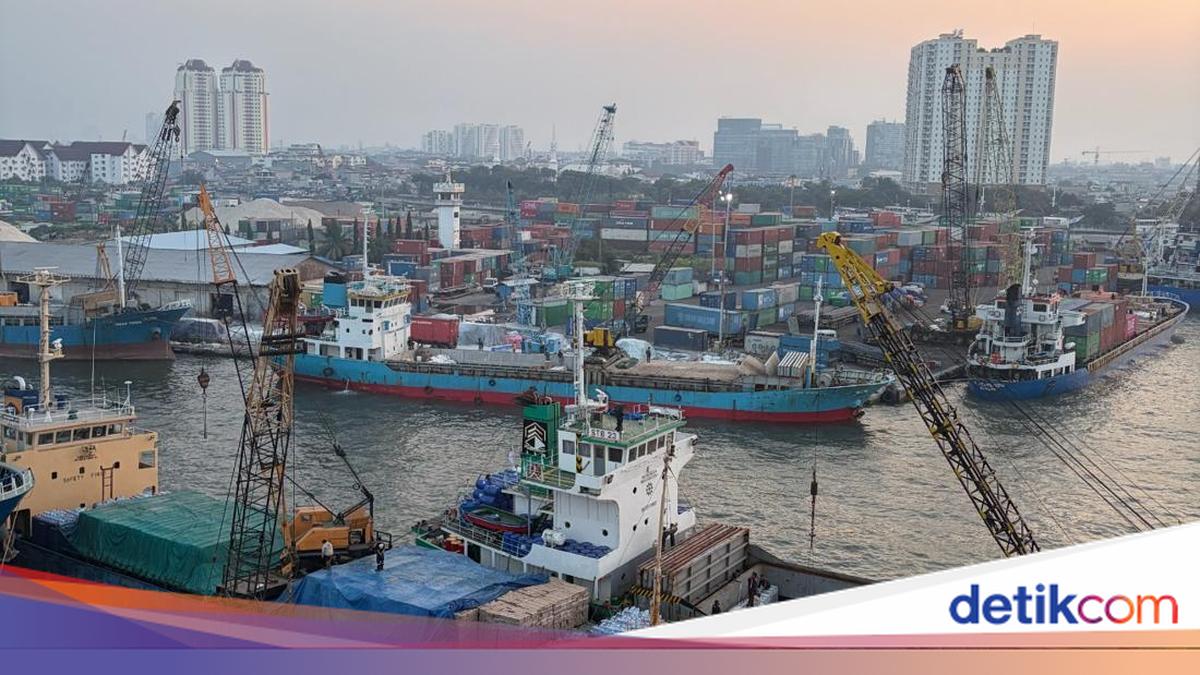
Towards the end of the tour, participants continued on foot to Batavia Marina, a closing that felt perfect after a long journey full of stories. The atmosphere immediately grew calmer. Participants were asked to go up to the fifth floor, a spot that had been talked about all afternoon as the most anticipated moment. And indeed, from up there, Jakarta Bay stretched out wide and unobstructed. The sun slowly descended, creating gradients of orange reflected on the sea’s surface, with the silhouettes of ships in the distance. Rows of pinisi ships stood majestically along the quay.
“It turns out that from here we can also see the tongkang barges used to transport coal to Kalimantan, which berth at this Port of Sunda Kelapa. I only just found that out,” said Olivia as she enjoyed the sunset.
The walking tour may have lasted only about two hours. Yet in that short time, participants were taken through hundreds of years of history, seeing how the past and the present meet.
The UPK Kota Tua’s Free Guided Walking Tour has become an increasingly popular tourism option because it is free, open to the public, and available every day, on both weekdays and weekends. At no cost, visitors can experience exploring the historic area in a more vivid and meaningful way. The tour is divided into two daily sessions: mornings at 09.30 WIB and afternoons at 15.00 WIB, each lasting roughly 90 to 120 minutes. During that time, participants walk through various key points of the Old Town, accompanied by professional guides who not only know the history but can also tell the stories in an engaging and accessible way.
To join the tour, prospective participants simply register via the form link available on UPK Kota Tua’s official Instagram profile, @kotatua.jkt. Interestingly, the routes are not always the same each week. A rotation system ensures every visit feels different. Among the routes on offer are exploring the Old Town area, tracing the canals and former walls of Batavia, uncovering another side of Chinatown Glodok, and following the historical trail of the Arab quarter of Kampung Pekojan. This variety gives visitors the chance to get to know Jakarta from many angles, and makes the tour worth joining more than once.
Source: jawawa.id (https://jawawa.id/newsitem/walking-through-history-a-free-tour-explores-the-hidden-stories-of-sunda-kelapa-1784436684)
Originally published by detikcom (https://news.detik.com/intermeso/d-8580370/jalan-kaki-menyusuri-sunda-kelapa), translated from Indonesian