
Walhi: South Kalimantan Not Yet Free from Haze and Climate Crisis
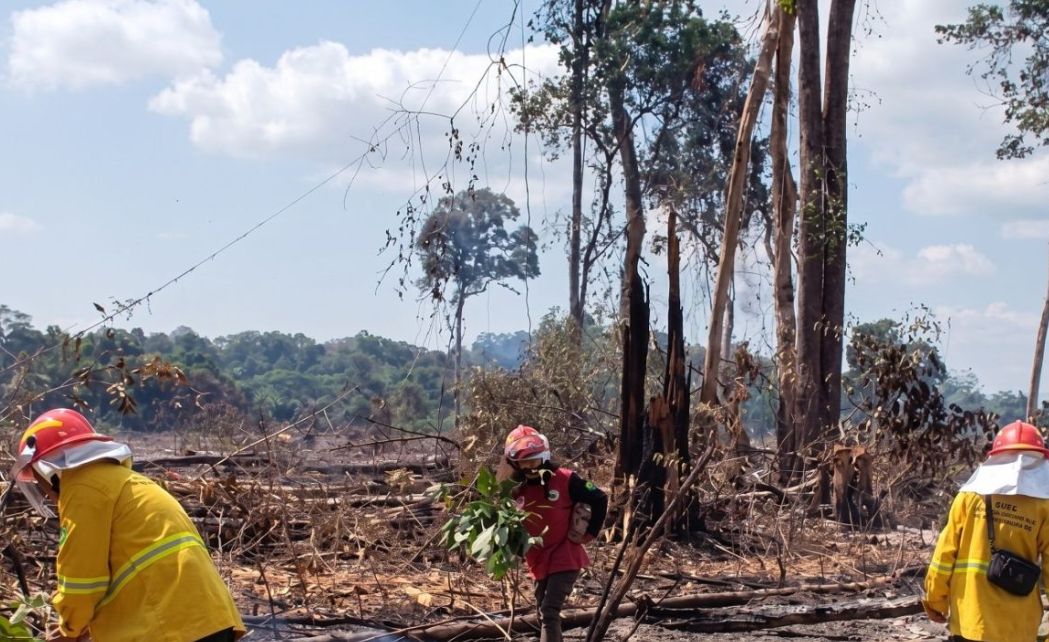
Forest and land fires (Karhutla) continue to spread and haze increasingly threatens public health in South Kalimantan Province. On the occasion of the 81st anniversary of the Republic of Indonesia’s independence, the Indonesian Forum for the Environment (Walhi) is urging regional leaders to overhaul and evaluate the governance system for mitigating and handling ecological disasters in South Kalimantan.
“Looking at the intensity of disasters that occur every year, such as the current forest and land fires and haze, it shows that South Kalimantan is not yet free from the climate crisis, smoke and other ecological disasters,” said Walhi South Kalimantan Executive Director Raden Rafiq Wibisono on Tuesday (18/8).
Walhi recorded that throughout the dry season, from May to August 2026, the distribution of hotspots detected through VIIRS NOAA-21 satellite imagery reached 3,520 hotspots in South Kalimantan. The province has experienced forest and land fires covering 4,582 hectares, causing widespread haze. Beyond the impacts of climate change and the El Niño phenomenon, Walhi South Kalimantan views this as an alarm signalling that the environmental ecosystem has lost its carrying capacity and resilience.
Analysis of Walhi South Kalimantan data using VIIRS NOAA satellite imagery overlaid with concession area data also shows that from May to July 2026, around 71 per cent of hotspots were located within corporate concession areas. Among them, 875 hotspots were in mining concessions and 32 hotspots were in oil palm plantation concessions.
“This data and information also strengthens the suspicion that there has been no comprehensive mitigation effort from either the regional government or the companies that should be responsible for their concession areas,” said M Jefry Raharja of Walhi South Kalimantan’s Advocacy, Campaign, Education and Cadre Development Division.
Many disaster response efforts are in fact supported by a network of volunteers who are quick to tackle fires spreading across various hotspots. For this reason, the regional government must fully support this volunteer ecosystem and provide space and access for their involvement, not only in technical response matters but also in formulating the direction of disaster mitigation policy, especially for ecological disasters.
“The regional government must not only improve the governance of ecological disaster mitigation, but must also immediately overhaul the system of supervision, evaluation and action against companies that are among the causes of landscape change and degradation of environmental quality,” said Jefry.
Forest and land fires are no longer events caused solely by natural factors. More broadly, we can see how the environmental governance system and the political will of policymakers shape the prioritisation of prevention and handling. As has occurred in corporate concession areas, several companies have engineered water management systems, causing changes to the natural characteristics and functions of essential peat swamp ecosystems.
For example, water canal engineering carried out by palm oil companies in South Kalimantan is suspected of causing or worsening drought in the dry season and worsening flooding in the rainy season. One of the affected areas is a food production region in Jejangkit District, Barito Kuala Regency.
Source: jawawa.id (https://jawawa.id/newsitem/walhi-south-kalimantan-not-yet-free-from-haze-and-climate-crisis-1787043073)
Originally published by Media Indonesia (https://mediaindonesia.com/nusantara/923055/walhi-kalsel-belum-merdeka-dari-asap-dan-krisis-iklim), translated from Indonesian