
Voting on PBNU Chairman Election Mechanism: Two Options to Be Chosen
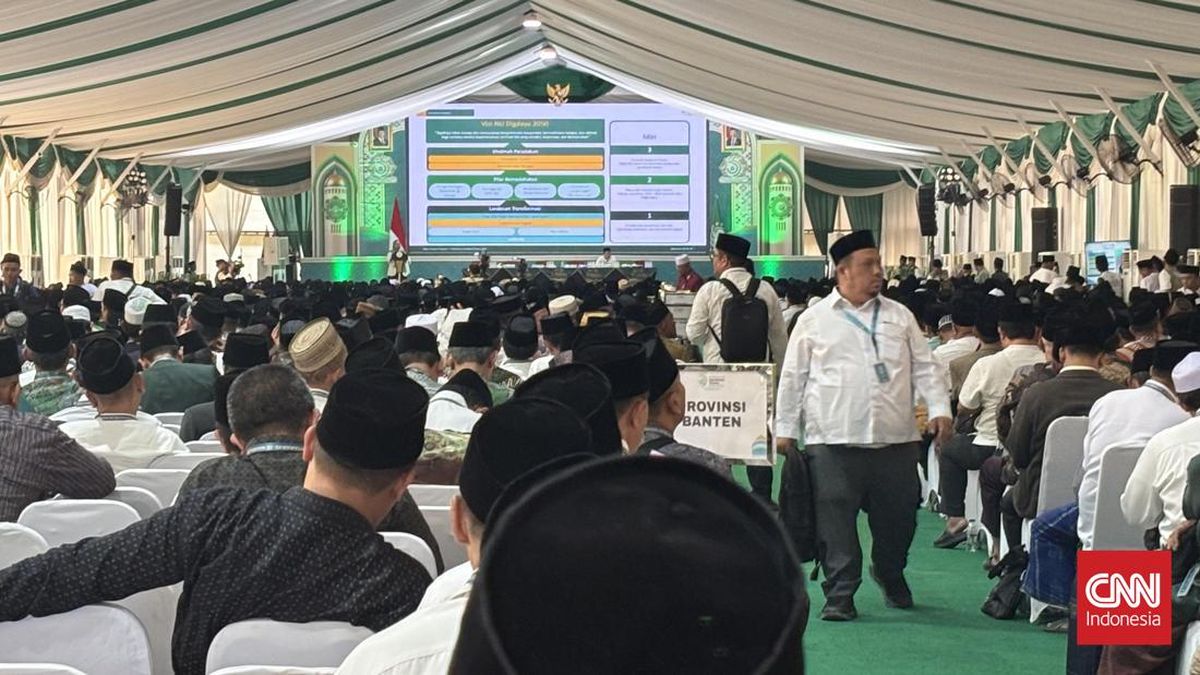
Discussion of the mechanism for electing the new Chairman of the Nahdlatul Ulama Executive Board (PBNU) in the Organisational Commission session of the 35th NU Congress must be determined further because two mechanism options have been proposed.
Monitoring by CNNIndonesia.com at the congress arena of Bahrul Ulum Islamic Boarding School, Tambakberas, Jombang, on Saturday (29/8), congress participants held differing views on determining the election mechanism.
The chair of the Organisational Commission session and Katib Syuriah of PBNU, KH M Asrorun Niam, said that initially two election options were offered to the congress participants.
The first is to maintain the mechanism that has been in place so far, namely deliberation, or to proceed with voting if no consensus is reached.
“There are two options, the option to remain. What does remain mean? The first is carried out by consensus. If consensus is not reached, then voting is carried out, one man one vote,” said Niam after the session on Saturday (29/8).
Meanwhile, the second option is that the new chairman is determined through deliberation by nine senior clerics who are members of the Ahlul Halli wal Aqdi (Ahwa) council.
“Now, the second new proposal is through the Ahlul Halli wal Aqdi mechanism,” he said.
Niam then elaborated on these proposals in full. First, he said the PBNU Chairman would be elected directly by congress participants through deliberation and consensus.
“The chairman is elected directly by congress participants through deliberation and consensus. So all deliberations at this congress are pursued through consensus,” he said.
However, Niam continued, if consensus is not reached, the election of the PBNU Chairman will be handed over to the Ahwa mechanism.
But candidates submitted to Ahwa will still be screened through proposals by congress participants first. Each participant is asked to submit a maximum of five eligible candidates.
“The difference is that in this second option, participants choose a maximum of five eligible candidates. So if previously they chose one, this one chooses five,” he explained.
From the results of that vote, Niam said, the top five candidate names will be taken and then submitted to Ahwa.
Niam added that candidates who have entered the top five will only be selected by Ahwa after they have conveyed their willingness orally or in writing, and obtained written approval from the elected Rais Aam.
“Only lastly, the Chairman candidate as referred to in paragraph 4 is selected by Ahlul Halli wal Aqdi after conveying willingness orally or in writing and obtaining written approval from the elected Rais Aam,” he said.
Niam denied that the session had been difficult. According to him, the discussion of the election mechanism point was brief and full of familial spirit.
After being presented, Niam said, specifically for the Chairman election mechanism, the forum agreed to decide it through voting between maintaining the old mechanism, namely deliberation and consensus and voting, or switching to the screening and Ahwa mechanism. The voting will be held tonight at 19.00.
“Now, specifically for this point, it was agreed to vote between remaining or changing with the details of the 5 items mentioned, to be held after Maghrib tonight at 19.00 WIB after prayers and dinner,” he said.
Niam confirmed that the discussion so far has only been limited to determining the election system, and has not touched on the names of PBNU Chairman candidates.
“This has not yet discussed names, but only how the election system will be. Whether one man one vote or through Ahlul Halli wal Aqdi. So names have not been discussed,” he said.
He also stressed that the voting to be held tonight only concerns the election system, not a double vote between the system and candidate names.
Niam explained the fundamental difference between voting on the system, which is open, and voting on figures or names, which is closed, in accordance with the congress rules.
“Now, the difference is that voting on the system is not closed. So it can be open directly, box A B, who chooses A, who chooses B, like that. It is different if it later concerns people, as per our rules, if it concerns people the voting is closed,” he said.