
Volcanic Eruptions Can Actually Cool the Earth — How?
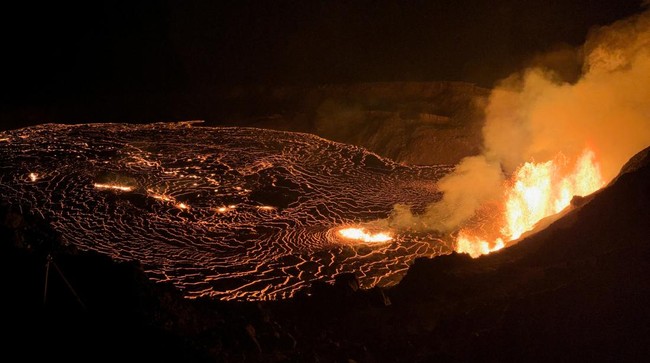
Jakarta, CNBC Indonesia — Volcanic eruptions are not only geological disasters, but can also affect weather and even climate.
The impact of volcanic eruptions is currently drawing attention amid the eruption of Mount Anak Krakatau. The volcano, located in the Sunda Strait, has been erupting continuously since Friday (4/9/2026). Volcanic ash has spread as far as Jakarta, Banten, and several areas in Java and Sumatra.
The event has forced eight airports to halt operations, disrupting more than 1,500 flights and some 170,000 passengers. The ash column was even detected reaching around 50,000 feet, or 15 kilometres, on the Sumatran side.
But can eruptions like this also change the climate?
Can Volcanic Eruptions Change the Weather?
In the short term, volcanic eruptions can affect atmospheric conditions around the affected area. Volcanic ash can reduce visibility and the sunlight reaching the surface, whilst volcanic particles and gases can also interact with clouds and local weather conditions.
However, influencing the global climate requires eruptions on a far larger scale.
According to the National Oceanic and Atmospheric Administration (NOAA), the eruptions most capable of affecting climate are explosive ones that propel large quantities of material and gas into the stratosphere, the atmospheric layer above most weather systems.
This is where the distinction between volcanic ash and sulphur gas becomes important.
The US Geological Survey (USGS) explains that most ash reaching the stratosphere falls back within days to weeks, so its climate impact is relatively small. By contrast, sulphur dioxide, or SO₂, can transform into sulphate aerosols that persist far longer.
How Can a Volcanic Eruption Actually Cool the Earth?
When SO₂ reaches the stratosphere, the gas reacts with water vapour and forms sulphate aerosols — tiny droplets of sulphuric acid.
These particles reflect and scatter part of the sun’s radiation back into space, reducing the energy reaching the Earth’s surface and causing temperatures to fall temporarily.
This effect can last from months to several years, because sulphate aerosols in the stratosphere are not easily washed away by rain and can spread widely following atmospheric circulation.
NOAA explains that the cooling effect from reflected sunlight is greater than the warming effect caused by aerosols trapping some of the Earth’s infrared radiation.
These changes can also affect atmospheric circulation, wind patterns, and rainfall, although the impacts vary from region to region.
In other words, major eruptions can indeed influence the climate, but the effect is generally temporary. This differs from warming caused by greenhouse gases from human activity, which continues to accumulate as long as emissions persist.
Volcanoes Also Produce Greenhouse Gases (GHG)
Volcanoes do emit carbon dioxide (CO₂), one of the main greenhouse gases driving global warming.
However, the scale is far smaller than emissions from human activity.
The USGS estimates that all of the world’s volcanoes, on land and underwater, release about 0.13–0.44 gigatonnes of CO₂ per year, with a central estimate of around 0.26 gigatonnes per year.
By comparison, data from the International Energy Agency (IEA) shows that global CO₂ emissions from energy combustion and industrial processes have continued to rise over the long term, reaching around 38 gigatonnes in 2025.
This means CO₂ emissions from energy combustion and industrial processes are currently several hundred times larger than the estimated emissions of all the world’s volcanoes combined. So although volcanic eruptions can affect the climate in the short term through sulphate aerosols, the rise in CO₂ concentrations and long-term global warming is still driven overwhelmingly by human activity.
Major Examples: Pinatubo and Tambora
Large eruptions have proven capable of temporarily lowering global temperatures. The 1991 eruption of Mount Pinatubo in the Philippines injected large quantities of sulphur into the stratosphere and caused measurable global cooling for several years.
The 1815 eruption of Mount Tambora contributed to the phenomenon known as the ‘Year Without a Summer’ in 1816. The shifts in temperature and weather patterns disrupted growing seasons and triggered crop failures in several parts of the world.
So What About Anak Krakatau Now?
Although Anak Krakatau’s ash has this time reached heights of around 15 kilometres, there is no evidence yet that the current eruption is large enough to produce a climate-cooling effect like Pinatubo or Tambora.
The height of the eruption column alone is also not enough to determine climate impact. More important factors are how much SO₂ actually enters and persists in the stratosphere, and how widely the resulting aerosols subsequently spread. The USGS and NOAA stress that major climate effects mainly arise when explosive eruptions inject very large quantities of sulphur into the stratosphere.
So for Indonesia today, the most tangible impact is in fact local and economic, rather than a change in the global climate.
On the other hand, volcanic cooling is not good news for climate change either. The cooling is only temporary and does not remove the CO₂ that has already accumulated in the atmosphere. When the sulphate aerosols eventually disappear, their cooling influence vanishes with them, whilst warming from human emissions remains.