
Volcanic ash exposure can endanger people with respiratory diseases
Jakarta (ANTARA) — A professor at the Department of Pulmonology and Respiratory Medicine of the Faculty of Medicine, University of Indonesia, Prof. Dr. Faisal Yunus, Ph.D., Sp.P(K), has stated that exposure to volcanic ash can endanger people suffering from respiratory diseases.
“For people who already have lung disease, the danger becomes greater, because even without such exposure, they already have difficulty breathing,” he said when contacted by ANTARA from Jakarta on Monday.
“What is the danger? Frequent respiratory attacks occur, known as exacerbations. That is what we fear with volcanic dust — people with asthma and COPD can suffer exacerbations with all their consequences,” he said.
He explained that volcanic ash can contain fine particles which, if inhaled and entering the respiratory tract, can trigger respiratory problems.
According to him, particles measuring 5–10 microns can reach the upper airways, while particles of 3–5 microns can penetrate as far as the middle airways.
Fine particles measuring 1–3 microns, he continued, can be harmful to health if inhaled, particularly for people already suffering from asthma, chronic obstructive pulmonary disease (COPD), and tuberculosis.
Particles smaller than that, he said, are known as respirable dust because they can reach the alveoli in the lungs, where gas exchange takes place.
Fine particles entering the alveoli can disrupt the distribution of oxygen, which plays a role in cellular respiration and energy production, supports brain and nerve function, aids heart performance and blood circulation, and maintains the immune system.
“So by itself it will interfere with people’s breathing and their activities — and that is for healthy people. Imagine if the person is not healthy and already has a lung disorder,” Prof. Faisal said of the effects of fine particle exposure.
“Which diseases are dangerous from this dust? There are asthma and COPD. For these people, this dust can trigger what we call exacerbations,” he added.
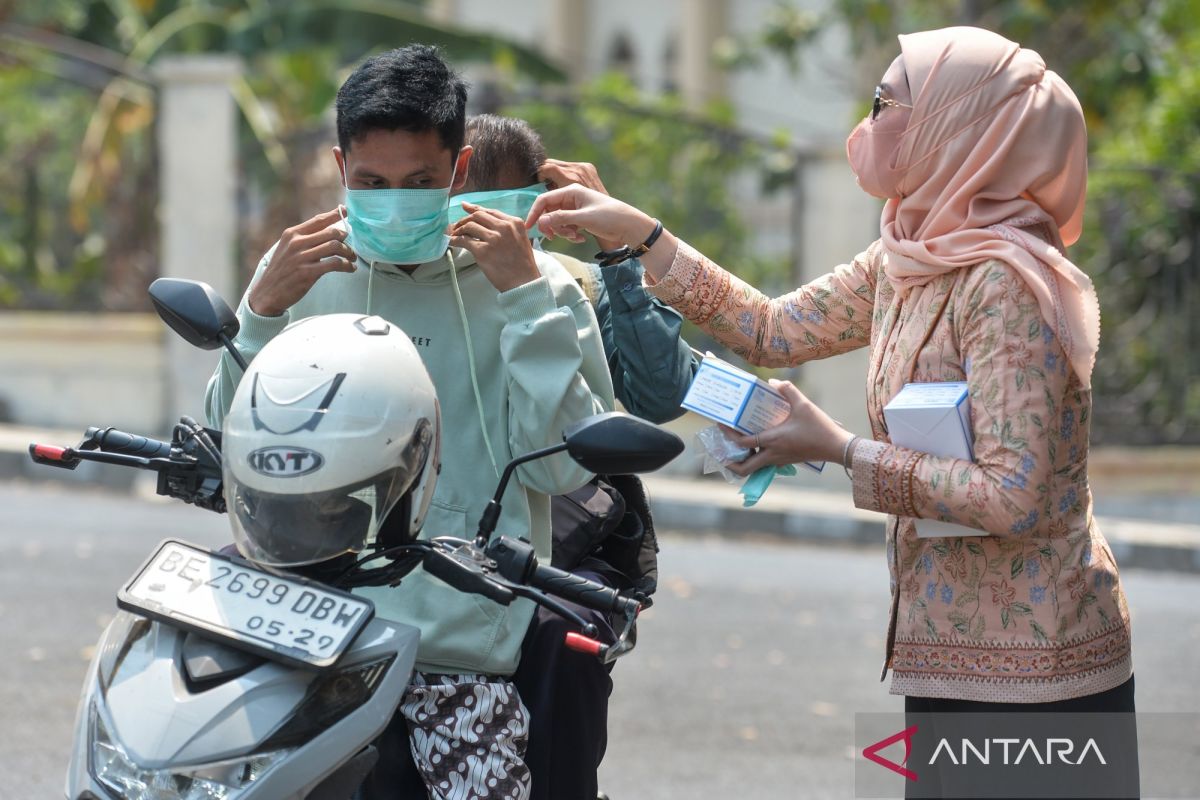
If they must unavoidably carry out activities outside the home, he continued, they should wear an N95 mask.
In addition, he said, people with respiratory diseases should stock up on medicines that can be used whenever they experience symptoms of respiratory distress.
“As soon as symptoms appear, the medication should be taken quickly, for both asthma and COPD, to reduce the likelihood of an attack,” he said.
“What we fear is the attack itself. Sometimes these attacks can be fatal,” he added.
Several volcanoes in Indonesia have erupted within a short period of one another, namely Mount Anak Krakatau, Mount Ibu, Mount Semeru, Mount Lewotobi Laki-laki, Mount Ili Lewotolok, and Mount Sinabung.
According to information shared via the social media account of the Meteorology, Climatology and Geophysics Agency (BMKG), volcanic ash from the eruption of Mount Anak Krakatau in the waters of the Sunda Strait on 7 September 2026 at 15.00 Western Indonesia Time was detected spreading towards Banten, West Java, Lampung, and Bengkulu.