
Visually Impaired Experience Inclusive Kayaking Adventure in Angke Kapuk Mangrove Forest
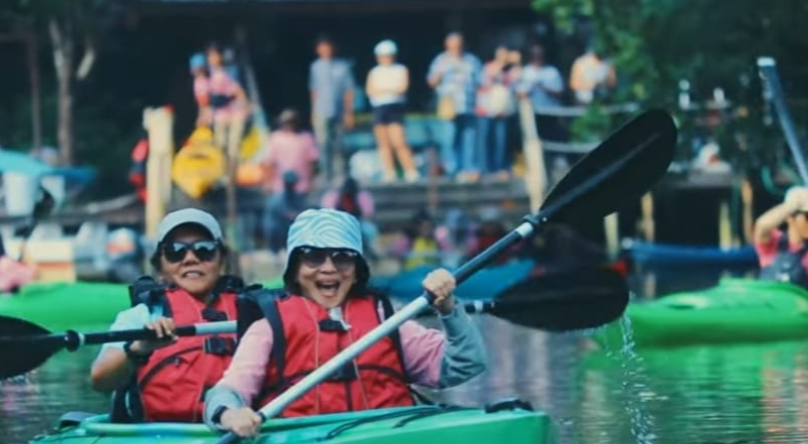
For some, piloting a kayak alone through mangrove waters is a rather audacious idea. However, for ten visually impaired individuals in Jakarta, this extreme challenge became the most effective vehicle for liberating self-confidence and finding complete happiness. Through the ‘Tunanetra Berwisata Vol. 4’ activity, ten participants with visual disabilities were invited to navigate the channels of the Pantai Indah Kapuk (PIK) Mangrove Forest for two hours in solo kayaks, proving that inclusive spaces can be created anywhere.
Over approximately two hours, the participants paddled kayaks along the lush green waterways. This activity was not merely a recreational event but also a space to sharpen self-confidence, foster independence, and deliver happiness through an open-air adventure. Of the ten participants, most were visually impaired couples (husband and wife), whose readiness had been selected through interviews, given the extreme nature of this activity. The adventure was also accompanied by volunteers, most of whom were experienced kayakers tasked with serving as companions or paddling instructors. Each kayaking participant was accompanied by one instructor to ensure their safety.
Nicky Hogan, Chair of the Tunanetra Berwisata Volume 4 committee, revealed that preparations for this agenda required a considerably long process. “Because this is a slightly unconventional, slightly extreme concept. We conducted a survey of the location, at the Peak mangrove park. There are 10 visually impaired people kayaking solo, meaning there are also 10 companions who stick close to them in separate kayaks throughout the 2-hour journey. But besides that, of course, we also prepared rescue personnel, a special kayak for rescue, and also a boat that was prepared for standby. Alhamdulillah, everything went smoothly,” he said.
Long before the day of departure, the committee team had conducted an in-depth survey of the location. Every detail of the terrain, water currents, and route accessibility was carefully analysed to anticipate potential hazards. The committee also held intensive discussions to align participant data, both from the Mitra Netra Foundation and independent participants. “From several participants selected to take part in this activity, the team tried to visit them directly and interview them about their readiness ahead of the departure day. Among them were Mr Asmat and Mrs Atun, an independent married couple who welcomed us warmly at their residence,” he said.
Before entering the water, participants attended an indoor briefing session and interacted with their respective companions to become more familiar. In this session, the committee explained the Standard Operating Procedures (SOP) for safety, including the use of life jackets. This introduction was conducted through tactile hand exploration and detailed verbal descriptions. The participants were also invited to map and recognise their new environment to build a sense of security and foster complete self-confidence and independence. Subsequently, the introduction focused on recognising the adventure elements at the water’s edge. Relying on their highly sensitive sense of touch, the visually impaired participants began to feel and interpret the physical shape of the kayak, sense the weight and rhythm of gripping the paddle blade, and ensure the life jacket was perfectly fitted as body protection.
Volunteer companion Martin Hertanto stressed the importance of compliance with these safety standards: “No one is exempt; everyone uses a life jacket. And regarding the re-entry procedure, I am sure the guides are also familiar. It’s about fitting, so hopefully, the companion can help with the fitting. The fitting has a 0.65, maybe friends already know, so it has to be released first, then the peg is pulled,” he said.
Tri Winarsih, Head of Administration at the Mitra Netra Foundation, welcomed the tourism initiative for the visually impaired. As a partner foundation of the Tunanetra Berwisata community, she expressed gratitude for empowering visually impaired people to be more independent, intelligent, and meaningful to society. “I watched the YouTube video. I was actually envious. So, I am grateful that those who are not handled by us here have a community or institution that is willing to contribute like this. I am very pleased,” she said.
Sergio Kurnianto Rustan (Oci), the initiator of the community and the activity, explained that the visually impaired adventure held this time was the fourth volume, featuring a kayaking tourism agenda, after three previous adventure activities: Volume 1 was an adventure into the forest, Volume 2 was snorkelling, and Volume 3 was scuba diving. “We want to welcome, to please, to make 10 visually impaired people happy. When we talk about visually impaired people travelling, we invite totally blind individuals and their partners,” he said.
For Supingatun, who has been visually impaired since birth, the kayaking adventure was an unforgettable experience. Mrs Atun, as she is called, who works daily as a masseuse, immediately agreed when her husband, Asmad, offered her the chance to go on the kayaking trip. “His father was offered it first, then he asked me, so I just said yes, let’s go. I imagined what a ‘kayak’ was like; I didn’t know. But I had been on a boat in Anyer before. So, I was curious, I wanted to know what it was like,” she said.