
Visiting Southeast Asia's Number One Hospital
Upon returning from SGH, the image of a hospital has changed; hospitals no longer feel like frightening spaces, but rather places where hope is continuously nurtured and created through advancements in science and technology.
Jakarta (ANTARA) - When hearing the word “hospital”, what usually comes to mind is a tense atmosphere, cold corridors, the sharp scent of antiseptic, and anxious faces hurrying about. That image is so strong, as if a hospital is a space synonymous with fear.
However, that impression slowly crumbled when ANTARA, at the invitation of Philips, had the opportunity to visit Singapore General Hospital (SGH), the hospital ranked first in Southeast Asia in Newsweek’s 2026 rankings.
As soon as setting foot there on 30 April 2026, the atmosphere felt far from intimidating. Instead of being rigid and tense, SGH presents an environment more akin to a futuristic research centre: calm, modern, and impressive.
It is hard to believe that this institution, established in 1821, is Singapore’s oldest and largest hospital. Rather than being trapped in the shadows of its age, SGH demonstrates how a history of more than two centuries can harmoniously blend with state-of-the-art technology.
During the visit, ANTARA had the chance to witness the SGH Innovation Showcase directly, a space showcasing various medical breakthroughs that are not only informative but also astonishing, leaving anyone in awe.
Here is the experience of touring the hospital located in the Outram Park area, with a building area of 146,000 square metres, while observing how artificial intelligence (AI) and advanced medical technology are transforming the way they care for patients.
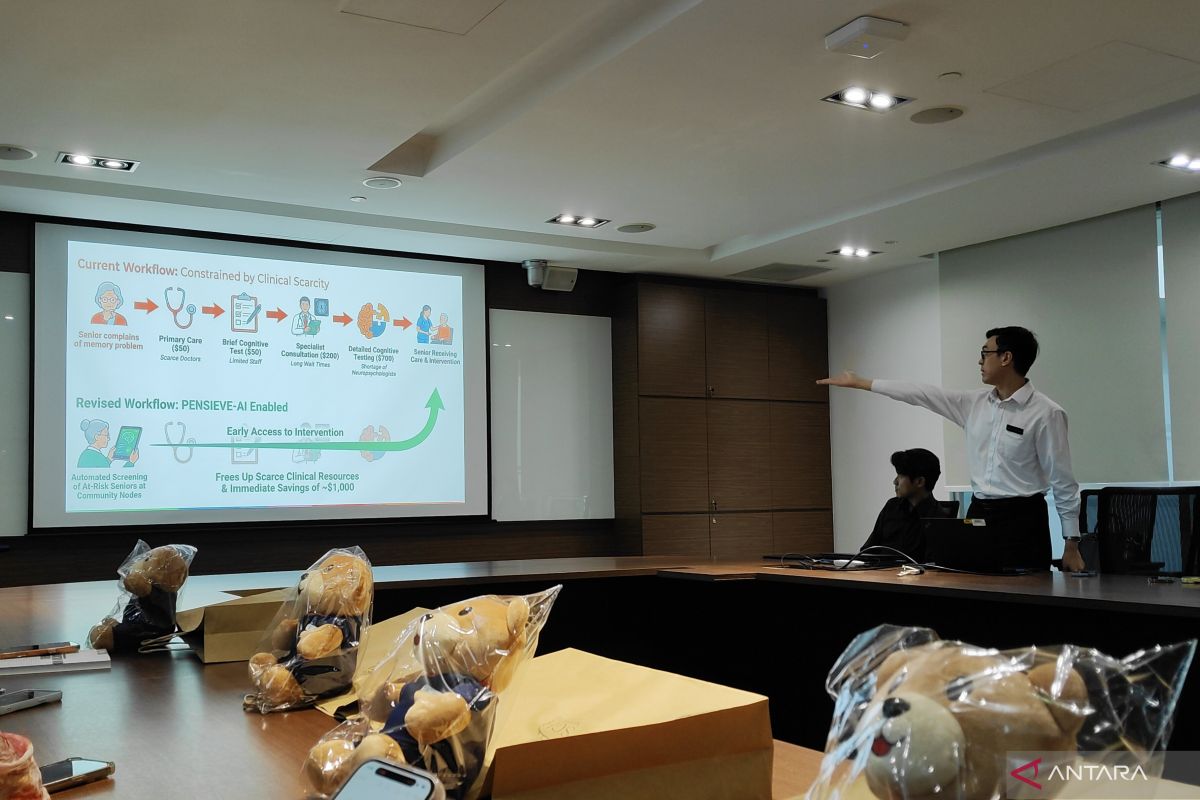
The first stop was a demonstration area featuring a service programme called PENSIEVE-AI. At first glance, this application seems simple, like a drawing feature on a tablet, which initially raised some scepticism.
However, behind its minimalist appearance lies artificial intelligence technology resulting from a collaboration between SGH and GovTech Singapore, an agency under the Prime Minister’s Office that leads digital transformation and Smart Nation initiatives. This technology is designed to detect cognitive disorders, including dementia, in elderly patients.
For a long time, cognitive examinations for the elderly have been known to be complicated, time-consuming, and relatively expensive. As a result, around 80 to 90 percent of cognitive disorder cases are often diagnosed late.
PENSIEVE-AI emerges as a solution that simplifies this process. In the demonstration witnessed by ANTARA, the patient is only asked to complete four drawing tasks on the tablet screen by following the provided patterns.