
Village Dollars
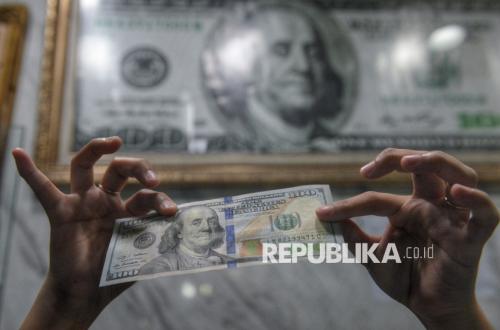
At the foot of Mount Manglayang, in a small village in Sukabumi, West Java, lives a farmer named Falah. He is no longer young, but his face is as calm as a paddy field after harvest. He has never seen the physical form of the US dollar; indeed, if presented with a hundred-dollar note, he might turn it over and ask, ‘Is this a lottery coupon?’
Falah lives with his wife and three children. They find their daily meals of cassava, sago, and occasionally rice from their own fields to be sufficient. His side dishes consist of tofu and tempeh, but he ensures they are made from local soybeans. This is not due to participation in an anti-globalisation seminar in a five-star hotel, but because he believes imported soybeans involve too much ‘laboratory interference.’ For Falah, local tempeh is more reassuring than temini that originates from genetic engineering and multinational corporate PowerPoint presentations.
Yet, life is ironic. While Falah may not know the dollar, his sarong is made in China. His t-shirt, his songkok, and perhaps even his underwear have crossed the South China Sea before reaching the village kiosk. Interestingly, these goods can now be purchased by small-scale importers via Alibaba using QRIS in Rupiah. It feels incredibly modern—simply scan, click, and finished. It is as if the dollar has taken early retirement.
Falah does not understand that behind the seemingly nationalist QRIS transactions, the global trade chain continues to move according to the logic of foreign exchange and international exchange rates. While the Rupiah is used for retail transactions, the structures of imports, interbank payments, trade balances, and cross-border conversions still revolve around the dollar and the world’s strong currencies. The digital world is skilled at dressing up; people feel they are not touching the dollar, even though the dollar remains the ‘invisible foreman’ in the warehouse of global trade.
It is at this point that President Prabowo Subianto’s statement becomes interesting to read, rather than being dismissed as a logical error. When he stated that villagers do not use dollars, many reacted like a fire alarm in a macroeconomics seminar. Social media boiled, and analysts rushed in with graphs. Some seemed intent on checking the Rupiah exchange rate while simultaneously checking their blood pressure.
However, perhaps what Prabowo was discussing was not merely the fact of monetary transactions, but rather providing a direction for a more optimistic national psychology to achieve the goal of a civilisation based on self-reliance. This is a different matter. Our problem today is that we too often read political speeches like reading photocopied receipts—everything must be literal, detailed, precise, and directly aligned with quarterly BPS data. As a result, this nation often loses the ability to understand directional signals.
If taken out of context, the phrase ‘villagers do not use dollars’ sounds like a sentence that would make an economics professor bite their calculator. But viewed in its entirety, the statement emerged during the inauguration of thousands of ‘Merah Putih’ Village Cooperatives. This suggests the President was speaking about the ambition of ‘money circulating in the village, production growing in the village, and consumption met by the village.’ In other words: community-based economic independence, which has long been a shared aspiration.
It must be admitted that this direction is not wrong. The problem is that political speeches are often like instant noodles: the hot water is present, but the seasoning is missing. This grand narrative is not fully explained to the public by his aides. Consequently, people hear the surface without understanding the framework. Even the President’s political aides and communication experts, who should be translating these ideas, are often busy acting as well-dressed television commentators.
To be honest, Indonesia has lived too long as a nation that feels independent, yet its kitchen still depends on imported ships. We speak of sovereignty while queuing for foreign soybeans. We deliver speeches on nationalism while wheat, sugar, machinery, medicine, and even sewing needles still wait for the dollar exchange rate to smile first. This is why criticism of Prabowo remains important, because economic reality is stubborn. When the Rupiah weakens, fertiliser prices rise. When the dollar surges, the price of instant noodles performs a somersault.