
Village Commission and Maturing the Essence of the Red and White Village/Sub-District Cooperatives
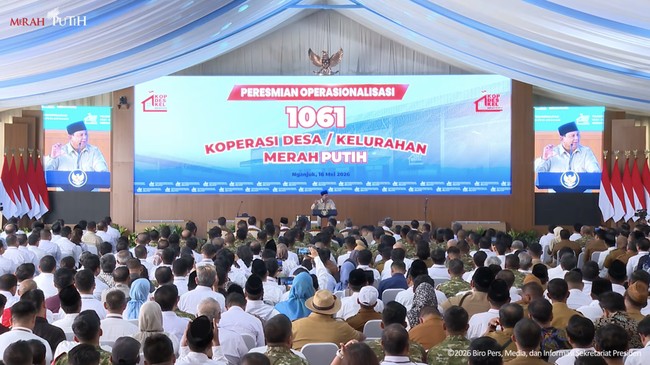
The Red and White Village/Sub-District Cooperatives (KDKMP) programme is one of President Prabowo Subianto’s strategic agendas to strengthen the village economy. Its objective deserves appreciation. Villages indeed require strong economic institutions to improve community welfare while reinforcing national economic resilience. However, as with any public policy, its success is determined not only by good intentions but also by the underlying paradigm. The government is shifting the KDKMP development orientation from a quantitative approach towards strengthening institutional quality. The initial formation target of 80,000 units has been adjusted to around 40,000 units by the end of 2026, with an emphasis on operational effectiveness, governance, and cooperative business sustainability. This policy shift indicates that the programme’s success is no longer measured solely by the number of cooperatives established, but by the extent to which cooperatives can function as productive, inclusive, and resilient village economic institutions. Given that the scope of 40,000 cooperatives already covers most of Indonesia, the government’s main challenge now is to ensure that cooperative principles, values, and essence truly live in the practice of village economic development, rather than merely meeting administrative targets.
The 1945 Constitution of the Republic of Indonesia provides two important foundations. Article 18B(2) mandates the recognition of customary law community units and their traditional rights, while Article 33 affirms that the economy shall be organised as a common endeavour based on the principle of familyhood. These two provisions are complementary: economic development must grow from communities whose existence is recognised, not formed administratively by the state. This spirit gives rise to the concept of the village as a self-governing community, a legal community that has the right to regulate and manage its own interests based on the principles of recognition and subsidiarity. The state is obliged to facilitate, protect, and empower villages, but not to take over decisions closest to the lives of village communities.
From this perspective, the problem with the KDKMP programme is not that the government chose cooperatives as an instrument of economic development. Cooperatives are precisely one of the most suitable forms of economic institutions in line with the spirit of Article 33 of the 1945 Constitution. In fact, in the concept of village law reform once formulated in the Academic Paper for the Village Bill by the Regional Representative Council (DPD), Village-Owned Enterprises (BUMDes) were designed flexibly so they could take the form of cooperatives, limited liability companies, or other legal entity forms according to the needs of the village community. Thus, cooperatives were positioned from the outset as one alternative village economic institution, not as the only model to be applied. The problem arises when the state determines in advance that all villages must form cooperatives with a uniform institutional design. Such an approach risks reviving the top-down development pattern that the Village Law was intended to correct. In reality, villages in Indonesia have highly diverse characteristics. A customary village in Bali is certainly different from a nagari in West Sumatra. A fishing village has different needs from a mountain village. A tourism village like Ubud faces economic challenges unlike those of an agricultural village, an industrial village, or a village on small islands. Even a village with tens of thousands of residents cannot be treated the same as a village inhabited by only a few hundred people. Therefore, it is very difficult to imagine that one institutional model will be able to uniformly answer the needs of more than 75,000 villages.
This diversity shows that the central government should not stipulate a single economic institutional model applicable to all villages. What is more needed is a mechanism capable of reading the objective needs of each village before development or financing policies are determined. For this reason, the establishment of a Village Commission in each district/city is important to consider. The Village Commission is not a new bureaucracy controlling villages. Instead, it is designed as an independent public institution free from the influence of local government or practical political interests. Its function is to be a bridge between villages and district/city governments through data collection, potential mapping, needs identification, and objective assessment of each village’s capacity. Based on this assessment, the Village Commission provides recommendations regarding development direction, financing needs, the most appropriate form of economic institution, and synchronisation between village planning and regional development policies. With a composition drawn from academics, village head associations, sub-district elements, business actors, and community leaders selected through a merit system, the Village Commission is expected to safeguard the implementation of the principles of recognition and subsidiarity so that villages do not once again become objects of government bureaucracy.
From a cooperative law perspective, this uniform approach also raises conceptual issues. In essence, a cooperative is a membership-based business organisation. It is born from the economic awareness and needs of its members to work together voluntarily, democratically, and independently. Therefore, the formation of a cooperative must fundamentally originate from the community’s own initiative, not as a result of government instruction. On that basis, the top-down establishment of cooperatives in all villages is questionable, as is the practice of financing their establishment almost entirely through the state budget.
Source: jawawa.id (https://jawawa.id/newsitem/village-commission-and-maturing-the-essence-of-the-red-and-white-village-sub-district-cooperatives-1782726776)
Originally published by CNBC Indonesia (https://www.cnbcindonesia.com/opini/20260629143246-14-746550/komisi-desa-dan-mematangkan-esensi-koperasi-desa-kelurahan-merah-putih), translated from Indonesian