
Vietnam's Stock Market Status Remains 'Frontier' but Economy Could Grow 8%
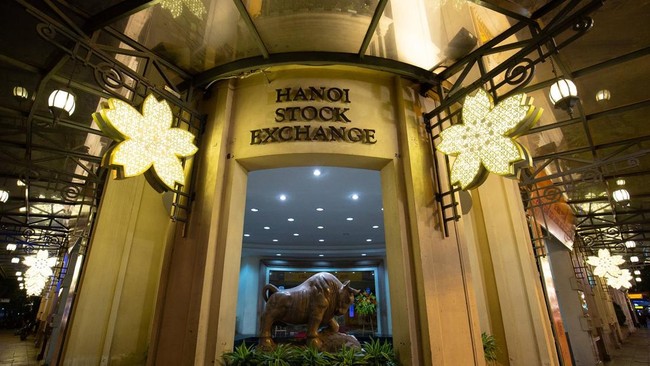
Vietnam’s stock market is entering an important period. High economic growth, a revival of initial public offerings (IPOs) and an upgrade in FTSE’s classification are making the country increasingly prominent on Asia’s equity capital market map.
As of 30 June 2026, the combined capitalisation of the Ho Chi Minh Stock Exchange (HOSE), the Hanoi Stock Exchange (HNX) and UPCoM approached VND10,600 trillion, or around US$405 billion. By comparison, the capitalisation of the Indonesian stock exchange stands at US$571 billion, or approximately Rp10,328 trillion.
HOSE is the centre of activity with a capitalisation of more than VND8,765 trillion. Meanwhile, UPCoM has a capitalisation of around VND1,300 trillion and HNX is approaching VND500 trillion.
So far this year, the main Hanoi exchange (HNX) has surged 22%. Compare that with the Indonesian Composite Index (IHSG), which has fallen 31%.
The vibrancy of Vietnam’s stock market stands in stark contrast to the Indonesia Stock Exchange, which has been hit repeatedly this year.
For the record, the JCI has slumped this year due to a number of factors, including scrutiny from global rating agencies over the performance of the Indonesian stock market.
Yet the position and rating of the Indonesian stock market, and Indonesia as a whole, remain better than Vietnam’s.
Index Surges, but the Market Is Concentrated
The VN-Index closed at 1,860.01 at the end of June 2026. After jumping 40.87% throughout 2025, the index added a further 4.2% in the first half of 2026.
The VN-Index’s valuation stands at a trailing price-to-earnings ratio of around 15.1 times. This level suggests Vietnam can no longer be considered cheap across the board after the previous year’s strong rally.
Index movements are also highly concentrated. The combined capitalisation of Vingroup and Vinhomes exceeds VND2,300 trillion, or more than a fifth of the entire market’s capitalisation. The two accounted for more than 70% of the market capitalisation added in Vietnam during the first half of 2026.
This means the VN-Index can strengthen even though the majority of shares have not moved as strongly as the index. Beyond the Vingroup group, the market’s direction is largely determined by major banks such as Vietcombank, BIDV, VietinBank and Techcombank.
Domestic Investors Absorb Foreign Pressure
Average daily share transaction value on HOSE reached VND18,419 billion in June 2026, down 24.34% from May. However, the average transaction value across the three boards in the first half of 2026 still rose around 36% year-on-year.
This liquidity has been primarily supported by domestic investors. Conversely, foreign investors recorded net sales of around VND14,904 billion on HOSE during June. For the whole of the first half of 2026, foreign net selling across the three boards is estimated to have reached US$3.1 billion.
The outflows show that emerging market status does not automatically translate into inflows. Global investors are still weighing currency risk, foreign ownership limits, low free float and index concentration.
IPOs Return, FTSE Provides a New Catalyst
Vietnam’s IPO market began to revive in 2025, with more than VND35,000 billion raised. In 2026, the value of planned IPOs and share issuances is estimated to reach VND289,500 billion, or US$11.13 billion.
However, this figure is not purely IPO realisation. It includes rights issues, private placements and other share issuances. Around 70% of the plan had not been executed by the end of May 2026. The dedicated IPO pipeline is estimated at around US$861.5 million.
The biggest catalyst comes from FTSE Russell. Vietnam is confirmed to move up from Frontier to Secondary Emerging Market status effective 21 September 2026. Even so, MSCI still maintains Vietnam as a Frontier Market due to issues concerning foreign ownership, foreign currency access, free float and information disclosure.
A Strong Economy Provides the Foundation
Vietnam’s economy grew 8.39% year-on-year in the second quarter of 2026, bringing first-half growth to 8.18%. Industrial production rose 10.8%, while realised foreign direct investment reached US$13.03 billion.
Vietnam also offers a standard corporate tax rate of 20%. Certain projects in high technology, infrastructure, software and renewable energy can qualify for a 10% rate for 15 years.
However, economic growth is not automatically fully reflected in the stock market. Many major exporters are subsidiaries of foreign companies not listed in Vietnam. The impact flows more indirectly to banks, industrial zones, logistics, energy and consumption.
Vietnam can thus be described as a large market moving up a class, but not yet fully mature. Its opportunities lie in growth and reform, while its risks lie in index concentration, foreign access and uneven governance quality.
Source: jawawa.id (https://jawawa.id/newsitem/vietnams-stock-market-status-remains-frontier-but-economy-could-grow-8-1783677129)
Originally published by CNBC Indonesia (https://www.cnbcindonesia.com/research/20260710105026-128-749735/status-bursa-saham-vietnam-frontier-tapi-ekonomi-bisa-tumbuh-8), translated from Indonesian