
Vietnamese Dong Rallies as Singapore Dollar and Ringgit Falter; How Is the Rupiah Faring?
Jakarta, CNBC Indonesia — Most Asian currencies came under renewed pressure this week amid a stronger US dollar and high US government bond yields.
At the final session of the week on Friday (9 October 2026), the rupiah closed at Rp17,875 per US dollar, weaker than the previous week’s close of Rp17,868 per US dollar.
Refinitiv data showed the rupiah fell by 0.04% over the week, reversing a 0.07% gain the previous week.
Despite the decline, the rupiah performed better than several other Asian currencies. The US dollar strengthened again amid high US government bond yields and expectations of a Federal Reserve rate rise.
Most Asian currencies weaken
The US dollar’s pressure persisted across Asia throughout the week.
According to Refinitiv data, six of the 10 Asian currencies monitored weakened against the US dollar. Only the Vietnamese dong, Chinese yuan, South Korean won and Thai baht posted gains.
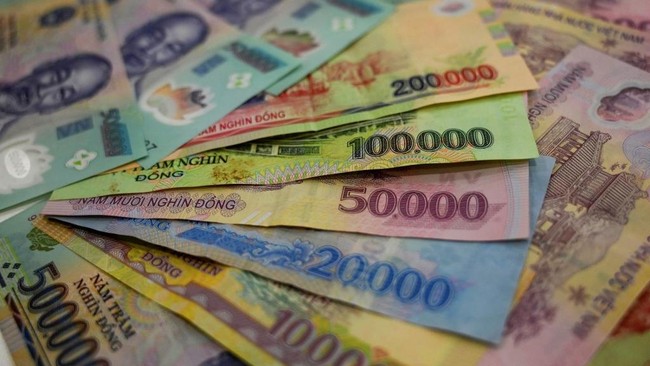
The Vietnamese dong was the strongest performer, rising 0.40% over the week to VND25,879 per US dollar.
The Chinese yuan followed, gaining 0.19% to CNY6.692 per US dollar, while the South Korean won rose 0.17% to KRW1,340.25 per US dollar. The Thai baht also strengthened 0.09% to THB33.50 per US dollar.
By contrast, the Taiwan dollar faced the steepest decline, falling 0.36% to TWD31.917 per US dollar. The Philippine peso dropped 0.32%, followed by the Japanese yen, which fell 0.30%.
The Singapore dollar weakened 0.12% and the Malaysian ringgit fell 0.05%, while the rupiah recorded the smallest decline, at 0.04%.
The pressure on most Asian currencies was linked to the US dollar’s strength over the week.
The US Dollar Index (DXY) rose 0.27% week on week to 102.23, marking its fourth consecutive weekly gain.
One factor supporting the dollar was the continued high level of US government bond yields. Reuters reported that the yield on the 10-year US Treasury rose 2.8 basis points on Friday to 5.261%.
The yield had earlier reached a 24-year high on Wednesday (7 October 2026).
However, the 10-year Treasury yield fell 3.5 basis points over the week, its biggest weekly decline in two months.
Yields that remain high keep dollar-denominated assets attractive to investors and could sustain demand for the currency.
Pressure has also come from European bond markets. Concerns about France’s fiscal position, including its heavy debt burden and budget deficit, have increased uncertainty in the region’s financial markets.
The euro fell against the US dollar for a fifth consecutive week and briefly touched a 17-month low of US$1.1161 early in the week.
High oil prices remain a risk
Alongside US bond yields, persistently high global oil prices remain an important factor in currency movements.
Brent crude closed at US$104.72 a barrel on Friday (9 October 2026), remaining above US$100 amid energy supply disruptions and geopolitical tensions in the Middle East.
High oil prices could put greater pressure on countries that rely on energy imports. Higher import costs can worsen trade balances and increase demand for US dollars.
This is one of the risks facing the currencies of energy-importing countries, including the Japanese yen.
Higher energy prices could also keep US inflation elevated, strengthening the case for the Federal Reserve to maintain tight monetary policy.
On Thursday (8 October 2026), Federal Reserve Bank of St Louis President Alberto Musalem said the US central bank still needed to raise interest rates to bring inflation back towards its 2% target.
Expectations of tighter monetary policy pose a challenge for Asian currencies, as high US interest rates can make dollar-denominated assets more attractive.
Source: jawawa.id (https://jawawa.id/newsitem/vietnamese-dong-rallies-as-singapore-dollar-and-ringgit-falter-how-is-the-rupiah-faring-1791633027)
Originally published by CNBC Indonesia (https://www.cnbcindonesia.com/research/20261010152723-128-774948/dong-vietnam-perkasa-dolar-singapura-ringgit-merana-rupiah-gimana), translated from Indonesian