
Video: Strong State Budget: Fuel Prices Remain Stable and Q1-2026 Economy Forecast at 5.5%
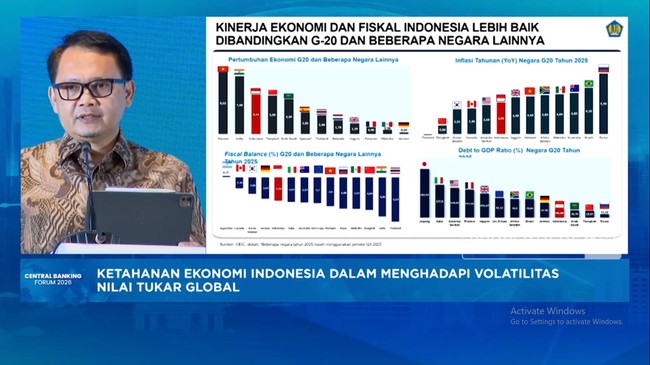
CNBC Indonesia, in collaboration with Bank Indonesia, presented the Central Banking Forum 2026 with the theme “Indonesia’s Economic Resilience in Facing Global Exchange Rate Volatility”. The forum thoroughly examined Indonesia’s responses and those of monetary authorities to global challenges, while strengthening national economic resilience and maintaining market confidence and positive perspectives.
Noor Faisal Achmad, Director of Strategic Economic Stability at the Directorate General of Fiscal Balance of the Indonesian Ministry of Finance, spoke at the Central Banking Forum 2026 about the government’s response to global economic turbulence resulting from the Iran versus United States-Israel War.
Indonesia’s economic data currently records that the manufacturing sector remains expansive, trade surpluses continue, inflation is controlled, foreign exchange reserves are adequate, and credit growth remains strong. This reflects that the growth engine is still functioning well, even as the financial market experiences selling pressure, though the pressure in Indonesia is still moderate, the rupiah depreciation is controlled, and the yield on government bonds remains low, so the perception of risk and market trust in Indonesia is still good.
In maintaining market confidence, state budget management is conducted prudently with adequate liquidity, while preserving credibility and communication on credit financing so that the market sees the government’s response as anticipatory and measured.
Inflation is also ensured to be controlled and maintained at 3.8%, indicating that domestic prices are under control and purchasing power is preserved, with healthy growth in domestic demand. However, the rise in global energy prices is a risk that is being monitored, though transmission to the domestic market can be responded to.
The state budget is confirmed to play the role of a “shock absorber” amid geopolitical turbulence, where the APBN is able to keep fuel prices stable, the fiscal deficit is targeted at 2.9% of GDP, and the economy for Q1-2026 is targeted at 5.5% or more.