
Video: Protein Self-Sufficiency, Zulhas Vows to Eradicate Middlemen and Loan Sharks
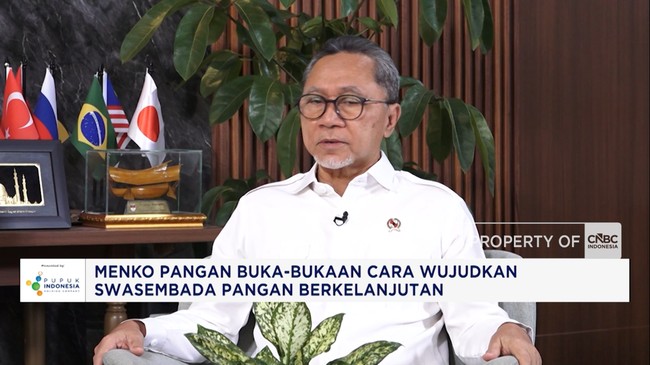
The administration of President Prabowo has officially announced the achievement of food self-sufficiency in 2025, ahead of the original 2029 target. Coordinating Minister for Food Zulkifli Hasan stated that this success was due to the government’s correction of policies that had been in place for 28-29 years since the post-reform free market era. The strategy towards food sovereignty focused not only on increasing production but also on improving the welfare of Indonesian farmers, fishermen, and livestock breeders. One key policy reform involved cutting 145 regulations on subsidised fertiliser distribution to farmers, resulting in an 7-8% increase in rice production. The government also boosted paddy field productivity by completing irrigation projects and raised the price of unhusked rice for farmers while addressing the issue of middlemen to ensure better prices. To sustain food self-sufficiency, the government is implementing several programmes, including the creation of new rice fields covering 1 million hectares in Merauke, Papua, Central Kalimantan, and South Sumatra. It is also strengthening the function of existing agricultural land through regulations prohibiting the conversion of farmland into residential areas. The government is collaborating with the National Research and Innovation Agency (BRIN) to develop new rice seed varieties that can further increase rice productivity. Looking ahead, the government is pushing for protein self-sufficiency by 2026, focusing on fish, shrimp, eggs, and chicken. The Ministry of Marine Affairs and Fisheries has launched the Kampung Nelayan Merah Putih (Red and White Fishermen’s Village) programme to increase fish catch productivity, ensure fishermen’s welfare, and tackle the problems of middlemen and loan sharks. A total of 20,000 such villages, supported by the Kopdes Merah Putih (Red and White Village Cooperatives), will address fishermen’s issues through the construction of auction halls, ice factories, cold storage facilities, and the strengthening of distribution chains. Regarding the Kopdes Merah Putih, which has a target of 80,000 units, Minister Zulhas is currently focusing on an initial phase of 40,000 units, expected to be operational by September 2026. These cooperatives are not intended to be supermarkets but are designed to resolve long supply chain issues. They will also serve as government infrastructure to distribute social assistance accurately, as well as subsidised fertiliser, subsidised gas, and low-interest financing. The cooperatives will act as off-takers to support village economic activities by absorbing local production of rice and fish.