
Video: Ministry of Environment Ensures Environmental Functions During Mining Operations Using EVs
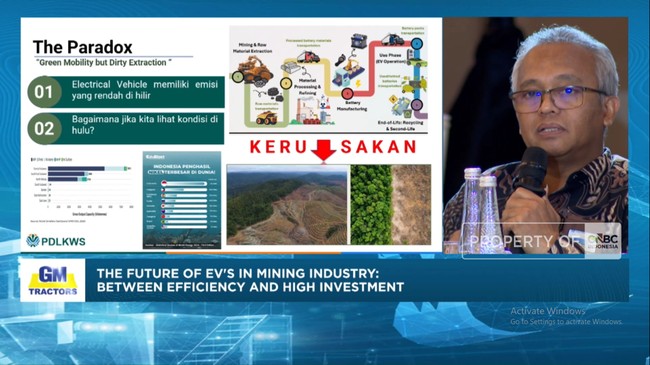
Jakarta, CNBC Indonesia - CNBC Indonesia held the EV Transition in Mining Industry Outlook 2026 with the theme “The Future of EVs in Mining Industry: Between Efficiency and High Investment”, which will discuss opportunities, challenges, and the industry’s readiness in adopting electric vehicle (EV) technology.
The Supervisory Board of the Indonesia Mining Association (IMA), Raden Sukhyar, at the EV Transition in Mining Industry Outlook 2026, assured the mining sector’s commitment to utilising electric vehicles or EVs.
Currently, several mines have begun trials of using trucks up to mining buses and mineral transport lorries. These EVs provide benefits in fuel savings and reducing carbon emissions, but there are still several challenges related to high EV import taxes and regulatory improvements.
Amid global geopolitical turmoil and rising oil prices, electrification is described by the Executive Director of the Indonesian Coal Mining Association (APBI), Gita Mahyarani, as a relevant policy for the industry, including the mining sector. However, production pressures on coal with the slashing of the 2026 Work Plan and Budget (RKAB) will make investments for EVs in coal mines a challenge.
From the nickel side, the use of EVs in nickel mines still faces challenges related to limited energy infrastructure and adequate road access. The Supervisory Board of the Indonesian Nickel Miners Association (APNI), Djoko Widajatno, also stated that challenges regarding the capacity and capabilities of mining human resources in utilising EVs must be a concern.
Meanwhile, the use of EVs in mining services business is described by the First Deputy General Chairman of the Indonesian Mining Services Association (ASPINDO), Ahmad Kharis, as closely related to mining contractor investments. Therefore, it is important to ensure government support regarding high EV import taxes and certainty of mining concessions.
Meanwhile, the Director of Prevention of Environmental Impacts of Regional and Sectoral Policies at the Ministry of Environment and Forestry/Environmental Impact Control Agency (KLH/BPLH), Widhi Handoyo, stated that the Ministry of Environment and Forestry in the energy transition sector ensures that environmental functions and ecosystems remain maintained.
From the government, the Director of the Machinery and Agricultural Equipment Industry/IPMP at the Ministry of Industry, Solehan, mentioned mining as a strategic sector in driving the economy as well as EV development, although mining transportation faces challenges from harsh terrain, high activity intensity, and remote areas, thus requiring high unit reliability.
The Ministry of Industry, in supporting the EV transition in mining, acts as a regulator as well as a facilitator in converting Internal Combustion Engines (ICE) to Electric Vehicles (EV) while strengthening the EV ecosystem to be competitive.
In supporting the acceleration of the mining energy transition through EVs, the Product Support Director of PT Gaya Makmur Tractors, Surateman, mentioned the commitment of the Gaya Makmur Group in providing mining vehicles such as EV-based trucks, one of which is a 110-tonne class truck with a 1.7 Megawatt-hour (MWh) battery capacity up to mining equipment.
Meanwhile, the Chief Operating Officer of PT Borneo Indobara, Raden Utoro, revealed the development of EV adoption at Borneo Indobara mines which has already begun with several challenges related to regulations to infrastructure, although the impact on mining efficiency is quite significant.