
Video: Labour Minister Yassierli and Government Strategies to Reduce Unemployment
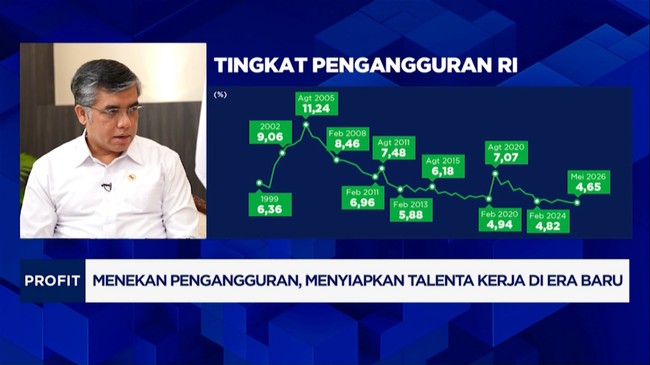
According to 2026 labour force statistics from the Central Bureau of Statistics, the open unemployment rate (TPT) decreased to 4.65% in May 2026, with the total number of unemployed individuals shrinking to 7,219,288.
The Indonesian Minister of Manpower, Prof. Yassierli, has reaffirmed the government’s commitment to suppressing unemployment rates. Specifically, the Ministry of Manpower is implementing several strategies, including the improvement of the labour market information system, known as Karir Hub. Through this career platform, the Ministry is collaborating with private job portals to provide accessible job vacancy information for job seekers.
The Ministry of Manpower also manages the Independent Workforce programme to assist workers in pursuing entrepreneurship. Furthermore, the Ministry is encouraging transformative and harmonious industrial relations to build a conducive business climate. Additionally, the Ministry is developing the National Internship Programme and the National Vocational Programme to provide essential training and skills to prospective workers.
Specifically, the Internship Hub programme is designed to enhance the skills and experience of university graduates to address the mismatch between industry requirements and candidate qualifications. Alongside the Coordinating Ministry for Economic Affairs and other relevant ministries, the Ministry of Manpower is pushing for the expansion of the Internship Hub. This initiative aims to act as an economic stimulus, allowing graduates to build portfolios while providing companies with an incentive to meet human resource needs over a six-month period.
Meanwhile, the free national vocational training programme is aimed at improving the skills and competencies of high school and vocational school (SMA/SMK) graduates. This programme is facilitated through 43 Vocational Training and Productivity Centres, which have the capacity to accommodate 400,000 individuals across 31 different vocational specialisations.