
Video: KUR and BRILink, BRI's Strategy to Boost the Economy Down to the Village Level
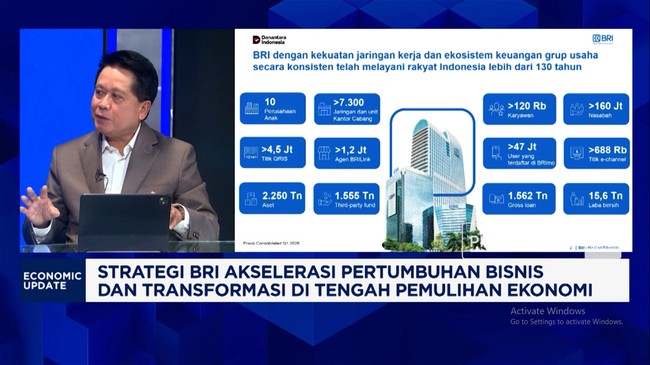
Jakarta, CNBC Indonesia - The banking sector continues to record positive growth prospects in the face of uncertainty in 2026. In May 2026, Bank Indonesia noted that Third-Party Funds (DPK) in the banking sector recorded higher growth. Bank Indonesia (BI) revealed that Third-Party Funds (DPK) grew by 10.8% year-on-year (yoy), reaching Rp 9,698.7 trillion.
Group CEO of PT Bank Rakyat Indonesia (Persero) Tbk (BBRI), Hery Gunardi, stated in an Economic Update that banks act as intermediary institutions that collect third-party funds, which are then channelled as credit to the public, generating a margin.
Amidst the current global economic and geopolitical turmoil, the banking sector continues to drive business growth through a number of strategies, including reducing the cost of funds in line with the increase in the benchmark interest rate, which has risen by 100 bps to 5.75%. Nevertheless, Hery Gunardi confirmed that national banking remains very strong, with double-digit credit growth, DPK growing by 10%, and sound capitalisation with maintained non-performing loans (NPL).
On the other hand, banks are also wary of market tightening due to the increase in the BI rate and SBRI yields, although liquidity remains sufficiently loose to support the government in boosting business and credit growth. In 2026, BRI, as a guardian of MSME sector growth, has channelled more than Rp 1,500 trillion in people’s business credit (KUR) since 2015, and in 2026 is targeting Rp 180 trillion in KUR for productive sectors, primarily agriculture and trade.
BRI also affirms its role in driving the national economy and the government’s priority programmes through its network and financial ecosystem across Indonesia, aiming to stimulate the community’s economy and help micro-enterprises to upgrade, one of which is through the BRILink service.