
Vice President stresses modernisation of seaweed farming in Rote Ndao
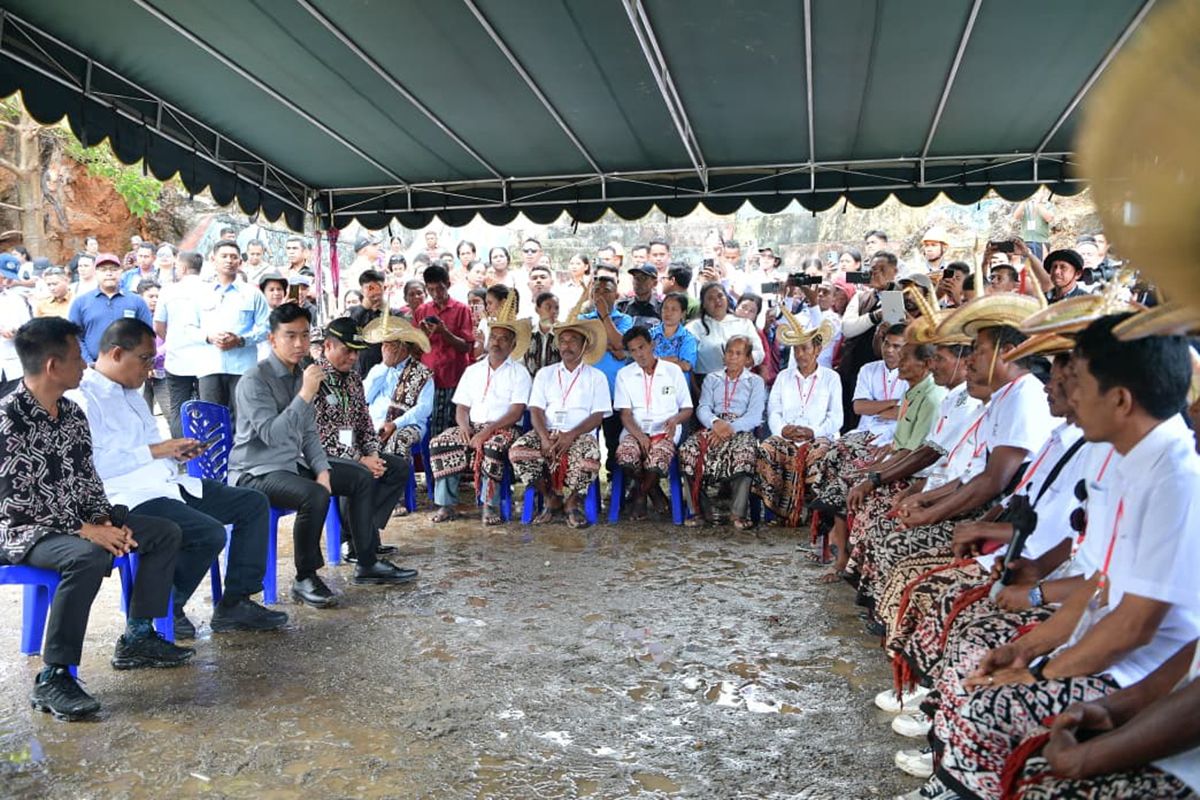
Today we specifically travelled to Rote to inspect a salt factory and seaweed operations. We see that the potential is extraordinary, but it has not yet been fully maximised. Kupang (ANTARA) - Vice President Gibran Rakabuming emphasised the importance of modernisation and downstream processing of seaweed, during a dialogue with seaweed farmers at Pantai Mulut Seribu, Daiama Village, Landu Leko District, Rote Ndao Regency, East Nusa Tenggara (NTT).
“Today we are specifically here in Rote to inspect the salt factory as well as seaweed. We can see that the potential is truly extraordinary, but it has not yet been fully maximised,” said the Vice President in Rote Ndao, NTT, on Friday.
This was stated during a one-day working visit to Rote Ndao Regency, with the agenda of reviewing the national strategic project (PSN) for the national salt-industry centre (K-SIGN) and seaweed in the southernmost district of the Republic of Indonesia (NKRI).
Gibran said modernisation and downstream processing of seaweed align with the direction of President Prabowo Subianto, who stresses the importance of strengthening national food security and downstreaming regional flagship commodities to increase value added and the welfare of society.
In various occasions, the President has stressed that Indonesia should not only be a producer of raw materials, but also capable of developing processing industries in the regions so that economic benefits can be felt directly by the people, including farmers and fishermen in coastal areas such as Rote Ndao.
In that dialogue, the Vice President assessed that the potential for seaweed farming in Rote Ndao Regency is very large, but has not yet been optimised.
During the dialogue, seaweed farmers in Daiama Village, numbering around 300 people, voiced a number of key needs to support their productivity.
The needs included nylon rope 8 mm and 2 mm, seaweed seeds, fibre boats, and a 0.5 GT ketinting engine.
Responding to this, the Vice President said the farmers are still using very traditional equipment, thus requiring more modern facilities and infrastructure.
“I saw just now that the equipment being used is still very traditional. So going forward, we will need drying equipment, warehouses, and perhaps a packaging plant here as well,” he said.
The Vice President also noted that the quality of Rote seaweed is considered superior to other regions, particularly due to its high carrageenan content.
According to him, this potential must be maintained and optimised through the downstreaming of the seaweed industry.
“If we are now one of the world’s largest producers and exporters of seaweed, we must not keep shipping raw goods. They must be processed here. So there must be seaweed downstreaming,” the Vice President asserted.
In addition, the Vice President stressed the need for modernisation across the entire production chain, from the use of superior planting stock, to improvements in production equipment and boats, to post-harvest facilities such as drying, storage, sorting, and packaging.
According to Gibran, if seaweed farming by traditional methods already performs well, it will perform even better once modernisation is in place.
“There are superior seeds, we will improve the boats, we will improve the tools. For post-harvest, there will be drying, warehouses, sorting, packing,” he said.
On that occasion, a women’s seaweed farming group also expressed hopes for business capital assistance in the form of rope, seeds, and boats to support their farming ventures.
The Vice President also urged local governments to undertake more detailed planning and data collection should there be any intervention or assistance from the central government.
According to him, this step is important so that assistance can be distributed evenly and targeted, while also supporting increases in production and the welfare of seaweed farmers in Rote Ndao.