
Veteran Nawi, 104, Recalls the Struggle for Independence in Padang
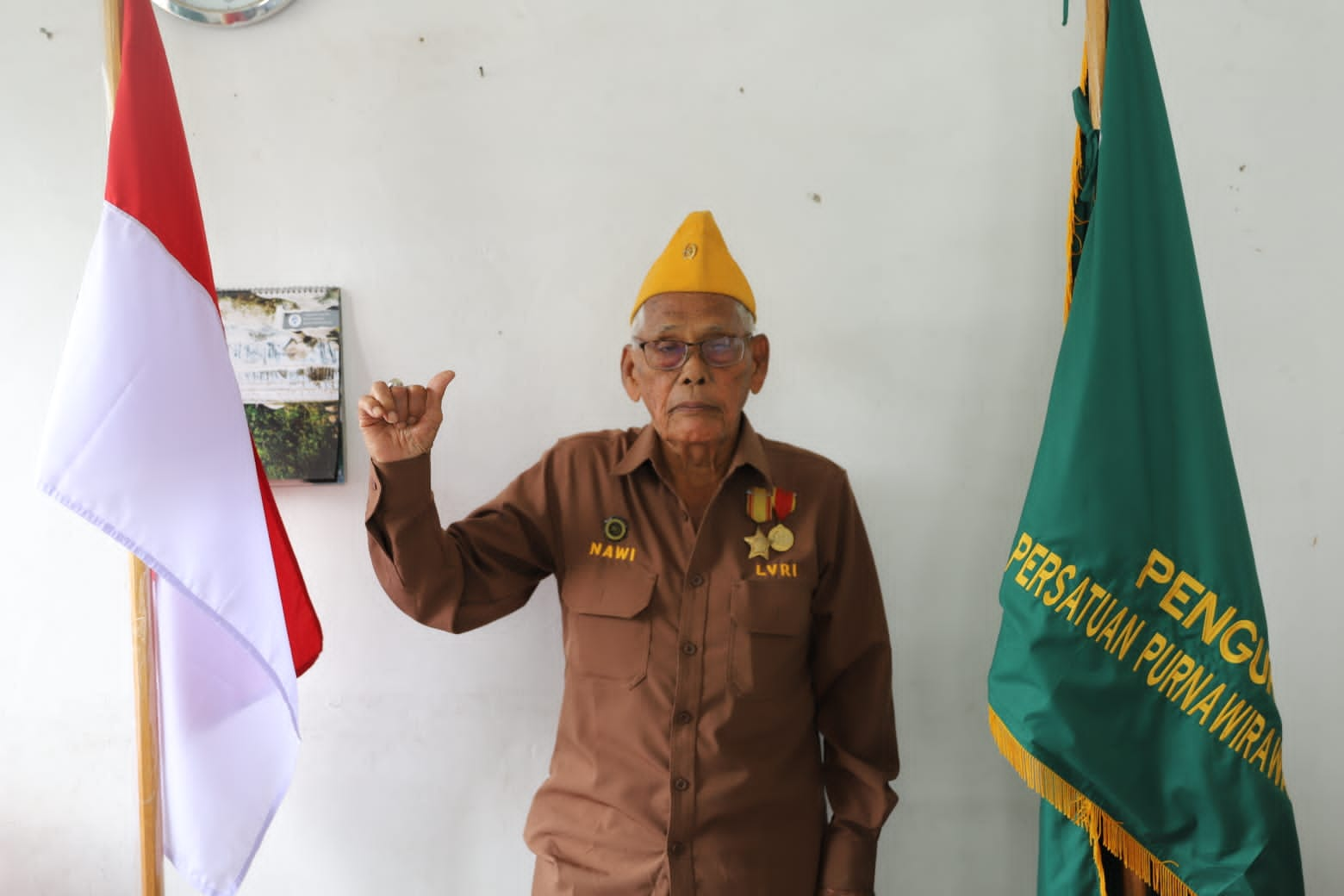
In a corner of Padang, an old man sits staring straight ahead. His gaze remains relatively clear, as clear as his memory that pierces a century of time. He is Nawi. Born on 12 May 1923, he is not merely a witness to history, but a thread in the fabric of history itself.
Ahead of the 81st anniversary of the Republic of Indonesia’s independence on 17 August 2026, while the younger generation busily celebrates freedom amid the bustle of the digital era, Nawi quietly holds a long story about how this Republic was fought for with sweat, blood and tears.
Nawi grew up when the name ‘Indonesia’ had not yet echoed as strongly as it does today. At that time, people only knew the area where he lived as ‘Padang Dalam Kota’ and ‘Padang Luar Kota’ under the shadow of Dutch colonial rule.
Entering 1940, in his teenage years, a calling led him to the battlefield. His footsteps traced the resistance routes in Banda Bakali, Lubuk Alung, Rimbo Kaluang, Andaleh, and across to Seberang Padang. At a very young age, Nawi was entrusted with leading around 300 youths as Commander of the Hizbullah Troop Squad in the Kapalo Koto region, moving step by step, in parallel but separate from the legendary Harimau Kuranji group.
For young Nawi and his troops, war was not about the grandeur of military weaponry. Their main asset was only a burning steel determination.
“Our weapon at that time was the talang baranjuang (sharpened bamboo spear). We fought for five years before independence. The Dutch had to leave Indonesia, that was a firm resolve in our hearts,” Nawi recalled, his eyes gazing into the distance.
If they ever held modern weapons such as Bren guns, chains, or grenades, it was nothing but the result of daring to seize them directly from enemy hands in close combat.
The stench of suffering grew stronger when the Japanese occupation began in 1942. For Nawi, this era was the darkest point in his memory of the struggle.
“The Japanese era was the hardest for food. Labour was squeezed heavily, food was only a little,” Nawi said softly.
After the Japanese left and the war of independence passed through critical times until the Dutch truly departed around 1950, the storm had not yet subsided. Regional upheaval erupted in the late 1950s. In a turmoil of civil conflict in 1957, a hot bullet pierced Nawi’s thigh.
Miraculously, the bullet remains lodged in his body to this day, a war ‘souvenir’ he refuses to remove from his own flesh.
“At that time I was shot in the thigh. The doctor had recommended surgery to remove it, but I did not want to. Besides, it no longer hurts,” he said with a faint smile.
Living through a span of 104 years also means learning to make peace with loss. Nawi has let go of two beloved wives and five of his eight children back to the embrace of the Creator. Yet grief has never eroded the warmth of his soul.
A recipient of three Satyalancana awards during the eras of President Soeharto and Megawati Soekarnoputri, he remains fit at over a century old. The secret to his long life is apparently very simple and touching.
“I do not want to hurt others, I always want to help friends. That is the spirit I always instil,” said this Category A veteran.
His life philosophy is firmly rooted in Minangkabau culture, which he has always held tightly:
“Barek samo dipikua, ringan samo dijinjiang. Saciok bak ayam, sadanciang bak basi (Heavy loads are carried together, light loads are lifted together. United in togetherness).”
Today, bamboo spears have gathered dust in museums, and the roar of cannons has long faded. For the veteran, the definition of struggle today no longer uses physical weapons, but rather how the next generation nurtures unity and extends a helping hand to one another.
Behind his calm smile and the wrinkles on his face, Nawi seems to entrust a wordless message: This independence was not free; it was paid for with blood, tears, and sacrificed youth.
Our task today is not to die for the nation, but to ensure that the flame fought for by Nawi and his comrades a century ago does not die out, eroded by time.
Source: jawawa.id (https://jawawa.id/newsitem/veteran-nawi-104-recalls-the-struggle-for-independence-in-padang-1786701024)
Originally published by Media Indonesia (https://mediaindonesia.com/nusantara/921842/nawi-sang-veteran-perang-di-padang-yang-berusia-104-tahun-kenang-masa-perjuangan), translated from Indonesian