
Vegetable Garden Made from Recycled Water Jugs at Purwosari State Primary School in Sleman
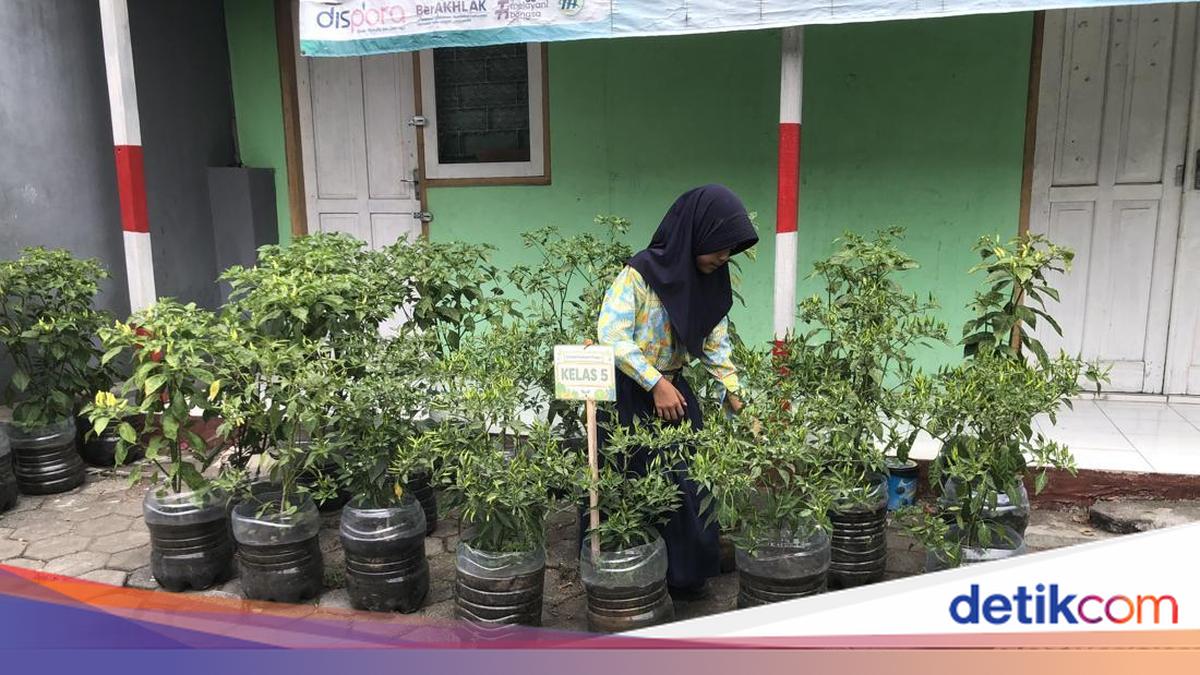
Hundreds of discarded water jugs, repurposed as containers for growing vegetables, are neatly arranged beside the playing field and in front of classrooms at Purwosari State Primary School in Mlati, Sleman. The thriving vegetables are fertilised with organic compost made from leftovers from the Free Nutritious Meals (MBG) programme.
“There are more than 500 jugs. Our school produces a lot of jug waste each week because we have six classes and one teachers’ room,” Purwosari State Primary School headteacher Zaenuri, 42, told detikJogja at the school on Wednesday (7 October 2026).
The recycled jugs are planted with chillies, aubergines, tomatoes, cucumbers, mustard greens, peanuts, long beans and other crops. Zaenuri said the garden was started in July 2026.
He said the jugs were being used as part of a curriculum diversification programme focused on food security. The aim is to introduce pupils to different vegetable crops and teach them how to grow them.
“We teach the children about agriculture. It is integrated education, so it is not just agriculture: we also integrate it with fisheries and livestock farming,” he said.
“The agricultural area is divided into plots. There are six plots, managed by each class. Each plot is the responsibility of a class, with pupils guided by their class teacher and the class association,” he added.
Zaenuri said the school used MBG leftovers to make liquid organic fertiliser.
“We make the liquid fertiliser from MBG waste and other organic waste around us, which we sort. The wet waste goes into a composter, where it produces liquid fertiliser. We harvest it regularly, then apply it after mixing it with water,” he explained.
“We had MBG waste that was causing us a problem, and we had not found a solution. Then, at a meeting of the class associations, teachers and parents, we worked out how to make use of it,” he added.
Purwosari State Primary School produces up to one 25-kilogramme bucket of liquid organic fertiliser a week from MBG leftovers. This is enough for the school’s container garden.
“We can produce one bucket a week, because we also use more than MBG waste. We add old leaves from our plants, rotting fruit and waste from the school kitchen,” he said.
The integrated farming programme not only teaches pupils about the links between agriculture, fisheries and livestock farming. Zaenuri said gardening had also helped them appreciate the food they eat.
“The children’s awareness of the value of food has actually grown, and MBG waste has decreased. That is what we hope for: that the MBG meals will be eaten. There is still waste, such as fruit peels, which cannot be eaten, and we use that in the composter,” he said.
As the project has developed, the school has found itself with a plentiful harvest. Some of the produce is used in cooking classes, with each class preparing food using the vegetables it has grown.
“We planted quite a lot—more than 500 plants—so we can harvest up to five kilogrammes every two days. There are tomatoes, cucumbers, long beans and chillies. The amount varies, and cucumbers weigh more,” Zaenuri said.
The recent bumper harvests have also attracted local buyers. What began with parents buying the produce has expanded to include food sellers near the school, such as pecel lele stalls and angkringan.
“Thankfully, in recent months we have harvested almost every two days. Some of the produce is marketed and sells very well; some has already been pre-ordered,” he said.
“Because we grow organically, there is a lot of interest—not only from parents but also from local businesses. Some, such as pecel lele sellers, have said they will take our tomatoes every day. We are even struggling to keep up with demand for chillies,” he added.
Revenue from produce sales is managed and spent on each class’s needs. Each class also handles its own management and marketing.
“Thankfully, after doing this repeatedly, sales have reached nearly Rp1 million. The pupils manage the sales with guidance from their teachers,” Zaenuri said.
“The proceeds go back to the class association and the pupils, and will be used to keep the cycle going—for maintenance and buying the next batch of seeds. Any remaining funds will go towards each class’s needs,” he concluded.
Source: jawawa.id (https://jawawa.id/newsitem/vegetable-garden-made-from-recycled-water-jugs-at-purwosari-state-primary-school-in-sleman-1791449449)
Originally published by detikJogja (https://www.detik.com/jogja/kota-pelajar/d-8698112/penampakan-kebun-sayur-pakai-galon-bekas-di-sdn-purwosari-sleman), translated from Indonesian