
UUCC Conference Becomes a Space for Transforming Islamic Civilisation and Global Ecosystem Sustainability
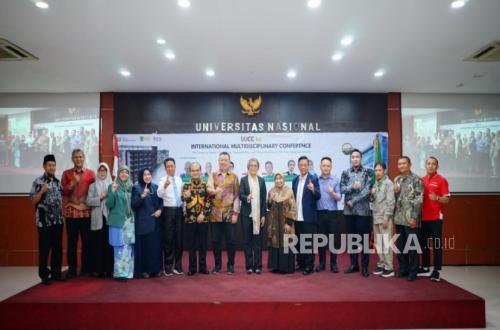
Universitas Nasional (UNAS), together with UCSI University Malaysia, through the UCSI–UNAS Collaboration Center (UUCC), successfully held the 1st International Multidisciplinary Conference. The conference, themed ‘The Future of Islamic Civilisation, Sustainability, and Nation Building in the New Multipolarism Era’, took place on 13–14 August 2026 at the Universitas Nasional Hall in Jakarta.
Held in a hybrid format, the conference brought together academics, researchers, students, practitioners, and stakeholders from various countries to discuss new directions for Islamic civilisation, sustainability, nation-building, education, and global dynamics in the era of multipolarism.
Amid the diversity of themes and perspectives presented, the Chairman of the Conference, Dr Iskandarsyah Siregar, positioned the conference not merely as an academic forum, but also as a space to transform knowledge into a force for social and civilisational transformation.
According to Iskandarsyah, current changes in the global structure demand that higher education institutions move beyond academic traditions oriented solely towards publications, reports, and institutional administrative compliance. Knowledge, he asserted, must have the courage to leave the seminar room and present itself as a solution to the problems of humanity, society, the environment, and the future of civilisation.
‘An academic activity must not stop merely at administrative notes or academic reports. All of it must become tangible benefit for the entire universe,’ said Iskandarsyah in a statement on Saturday (25/8/2026).
This statement became one of the central ideas of the conference. For Iskandarsyah, the measure of a scientific forum’s success lies not only in how many papers are presented or publications produced, but also in the ability of the knowledge produced to be translated into collaboration, policy, innovation, and action that provide concrete benefits.
Iskandarsyah explained that the first conference received international enthusiasm. A total of 42 presenters participated online, while 14 presenters from seven countries attended in person at Universitas Nasional. The countries involved included Indonesia, Malaysia, Australia, Iran, Brunei Darussalam, China, and Russia.
In addition to the presenters, the conference was also attended by 102 non-presenter participants, forming a multidisciplinary academic space with diverse scholarly, cultural, and national backgrounds.
For Iskandarsyah, this diversity holds strategic meaning. The problems of modern civilisation—ranging from the ecological crisis, technological transformation, geopolitical uncertainty, changes in economic structures, education, to the future of relations between nations—can no longer be solved through a single field of study in isolation. Therefore, multidisciplinary, interdisciplinary, and even transdisciplinary approaches must be developed as the main character of future academic work.
The conference was also designed to open space for sustainable collaboration. Iskandarsyah expressed hope that the relationships formed during the conference would develop into joint research, international publications, academic exchanges, innovation, community service, and cross-border institutional networks.
The conference theme became increasingly relevant as the world moves towards a more multipolar global structure. In this context, discussions about the future of Islamic civilisation, according to the organisers, cannot be separated from issues of sustainability, national resilience, education, leadership, technology, diplomacy, and global justice.
Nangkula Utaberta, Head of the Indonesia Collaboration Program, explained that the conference had five main focuses: Islamic thought and civilisation, sustainability, national resilience, diplomacy and multipolar interaction, and education. He emphasised three main objectives of the conference: encouraging interdisciplinary dialogue, producing actionable recommendations and policies, and strengthening collaboration networks.
This idea aligns with the direction built by Iskandarsyah that international forums must produce intellectual and institutional sustainability. The UNAS–UCSI collaboration is therefore not designed to end after the conference concludes, but rather to develop into strategic programmes with broad impact.
UUCC Director Paisal Halim asserted that collaboration is an important foundation in building a modern academic ecosystem. International conferences, according to him, must be able to bring together various ideas, build trust, expand networks, and create cooperation opportunities that were previously unavailable.
‘Differences should not separate us in the academic world. When perspectives meet with mutual respect, knowledge becomes stronger, and when institutions work together with trust, opportunities will become wider,’ he said.
The sustainability dimension received special attention through a presentation by UNAS Vice Rector for Research, Community Service, and Cooperation, Ernawati Sinaga. She asserted that nature is not merely a development sector, but the basic infrastructure of life. Artificial intelligence, biotechnology, renewable energy, smart cities, and modern medicine will have no meaning if humanity loses clean air, safe water, productive soil, healthy seas, and biodiversity.
Ernawati also raised the One Health approach, namely the view that human health cannot be separated from the health of animals, plants, the environment, and the entire ecosystem. According to her, conservation must be viewed as a long-term development investment. Higher education institutions are not enough merely to teach the concept of sustainability, but must become real examples of its implementation.
‘Universities must also set an example that sustainability should become something that…’