
Utilising Seaweed: Indonesian Government Aims to Boost Coastal Communities' Income
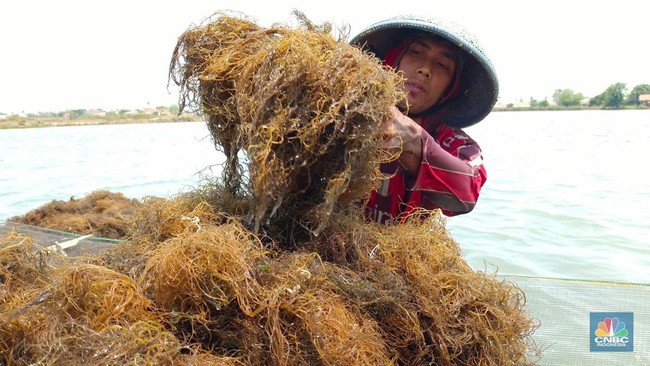
The Indonesian government has formulated the Integrated Seaweed Development Action Plan (ISDAP) 2026-2030. This action plan was developed by the Ministry of National Development Planning (Bappenas) to enable coastal communities to increase their income by developing the seaweed commodity into a value-added industry.
The Minister of National Development Planning/Head of Bappenas, Rachmat Pambudy, emphasised that seaweed is one of Indonesia’s strategic assets that needs to be developed not merely as a production commodity, but as a basis for a value-added industry. Indonesia’s seaweed production reached 10.81 million tonnes in 2024, accounting for approximately 29.6 per cent of global production.
“Our seaweed production is second in the world. However, given our maritime area, coastline length, and number of islands, Indonesia should be number one. Therefore, we must increase production, productivity, and quality,” Rachmat stated in a press release during the National Seaweed Forum 2026 in Jakarta on Wednesday (7/10/2026).
The Integrated Seaweed Development Action Plan will serve as a shared reference to integrate seaweed development from upstream to downstream, while simultaneously strengthening productivity, downstreaming, investment, innovation, and the welfare of coastal communities. The document covers five main pillars: increasing production, productivity, cultivation quality, and post-harvesting; developing industry, value-add, market access, and exports; strengthening data, research, innovation, technological intermediation, and collaboration; increasing support for financing and investment; and strengthening the ecosystem, governance, regulation, and institutions.
The transformation of the seaweed sector will be carried out through three primary shifts. First, from a volume-oriented approach to a value-oriented one (volume to value), through increased productivity, quality, standardisation, and raw material quality. Second, from a commodity-based approach to an industry-based approach (commodity to industry), by strengthening downstreaming, product diversification, technology, and innovation. Third, from a fragmented approach to an integrated ecosystem (fragmentation to integration), by connecting cultivators, post-harvesting, industry, innovation, logistics, financing, and markets within a single value chain.
This development of the seaweed commodity aligns with the 2025-2029 National Long-Term Development Plan (RPJMN), which has positioned seaweed as one of the nation’s leading commodities. Under the RPJMN, seaweed production targets are set to increase from approximately 11.64 million tonnes in 2025 to 14.14 million tonnes by 2029, while export value is targeted to rise from around USD 0.57 billion to USD 0.9 billion during the same period.
To achieve these targets, the government is encouraging increased cultivation productivity, industrial development and downstreaming, research and development of new species and products, strengthening of regulations and institutions, as well as the facilitation of financing and investment. “We must do more than just prepare plans; we must take action. The Integrated Seaweed Development Action Plan 2026-2030 affirms the direction that seaweed is not merely a raw export commodity, but a basis for inclusive and sustainable industrialisation,” Rachmat asserted.
The implementation of the ISDAP also requires close collaboration between central and regional governments, the business world, research institutions, universities, development partners, and farming communities. The government plays a role in synchronising policies, infrastructure development, and facilitating finance and investment, while the business sector serves as the engine for downstreaming and value creation. Simultaneously, research and innovation are required to produce superior varieties, cultivation technology, high-value products, standardisation, traceability, and human resource strengthening.
The National Seaweed Forum 2026 also serves as a momentum to strengthen Indonesia’s involvement in the United Nations Global Seaweed Initiative (UNGSI), an international collaborative platform to promote a sustainable, inclusive, and value-added seaweed value chain. This cooperation covers production, commercialisation, trade, regulation, standards, financing, and innovation. Indonesia is also preparing its contribution to the 2027 UNGSI agenda, including the strengthening of standards, trade, innovation, financing, mapping best practices, and determining pilot locations.
“Let us synergise in processing seaweed guided by the ISDAP 2026-2030 to create inclusive and equitable value-add and strengthen national competitiveness towards Indonesia Emas 2045,” said Rachmat.
Source: jawawa.id (https://jawawa.id/newsitem/utilising-seaweed-indonesian-government-aims-to-boost-coastal-communities-income-1791345274)
Originally published by CNBC Indonesia (https://www.cnbcindonesia.com/news/20261007094936-4-773984/gunakan-rumput-laut-pemerintah-ri-mau-pertebal-dompet-warga-pesisir), translated from Indonesian